
The dream of a rail line remains distant for the residents of Pachuca, despite the federal government’s promise to make it a reality next year with the new line extending to the city. If residents of the capital of Hidalgo were to opt for the recently inaugurated AIFA-Buenavista line, their daily commutes would increase, as would the cost of fares.
Currently, a one-way trip on the new line, covering 12 stations, costs 45 pesos. However, railway personnel stated that this price will only last for a month, as the official fare for a full trip will be 110 pesos.
If a resident of Pachuca uses the AIFA-Buenavista train to reach the Zócalo in Mexico City, the journey will take up to five hours.
During two trips taken by MILENIO, a higher demand for passengers was observed on the route from Buenavista to AIFA, with standing passengers completely filling the train cars.
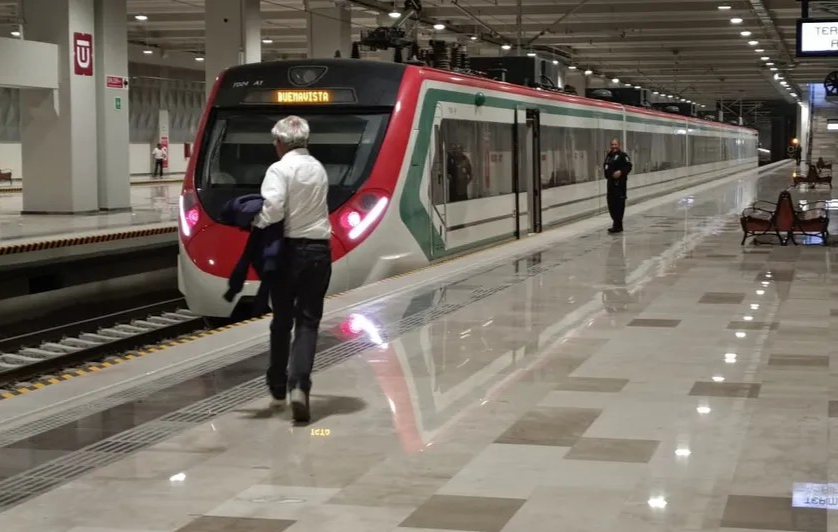
At the AIFA station, everything smells new: platforms, benches, and escalators, where passengers arrive for the train that Mayor Claudia Sheinbaum inaugurated on Sunday, April 26.
The calm and quiet atmosphere, which prevails until the trains arrive for passengers to board and disembark at AIFA, contrasts sharply with the noisy Buenavista terminal in Mexico City, bustling and chaotic with thousands of passengers walking in all directions, where the train arrives after an hour-long journey.
However, the 100,000 daily passengers who will use the AIFA-Pachuca train for their one-hour and 15-minute commutes, according to estimates from the Railway Transport Regulatory Agency (ATTRAPI), will have to wait until 2027 when the project is completed.
Currently, the connection between the capital of Hidalgo and AIFA relies on buses that take up to two hours, or taxis that reduce travel time but increase costs.
The AIFA-Buenavista train cars are interconnected, well-lit, with large side windows, luggage racks, and overhead screens displaying videos about federal government railway projects and Mexican music.
The doors can be opened with a button on the outside, but when the train is about to depart, the doors remain closed.
Toward Buenavista, the trains, built by the Spanish company CAF, have enough seats for all passengers, but on the return trip, especially in Lechería, Tlalnepantla, and Teyahualco, many can’t find seats and fill the aisles.
Passengers look at their cell phones, make calls, chat amongst themselves, use headphones, and sleep. “The seats are comfortable,” they say. “You don’t even feel the air conditioning in this heat,” they add. Abandoned lots, graffiti-covered walls, and soccer fields—whose value has increased thanks to the railway project—pass by the windows.
A woman’s impersonal voice announces that the next station is Xaltocan. At Prados Sur and Lechería, more people are waiting. Before reaching the San Rafael station, the train passes through a short tunnel. Near Buenavista, the train is full of commuters from the State of Mexico, and the song “Quiéreme mucho” plays on the screens.
“It is forbidden to drink, smoke, or have drinks inside the trains,” says a man’s voice, repeating the phrase in English. “For your safety, you must not remain on board,” he adds before bidding farewell to the passengers who disappear among the concrete structures of the Buenavista station.
Milenio was able to confirm that the lack of connectivity between the capital of Hidalgo and the air base makes it impractical for residents of Pachuca to use the new rail line, due to travel time and cost.
For example, at the Pachuca bus terminal, ADO offers buses to the AIFA (Felipe Ángeles International Airport) starting at noon for 156 pesos; While the bus from the air base to the capital of Hidalgo only has two departures: at 10:00 AM and 2:30 PM, Monday through Saturday.
The ODT bus company also offers budget-friendly trips for 52 pesos, departing every 15 minutes starting at 4:00 AM. These trips can take up to two hours due to traffic on the Mexico-Pachuca highway. Passengers are dropped off at the air base, where they must then take the Mexibús to reach the AIFA airport and board the train.
Additionally, outside the Pachuca bus terminal, taxis offer rides to the AIFA for 800 pesos, with a one-hour journey.

Upon exiting the Mexibús and walking a few meters, the sign “Buenavista-AIFA Train, to Mexico City” appears. Passengers can access the platforms with the Mexico City Integrated Mobility Card, which covers Metro, Cablebús, Ecobici, and other services, and can be recharged.
The card costs 15 pesos plus 45 pesos for the train fare. At the terminal entrances, railway staff guide users on how to access the platforms, how to recharge their cards, and the routes they need to take.
The problem isn’t just getting to AIFA, but also returning to Pachuca, since Omnibus has departures to the state capital at 1:00 PM and 4:00 PM for 176 pesos; while Futura has departures until 6:30 PM for 156 pesos.
As part of the rail system being built by the federal government, passengers will be able to continue their journey to Pachuca, a section still under construction, without needing to transfer at the Felipe Ángeles International Airport (AIFA), thus ensuring an uninterrupted trip.
“This will allow us to offer a complete route from Mexico City to Pachuca. Some passengers will stop at AIFA, but if their destination is not the air base, they can continue directly to the service in Pachuca,” stated Andrés Lajous Loaeza, head of the Railway Transport Regulatory Agency (ARTF), during the inauguration this Sunday of the Buenavista-air base section.
As in other cities near Mexico City, traveling to the nation’s capital can be a real ordeal depending on the time of day, the day of the week, and external factors such as accidents or road closures.
From Pachuca, a ticket costs between 74 and 145 pesos, depending on the line and the route. The fare for a “direct” route ranges from 100 to 145 pesos and takes just over two hours to reach the Central del Norte bus station. Yes, there are cheaper routes and bus lines, but they make stops in communities or go through municipalities like Tizayuca, which increases travel time to up to two and a half hours.
Milenio tested the system by traveling on a Futura bus at a cost of 142 pesos. According to employees and the station’s technology, the trip will take almost two hours.
The bus was boarded at 9:00 a.m., and there were still people at the bus station, although not as many as on a typical weekday morning, when hundreds of people are eager to board a bus to get to work on time in the big city.
The worst part isn’t the stops it makes at Tulipanes and another at Felipe Ángeles, where the seats that were left vacant are now used by people going to medical appointments, buying supplies, work commitments, and, less frequently, sightseeing.
The worst part is that, as a consequence of the authorities’ decisions, leaving Pachuca involves navigating a real bottleneck that sometimes takes longer than getting to Mexico City because “they’re repaving the road,” ticket sellers explain to justify the time it takes the bus to travel the nearly 95 kilometers between the two terminals.
There are routes like Flecha Roja where, even in the mornings, people travel standing for almost two hours to reach their respective destinations in the nation’s capital.
From the nation’s capital to Pachuca in a single trip: a passenger train will eliminate transfers at the air base.
The train will connect Mexico City with Pachuca.
If your goal is to reach the Zócalo in Mexico City, there are several ways to do so.
The first is to get off at Indios Verdes and take Metro Line 3, get off at Hidalgo station, and transfer to Line 2 to get off at Zócalo station. This will take approximately 35 minutes, traveling through the tunnels under the city.
The other option is to get off at Indios Verdes, take Metrobús Line 1 (the red line), and get off at Buenavista station. From there, take Line 4 (orange line) towards San Lázaro (South Route) and get off at Museo de la Ciudad de México station.
From there, it’s about a 5-minute walk to the Plaza de la Constitución. The entire trip will take between 40 and 50 minutes, depending on traffic, including the dedicated bus lane.
Another option is to arrive at Central del Norte bus station and take Trolleybus Line 1 southbound on Insurgentes Avenue to the Bellas Artes station. From there, it’s a 10-minute walk along Madero Street to the Zócalo, which will take approximately 50 minutes in total.
Finally, at Central del Norte, take Metro Line 5 (yellow) to La Raza station, transfer to Line 3 to Hidalgo station, and then transfer to Line 2 (blue) to the Zócalo. This journey takes between 45 and 55 minutes.

Source: milenio