
Standard & Poor’s (S&P) Global Ratings changed its outlook on Mexico’s sovereign credit rating from “stable” to “negative,” citing concerns that the country’s fiscal consolidation may be slower than anticipated.
“The negative outlook reflects the risk of very slow fiscal consolidation, primarily due to weak economic growth, resulting in a larger-than-expected increase in public debt and a higher interest burden,” the rating agency said in a report.
According to S&P Global Ratings, continued support for Petróleos Mexicanos (Pemex) and the Federal Electricity Commission (CFE) would further exacerbate the country’s fiscal rigidity, while a deterioration in trade relations with the United States could weaken Mexico’s external position.
We could revise the outlook to stable within the next 24 months if the effective implementation of policies translates into significant fiscal consolidation, which would contribute to stabilizing debt levels and the government’s interest burden, according to S&P Global Ratings.
S&P also considered that a rebound in private sector investment levels that boosts economic growth could strengthen the country’s economic resilience and help stabilize public finances.
With the change in outlook from S&P Global Ratings, whose last review was in September 2025, Mexico joins a trend of greater caution among international rating agencies regarding the evolution of the country’s public finances.
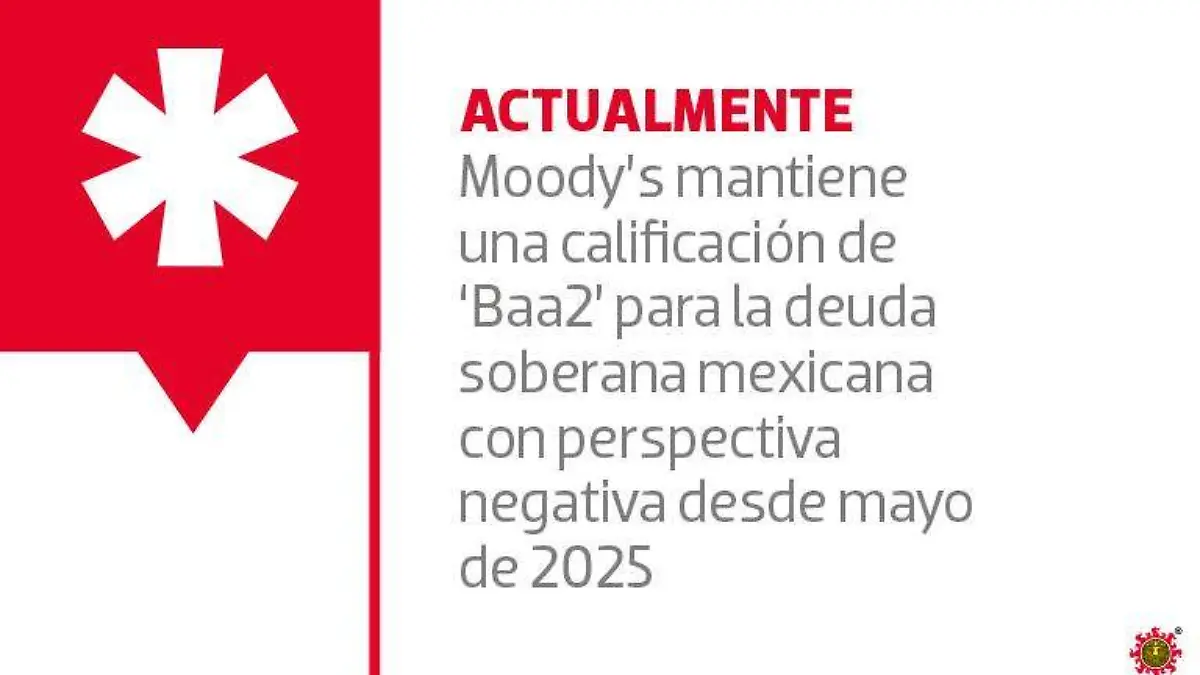
Currently, Moody’s maintains a ‘Baa2’ rating for Mexican sovereign debt, but also with a negative outlook from May 2025, while Fitch Ratings maintains the ‘BBB-‘ rating with a stable outlook.
Other agencies, such as HR Ratings, DBRS, KBRA, and the Japanese agency JCR, maintain stable outlooks for Mexico, with ratings ranging from ‘BBB’ to ‘A-‘.
Experts consulted by El Sol de México agreed that S&P Global Ratings’ move sends a warning signal about pressures on the economy, primarily on public finances, given the limited fiscal space.
For James Salazar, deputy director of economic analysis at Kapital Grupo Financiero, the trajectory of public finances, linked to low economic growth, is more worrisome than last year.
The analyst explained that while Mexico still maintains its investment grade rating, the rating agency is raising concerns because the fiscal consolidation process was not achieved by 2025.
“Now we have to wait for Moody’s, because the 18-month period since they modified the outlook has passed, and it is very likely they will lower the rating because the economy and public finances have worsened,” he said.
According to data from the Ministry of Finance and Public Credit (SHCP), in the first year of President Claudia Sheinbaum’s administration, the deficit closed at 4.9 percent of GDP. It is expected to end at 4.1 percent by 2026.
Humberto Calzada, chief economist at Rankia Latin America, stated that the rating agency’s move is “a strong wake-up call” that other agencies such as Fitch Ratings and HR Ratings could follow.
Despite the change in the sovereign debt outlook, the SHCP emphasized that S&P Global Ratings maintains the country within investment grade.
The agency, headed by Édgar Amador Zamora, explained that the rating agency’s decision confirms its confidence in Mexico’s macroeconomic and institutional fundamentals, as well as its capacity to maintain stable access to international capital markets.
The Ministry of Finance and Public Credit (SHCP) also considered that the first-quarter balances showed better-than-expected performance, as the budget deficit was 207 billion pesos, 172 billion pesos lower than projected.
“These results reflect prudent fiscal management and a sustainable debt trajectory,” the ministry said separately.
Although Mexico’s sovereign rating remained at ‘BBB’, S&P Global Ratings warned that it could downgrade the rating in the next 24 months if the country does not reduce its fiscal deficits in a timely manner.
In practice, a potential downgrade of the sovereign rating could increase the cost of financing for the government and businesses, as well as generate greater caution among domestic and foreign investors.
Under S&P Global Ratings’ scenarios, Mexico’s deficit will reach 4.8 percent of Gross Domestic Product (GDP) in 2026, amid a weak economy and the government’s efforts to stabilize fuel prices through fiscal stimulus.
Source: oem