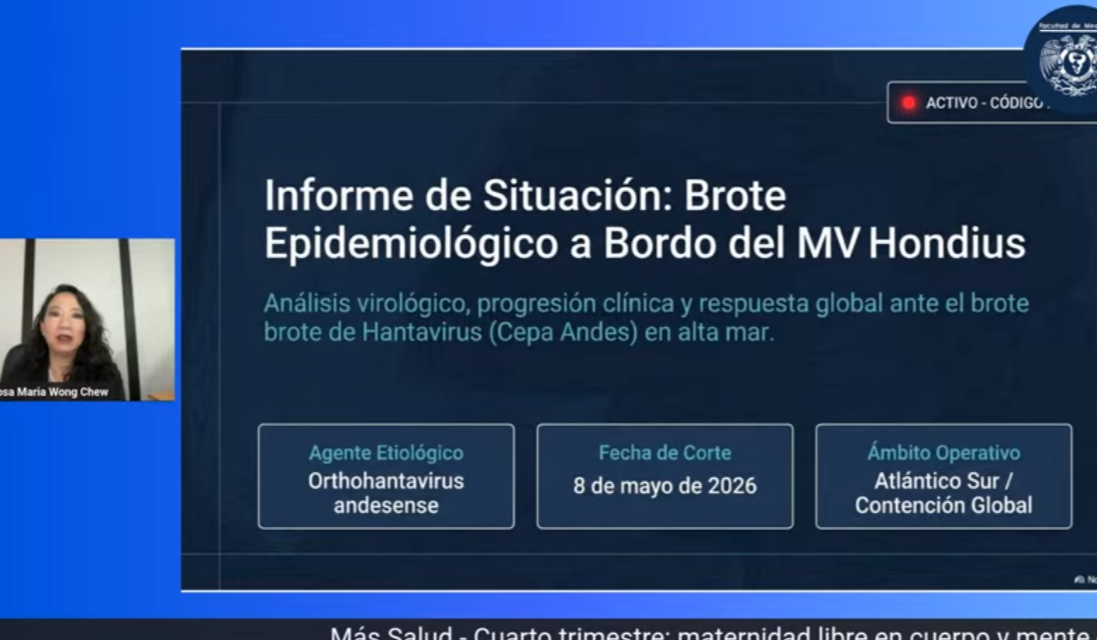

“In Mexico, the probability of hantavirus being present is currently very low,” stated Dr. Rosa María Wong Chew, Head of the Clinical Research Subdivision of the Research Division at the Faculty of Medicine, during the program “Más Salud” (More Health), in which she analyzed the hantavirus outbreak registered on the MV Hondius cruise ship in the South Atlantic and the risk of a population alert in our country.
Dr. Wong Chew explained that the outbreak originated from an index case, a 70-year-old man who had previously traveled overland through endemic areas of Chile and Argentina, the natural habitat of the rodent Oligoryzomys longicaudatus, the main reservoir of the Andes strain of hantavirus.
“What appears to have happened was zoonotic exposure prior to boarding; the index case came into contact with secretions from the mouse, either through inhalation of aerosols of urine, feces, or saliva.” Later, on the cruise ship, there was limited person-to-person transmission due to enclosed spaces and prolonged close quarters,” she explained.
The Andes strain, characteristic of South America, has a 30 to 40% fatality rate and causes severe cardiopulmonary syndrome, with a prodromal phase of nonspecific flu-like symptoms followed by rapid progression to respiratory distress, heart failure, and refractory shock due to capillary leak. In contrast, “old world” hantaviruses cause hemorrhagic fever with renal syndrome and a 1 to 15% fatality rate, and have no documented interpersonal transmission.
The specialist emphasized that the risk of person-to-person transmission is extremely low and only occurs under conditions of close and prolonged physical contact in confined spaces, as happened on the cruise ship. “It is not a virus with widespread community transmission; only people who have been in an enclosed space for a prolonged period with high exposure to secretions from an infected person are at risk,” she noted.
The incubation period can be up to six weeks, with a median of 18 days. Currently, there is no specific antiviral treatment or approved vaccine, although companies like Moderna and the University of Bath are accelerating preclinical studies. Management focuses on immediate transfer to intensive care, hemodynamic support with vasoactive amines, mechanical ventilation, and, in critical cases, extracorporeal membrane oxygenation (ECMO). The specialist recommended avoiding volume overload and not administering steroids due to a lack of evidence of benefit.
The outbreak triggered an international health response coordinated by the World Health Organization (WHO), with medical evacuations, contact tracing, and quarantine protocols in countries such as South Africa, Spain, the Netherlands, the United States, and Canada. On May 11, Mexican health authorities issued an epidemiological alert for hospitals, emphasizing handwashing, the use of personal protective equipment (gloves, gowns, N95 masks, and eye protection), and symptom monitoring for 42 days for healthcare personnel who treated confirmed cases.
Dr. Wong Chew concluded that no There are Mexican passengers involved in the outbreak, and the risk of spread within Mexico is extremely low. In response to audience questions, he clarified that there is no age group more susceptible to infection, as the infection depends exclusively on contact with rodent reservoirs, and emphasized that continuous epidemiological surveillance and control of environmental vectors remain the only effective preventative measures in the short term.

Source: gaceta.facmed.unam