
“Writing Las Ausentes meant confronting the truth and the memory of Indigenous and Afro-Mexican women who are unnamed and who live invisible to a racist state and nation,” said Ñuu Savi journalist Juana García during the book’s presentation.
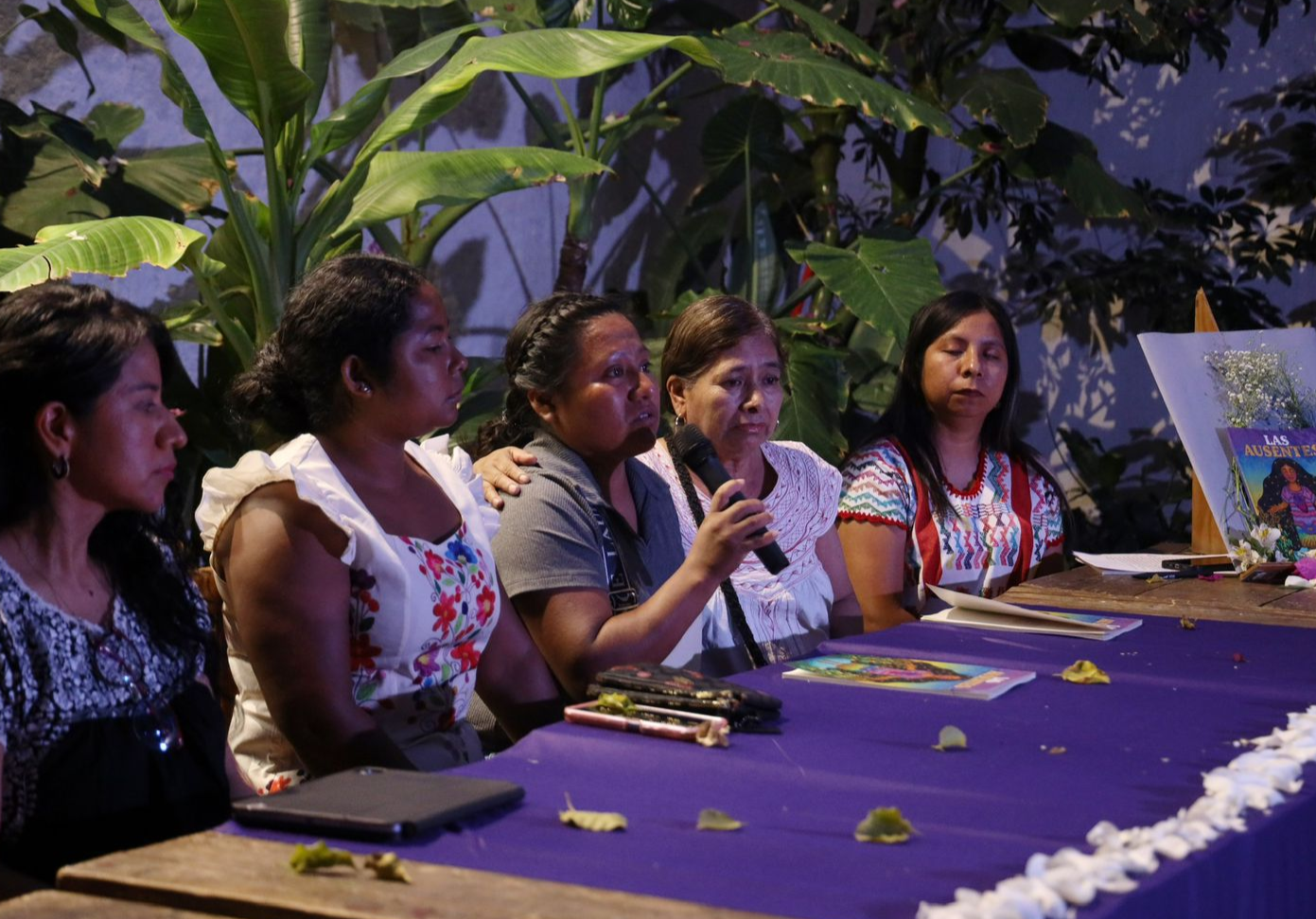
García, along with Binnizá journalist Diana Manzo, presented their book Las Ausentes at the Graphic Arts Institute of Oaxaca (IAGO) in Oaxaca City, in an act of remembrance, respect, and hope for the mothers, fathers, and families searching for their missing loved ones.
The stories, told in a chronicle style, of Sandra Domínguez, Mayra Colón, Yesenia Pascual, Obdulia de León, Adolfa Roque, Andrea Itzel Martínez, Itzel González, and Yeimi Zulen Molina are recounted in the book, which exposes the phenomenon of enforced disappearance, which, according to official data, affects more than 130,000 people in Mexico.
The presentation included the participation of some of the victims’ mothers, who spoke about the profound impact of their daughters’ absence and the deep-seated pain of forced disappearance.
Author Diana Manzo explained that Las Ausentes (The Absent Ones) “doesn’t show the faces of all the victims, but it dignifies them by naming them, offering hope to their mothers and families of finding them alive.”

“Las Ausentes was a collective effort, because we couldn’t have done it individually,” said the Binnizá journalist, acknowledging the support of Oaxacan organizations such as Mano Vuelta, Cepiadet, Código DH, Iranu, and Conami, among others.
The illustrations for Las Ausentes were created by Oaxacan artist Victoria Gaspar, while the prologue was written by Zapotec poet Irma Pineda. The book also includes a monitoring report on missing persons in Oaxaca by Mano Vuelta and an analysis by Ita and Judith.
The journalists agreed that the proceeds from the book sales would go to the mothers, so that the hope of finding them and of justice would remain alive, like the fire in their hearts and the hearth where they remember them with love and long to see them one day and embrace them.
“Thank you to those who are with us today. Today is not a day of celebration, it is a day of remembrance and justice, a day to remember the absences and debts owed by a state that revictimizes, forgets, and erases,” the authors emphasized.
“Perhaps we are not great writers, but we want our ink to continue staining what the authorities try to erase or cover up every day,” they concluded.

Source: desinformemonos