
Guanajuato Updates Risk Atlas for Journalists and Human Rights Defenders, but Lack of Transparency Raises Questions
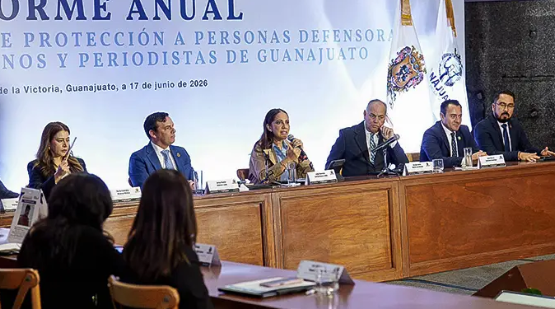
The Government of Guanajuato presented an updated version of the Risk Atlas for Journalists and Human Rights Defenders as a tool to identify threats and guide protection measures. However, the public version of the document has generated concerns due to the lack of access to fundamental information, making it difficult to clearly understand the situation faced by those working in journalism in the state.
One of the main points of confusion concerns the so-called “zones of silence.” Although the presentation highlighted the existence of 11 regions where risk conditions limit coverage of certain topics, municipalities such as Dolores Hidalgo and San Miguel de Allende do not appear within this classification. Nevertheless, both municipalities are identified among those with documented cases of risk for journalists, a situation that may lead to misleading interpretations regarding the actual level of vulnerability.
The structure of the public version of the atlas itself contributes to these uncertainties. Several sections refer to data, methodologies, and criteria that are not fully available for public consultation, preventing citizens from verifying information and understanding how risk zones and zones of silence were determined. In a matter as sensitive as the protection of journalists, transparency should be a central element rather than a limitation.
In addition, there appear to be contradictions within the document and in the public explanation of its findings. On one hand, it acknowledges that there are municipalities where journalistic work faces documented risks; on the other hand, the classification of zones of silence does not always seem to correspond with the reported incidence of such risks. This raises questions about the parameters used to distinguish between a risk situation and an area where certain topics simply cannot be covered.
The atlas represents an important effort to recognize the challenges faced by journalists and human rights defenders in Guanajuato. However, as long as the publicly available information remains incomplete and contains elements that may be interpreted inconsistently, the document risks becoming more a source of confusion than an effective tool for understanding and addressing a reality that affects municipalities such as Dolores Hidalgo and San Miguel de Allende, where documented cases exist even though they have not been classified as zones of silence.
Source: masdeaca