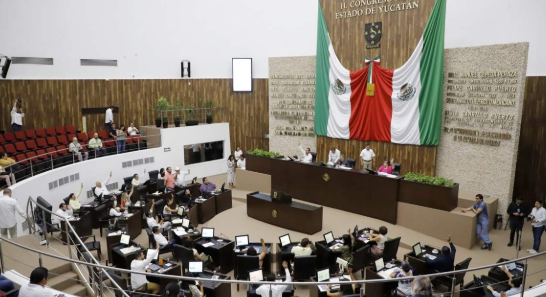

It was an extraordinary session in every sense. Brief, silent, and without dissenting voices.
This Monday, the Congress of Yucatán unanimously approved the reform of Article 1 of its local Constitution, removing the phrase “from fertilization” from the recognition of the right to life and thereby aligning the state constitution with the decriminalization of abortion up to 12 weeks of gestation, which the same Congress had already approved in the Penal Code in April 2025.
The vote was unanimous. All legislative groups voted in favor, including the National Action Party (PAN). There were no abstentions. There were no votes against. And above all, there was no debate.
Declaring something unconstitutional is not the same as imposing how to legislate.
The pressure that preceded the vote
Monday’s session did not occur in isolation. As Uno TV reported exclusively on Sunday, the Supreme Court of Justice of the Nation (SCJN) had issued formal requirements to the Congress of Yucatán to comply with the ruling in Review Appeal 274/2024, through which the former First Chamber instructed legislators to amend the state Constitution regarding abortion.
The Third District Court individually notified each legislator that there was no room for deliberation: they were obligated to comply with what the nation’s highest court had determined. The warning was explicit: individual fines of up to 269,226 pesos for each legislator who failed to comply.
It was under that pressure—and with that clock ticking—that Congress convened the extraordinary session on Monday.
A session without words
What happened in the chamber was as revealing as the outcome itself. The bill submitted for voting was not made public before the session. To speed up the process, Congress approved a waiver of reading, a mechanism that allows the document to be voted on without being read before the assembly. No legislator took the podium to defend their vote, explain their position, or argue against the proposal.
In a constitutional reform that had generated months of legal, political, and social controversy in Yucatán and throughout the country, the full chamber took only minutes. No one spoke. No one debated. Everyone voted yes.
When consulted by Uno TV, no legislator agreed to comment on the matter.
The debate that did not take place in the chamber
Outside Congress, however, the debate does exist—and it is profound.
For constitutional scholar Abraham Madero Márquez, what occurred Monday in Yucatán precisely illustrates the problem posed by the SCJN’s actions in cases like this. He explained to Uno TV that the core issue is not whether abortion should be decriminalized, but whether the Court can instruct state legislatures on the direction they must legislate without respecting the separation of powers.
That is the limit no court should cross, Madero Márquez warned: it is one thing to declare a law unconstitutional and quite another to order elected representatives to produce a specific legislative outcome under threat of personal financial penalties. What happened, he argued, was not legislative deliberation. It was the execution of a judicial instruction.
Along those lines, more than 1,200 civil, pro-life, family-oriented, and religious organizations from across the country published a statement addressed to Governor Joaquín Díaz Mena, asking him not to yield to pressure from the Court. They described it as “abominable” to sacrifice the right to life for political purposes and accused the SCJN of attempting to act as a “Supreme Legislator,” violating the separation of powers and the sovereignty of Yucatán.
Attorney Amelia Ojeda, by contrast, defends the Court’s actions. According to the legal expert, the SCJN did not invade anyone else’s authority; it simply ordered Congress to align local regulations with the Federal Constitution and with constitutional criteria that the Supreme Court itself had already established as precedent. In her view, the Court did not legislate on abortion; it ensured compliance with a constitutional standard regarding who has the authority to define the holders of human rights.
What changed and what did not
With the reform approved Monday, Article 1 of the Constitution of Yucatán continues to recognize the right to life but removes the phrase “from fertilization,” which was the central point of the legal dispute. The new text incorporates respect for human rights and international treaties as a framework for interpretation.
The amendment closes the cycle opened by Review Appeal 274/2024 and formally ends the judicial requirements and warnings that had been imposed on Yucatán’s legislators.
The precedent that remains
What does not end on Monday is the underlying debate. Madero Márquez warned that the mechanism used by the SCJN—instructing legislatures on the specific content of reforms under threat of personal fines—sets a precedent that could extend to any area of public policy, beyond ideologically sensitive issues such as abortion.
Source: unotv