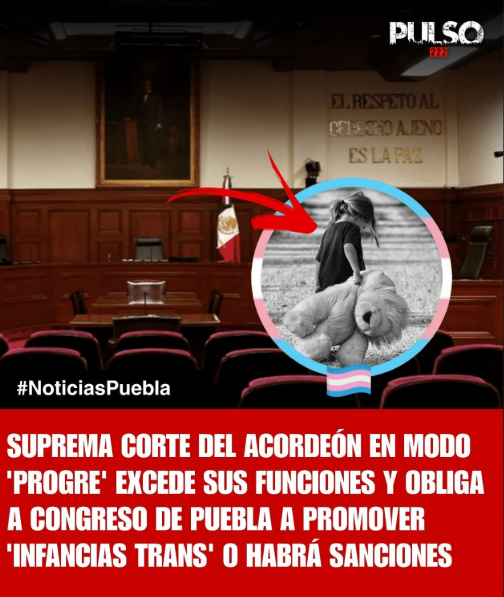

The Congress of Puebla faces an ultimatum from Mexico’s Supreme Court (SCJN): it must amend the Civil Code to allow minors to modify their birth certificates according to their “self-perceived gender identity,” under the threat of personal fines against legislators and even removal from office for noncompliance.
Is the Court protecting universal children’s rights, or imposing a controversial ideological interpretation that conflicts with recent medical evidence, the best interests of the child, and the constitutional balance of powers?
The Convention on the Rights of the Child (ratified by Mexico) and the General Law on the Rights of Children and Adolescents already guarantee comprehensive protection, the best interests of the child (Article 3), non-discrimination based on sex, mental health care, and preservation of identity. None of these provisions require the legal registration of a self-perceived gender identity on birth certificates before adulthood, nor do they require the medicalization of pubertal development.
The SCJN, in recent rulings concerning Puebla, has invalidated age-of-majority requirements by invoking the “free development of personality” and Inter-American human rights standards. However, these legal instruments do not resolve the scientific tension: biological sex is observable, binary in more than 99.98% of cases, and relevant for healthcare, sports, privacy, and medicine.
🔴 The Cass Review (United Kingdom, 2024), the most comprehensive systematic review conducted to date, concluded that the evidence supporting puberty blockers and hormone treatments for minors is “remarkably weak.” It found high uncertainty regarding long-term benefits and identified potential risks related to bone density, fertility, brain development, and sexual function. Countries such as Sweden, Finland, England, and Norway have significantly restricted this model.
The recent sharp increase in cases—especially among adolescents and girls—coincides with social influences and online networks, rather than with the sudden discovery of “children born in the wrong body.”
Constitutional Concerns
⚖️ The Mexican Constitution (Article 49) establishes three independent branches of government. State legislatures possess legislative autonomy in matters related to civil registries. While the SCJN may declare laws unconstitutional, imposing short deadlines, specific legislative guidelines, and personal sanctions on elected lawmakers (including fines against personal assets and possible removal from office) raises concerns about judicial substitution of the legislative function.
🔴 This is not ordinary constitutional review; it is the intense judicialization of an ideological agenda. The legislators of Puebla are accountable to their voters, not to a Court that appears to prioritize “progressive” interpretations over scientific evidence and democratic pluralism.
Where is the space for open debate, hearings with endocrinologists, psychologists, and concerned parents, or public consultation?
Children’s Protection and Public Policy
All children deserve protection from bullying, serious psychological care for comorbidities (such as autism, trauma, and depression), and opportunities for healthy development. By pressuring Puebla through ultimatums and sanctions, the SCJN is, according to this perspective, prioritizing an activist vision over scientific caution (as reflected in the Cass Review and similar European reassessments), as well as over the roles of parents and legislators. This, it is argued, weakens representative democracy and federalism.
Real protection of children does not come from legally redefining sex on minors’ birth certificates according to what critics describe as an ideological trend of the moment. It comes through evidence, caution (“first, do no harm”), and respect for constitutional separation of powers.
Puebla has both the right and the democratic obligation to deliberate on this issue without judicial coercion.
Source: mexicodailypost