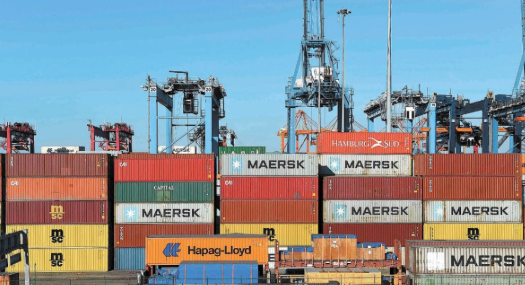

Mexican exports increased 25.4% in May, reaching $69,544.5 million, marking four consecutive months of double-digit year-on-year growth, the National Institute of Statistics and Geography (Inegi) reported Friday.
Merchandise imports also saw four consecutive months of double-digit increases, climbing 24.0% in May to $67,285.3 million.
All major categories of these indicators showed year-on-year growth, with the exception of automotive exports, which declined 2.2%.
With these overall results, Mexico’s trade balance registered a surplus of $2,259.2 million, an 83.4% increase compared to May of last year.
The strongest relative growth in exports was in non-oil extractive industries, with an 88.7% increase. While the largest contribution in value continued to come from non-automotive exports, with a growth of 38.0 percent.
In May 2026, the value of manufactured goods exports was US$62.99 billion, representing a 25.1% year-on-year increase.
The most significant increases were observed in exports of machinery and specialized equipment for various industries (98.1%), mining and metallurgical products (47.2%), electrical and electronic equipment and appliances (13.8%), plastic and rubber products (4.3%), and food, beverages, and tobacco (4.2%).
Meanwhile, automotive product exports showed a year-on-year decrease of 2.2%, resulting from a 3.5% decline in sales to the United States and a 5.7% increase in sales to other markets.
In the month under review, the value of oil exports was US$2.423 billion. This amount consisted of US$1.936 billion in crude oil sales and US$488 million in exports of other petroleum products.
In that month, the average price of the Mexican crude oil export mix was $101.32 per barrel, $6.33 higher than the previous month and $43.44 higher than in May 2025.
As for the volume of crude oil exported, it reached 616,000 barrels per day, higher than the 478,000 barrels per day in April, but lower than the 743,000 barrels per day in May 2025.
In May 2026, the value of agricultural and fishing exports was $1.997 billion, representing a 2.2 percent year-over-year increase.
The most significant increases were recorded in exports of grapes and raisins (65.4%), tomatoes (45.2%), fresh vegetables and legumes (28.4%), citrus fruits (27.5%), and cucumbers (21.3%).
In contrast, the most significant year-on-year declines were seen in exports of raw coffee beans (39.6%) and avocados (22.5%).
Extractive exports reached US$2.134 billion, representing an 88.7% year-on-year increase.
In the period from January to May 2026, the value of total exports reached US$317.172 billion, reflecting a 22.6% year-on-year increase. This rate was driven by a 23.9% increase in non-oil exports and a 9.8% decrease in oil exports.
Conversely, in the reference month, Mexican imports of consumer goods reached US$8.305 billion, representing a 6.5 percent year-on-year increase.
This rate resulted from a 3.1 percent increase in imports of non-petroleum consumer goods and a 21.4 percent increase in imports of petroleum consumer goods (gasoline and butane and propane gas).
At the same time, imports of intermediate goods totaled US$54.314 billion, a level 29.8 percent higher than that reported in May 2015.
This figure, in turn, stemmed from a 29.7 percent increase in imports of non-petroleum intermediate goods and a 31.5 percent increase in imports of petroleum intermediate goods.
Meanwhile, imports of capital goods reached US$4.667 billion, representing a 1.6 percent year-on-year increase.
In the period January-May 2026, the accumulated value of total imports was 311,405 million dollars, an amount 20.8% higher than that observed in the same period of 2025. Within it, non-oil imports rose 22.0% and oil imports, 6.5%, at an annual rate.
Source: eleconomista