
Since January 2026, Mexico has applied tariffs of up to 50% to vehicles imported from China. The measure aimed to protect domestic industry, balance the trade deficit, and, incidentally, ease pressure from Washington regarding the infamous China-Mexico-United States “triangle”—the scheme where Chinese companies use Mexican soil to enter the U.S. market without paying the tariffs imposed directly by Trump.
The result was not exactly what was expected.
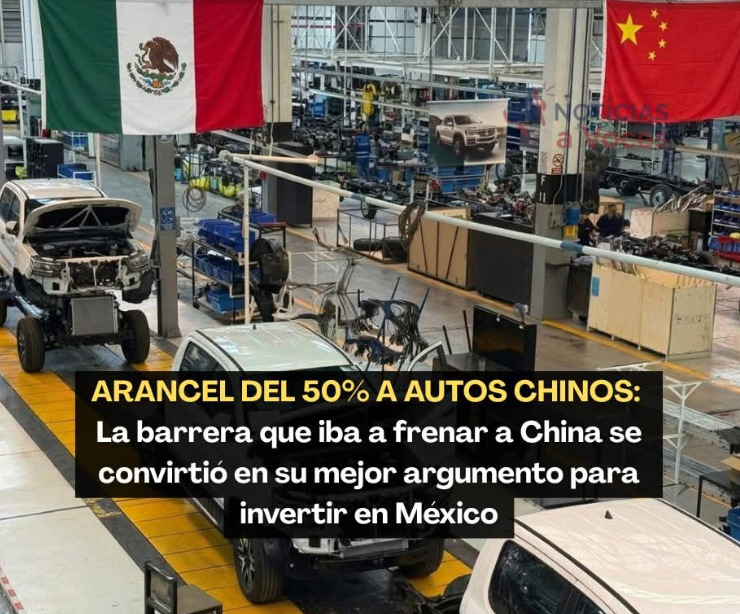
JAC Motors, the only Chinese brand with an active plant in Mexico—located in Ciudad Sahagún, Hidalgo, for years—simply smiled. Its vehicles arrive semi-assembled from China, are completed in Mexico, and qualify as locally manufactured. “Made in Mexico” certification included. Exemption from the 50% tariff, competitive prices, and nearly a thousand direct jobs in Hidalgo. While other Chinese brands see their imported cars become drastically more expensive, JAC has the advantage.
And the domino effect has already begun.
GAC Motor announced its first assembly plant in Mexico in April, with operations planned for the second half of the year. BYD and Geely are evaluating options, including the possible purchase of existing plants in Aguascalientes. Eight Asian manufacturers have approached JAC to explore shared manufacturing arrangements.
In plain English: the tariff barrier designed to curb China is becoming the best selling point for Chinese investment in Mexico.
This is where the analysis gets interesting, because this isn’t simply good or simply bad—and anyone who presents it in only one way is oversimplifying reality.
On the one hand, there is something genuinely positive: jobs in regions that need them, investment in manufacturing, development of local suppliers, and the real possibility that Mexico will cease to be just a massive importer of Chinese cars and become an assembly hub for the entire Latin American market. That has tangible value.
On the other hand, there’s the uncomfortable question no one in the government wants to answer aloud: Are we attracting real Chinese industry, or are we building the perfect infrastructure for China to continue accessing the U.S. market with a Mexican label, just when the USMCA is under review and Washington already has us in its sights for precisely that reason?
Because if the Chinese plants in Mexico produce primarily for the domestic market—as they claim—the impact on exports and on tensions with the United States will be limited. But if the model scales up to exports, Mexico would be caught right in the middle of the world’s biggest trade conflict: between a China that needs access to the North American market and a United States that is prepared to use the USMCA as leverage to prevent it.
The 50% tariff was intended as a wall. China is turning it into a gateway. And Mexico will have to decide very soon what kind of industrial partner it wants to be—and for whom.
Should Mexico embrace Chinese manufacturing investment even if it complicates the relationship with the U.S., or is the geopolitical risk too high?
Source: mexicodailypost