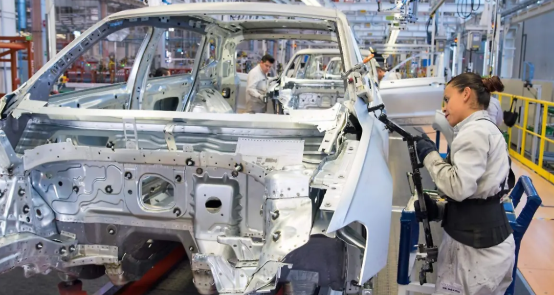

Puebla’s Automotive Companies Accelerate Search for Mexican Suppliers Amid Tariff Concerns and USMCA Uncertainty
Automotive companies in Puebla have accelerated their search for suppliers in Mexico to reduce their reliance on parts imported from Asia. The move comes amid concerns over tariffs and uncertainty created by the decision to keep the United States-Mexico-Canada Agreement (USMCA) in force with annual reviews over the next decade instead of guaranteeing its renewal for another 16 years, according to René Mendoza Acosta, president of the Supply Chain of the Industry in Mexico (CAPIM).
He stated that the sector increased its demand for local suppliers by 35% this year as part of a strategy that began in 2025 following President Donald Trump’s return to the White House. Companies started preparing in advance for the decision announced on Wednesday by the United States to subject the agreement to annual reviews without guaranteeing its extension for another 16 years.
“It is definitely not what we would have liked. We would have preferred an immediate announcement saying, ‘Let’s renew it for another 16 years under these rules.’ But one thing is ideal, and another is reality. The reality is that this is the scenario we face, and there were no surprises. We already knew this was coming, and companies had already been preparing for it,” he said in an interview.
He explained that the industry’s main response in Puebla has been to strengthen supply chains within North America, especially in Mexico, by regionalizing production to reduce dependence on Asian suppliers and make the automotive industry more resilient to potential trade policy changes.
Demand for Mexican Suppliers Rises by 35%
Mendoza Acosta revealed that the approximately 1,000 companies represented by CAPIM increased their efforts by 35% this year to identify domestic suppliers capable of manufacturing auto parts, components, and production processes that are still imported from Asia.
“By the end of this year, we expect nearly a 35% increase in efforts to locate suppliers in Mexico to replace imports from Asia. Today, companies are 35% more active than in previous years in searching for suppliers established in the country,” he said.
He noted that the search is primarily focused on companies in the metalworking, plastics, and technology sectors, as well as specialized manufacturing processes that would allow imports to be replaced and increase the regional content of vehicles produced in North America.
Strengthening Domestic Production Capacity
Mendoza Acosta said another major challenge is identifying the production capabilities that already exist in Mexico so they can be fully utilized, strengthening domestic suppliers that still need to become more competitive, and attracting investment or strategic partnerships in areas where the country still lacks sufficient production capacity.
“If we find components that are already manufactured in Mexico, we need to tell companies that there is no reason to continue importing them from Asia. Where competitiveness is still lacking, we must develop suppliers. And where that capability simply does not exist, that opens the door to attracting investment and bringing that technology into the country,” he explained.
The CAPIM president added that once the USMCA negotiations conclude, the industry expects to deepen this strategy by increasing regional content—meaning greater purchasing among Mexico, the United States, and Canada while further reducing dependence on suppliers from Asia and Europe.
“We will likely see an increase in regional content, with more trade among the three countries and fewer imports from third-party markets. That is where we step in to ensure that import substitution translates into new opportunities for Mexican suppliers,” he concluded.
Puebla’s Automotive Industry Remains the State’s Economic Engine
According to official figures, the automotive industry remains the main driver of Puebla’s economy, supported by companies such as Volkswagen de México and Audi México, along with an extensive supplier network serving both manufacturers.
The industry’s importance is reflected in export performance. According to the National Institute of Statistics and Geography (INEGI), Puebla exported $4.0615 billion worth of goods during the first quarter of 2026. Of that total, $3.291 billion came from the manufacturing of transportation equipment, primarily vehicles and auto parts.
This represented 81% of the state’s total exports, highlighting the strategic importance of the automotive industry to Puebla’s economy and the need to maintain stable trade conditions within North America.
How the USMCA Agreement Changed
Last Wednesday, the United States, Mexico, and Canada held the first trilateral meeting under the USMCA review mechanism. During the meeting, the U.S. government rejected extending the agreement for another 16 years. As a result, the agreement will continue only through the remaining 10 years of its current term, until 2036, subject to annual reviews.
The meeting included Jamieson Greer, the U.S. Trade Representative; Dominic LeBlanc, Canada’s Minister of International Trade; and Marcelo Ebrard, Mexico’s Secretary of Economy.
Following the outcome of the review, César Bonilla Yunes, president of the National Council of Business Organizations (COE), warned that the new framework would create greater uncertainty for investment decisions and business planning, particularly affecting Puebla’s automotive industry and its supplier network. He cautioned that the consequences could range from economic slowdown to business closures.
Meanwhile, Guillermo Malpica, advisor to the Mexican Business Council for Foreign Trade (COMCE) South, said that with the renewal for another 16 years now ruled out, investors will begin evaluating whether to maintain, postpone, or redirect their projects to other destinations. However, he believes there is still a 10-year window of opportunity to continue negotiations and improve the terms of the trade agreement.
Source: oem