
Next August, the International Boundary and Water Commission (IBWC/CILA) between Mexico and the United States is expected to announce a reduction in Mexico’s Colorado River water allocation for 2027. The projected cut is expected to be greater than any recorded during the past six years, increasing pressure on the drinking water supply for Baja California.
According to Alfonso Andrés Cortez Lara, a researcher at El Colegio de la Frontera Norte (Colef), the reduction could reach approximately 355 million cubic meters of water, equivalent to twice the annual water consumption of Tijuana and Playas de Rosarito combined.
If confirmed, it would mark the seventh consecutive annual reduction, reflecting the prolonged drought affecting the Colorado River Basin since 1999.
In 2026, Mexico’s allocation was reduced by 182 million cubic meters, representing a 10% decrease from the original allocation. Previous reductions were:
- 2025: 346 million cubic meters (-19%)
- 2024: 263 million cubic meters (-14%)
- 2023: 128 million cubic meters
- 2022: 99 million cubic meters
- 2021: 51 million cubic meters
The cumulative reductions from 2021 through 2026 total 1.069 billion cubic meters.
A study by the Colef researcher indicates that the 346 million cubic meters cut in 2025 would have been sufficient to irrigate approximately 34,000 hectares of farmland, representing 19% of the irrigated agricultural land in the region, or 3.5 times the annual water consumption of Mexicali.
Under the 1944 Water Treaty, Mexico receives 1.85 billion cubic meters of Colorado River water each year. This allocation supplies the cities of Mexicali, Tecate, Tijuana, Rosarito, and Ensenada, home to more than 3.5 million people, as well as agricultural areas including Irrigation District 015 Río Colorado, the Guadalupe Valley, and the Maneadero Valley, covering approximately 200,000 hectares.
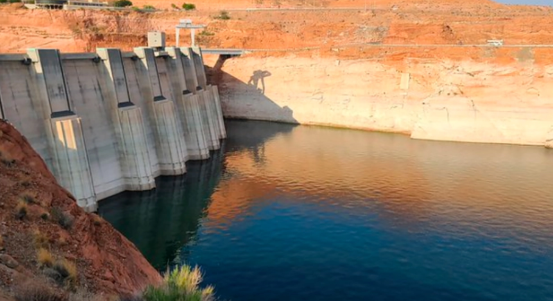
As of June 2026, water storage throughout the Colorado River system remained at critically low levels.
- Lake Powell, located on the Utah-Arizona border, was at 25% of its storage capacity.
- Lake Mead, formed by Hoover Dam on the Arizona-Nevada border and used to determine Mexico’s annual allocation, stood at 34% capacity.
Given these conditions, Cortez Lara stated that emergency reductions, as established under Minute 323 of the IBWC, will likely be necessary.
Minute 323 specifies that if forecasts indicate Hoover Dam’s reservoir elevation will fall below 1,045 feet above sea level on January 1 of the following year—which current projections suggest, estimating a level of approximately 1,034 feet for 2027—Mexico and the United States must negotiate emergency reductions.
These agreements must be reached before the end of 2026 to prevent the reservoir from falling to 950 feet above sea level, a threshold that would jeopardize hydroelectric power generation.
Agricultural Land Fallowing as a Water Conservation Measure
Over recent years, IBWC Minutes 218, 219, 323, and 330 have supported irrigation infrastructure projects designed to improve water-use efficiency and increase storage levels within the Colorado River system.
More recently, farmers holding irrigation rights in District 014 have promoted a voluntary land-fallowing program aimed at conserving water and helping stabilize storage levels in Lake Powell and Lake Mead.
Minute 323 authorizes US$31.5 million for water conservation projects through irrigation infrastructure improvements and temporary agricultural land retirement in District 014.
Meanwhile, Minute 330 establishes conservation measures intended to recover 493.4 million cubic meters of water during 2024 and 2025, in exchange for US$65 million.
The first land-fallowing agreement took effect in 2024, providing compensation of 16,000 pesos per hectare across 43,746 hectares.
Growing Demand in Baja California’s Coastal Region
According to Luis Gerardo Domínguez, Deputy Director of the Center for Innovation and Environmental Management of Mexico (CIGA), Tijuana remains one of Mexico’s fastest-growing cities, resulting in a continuous increase in demand for drinking water.
He emphasized that the region already faces severe water stress, intensified by prolonged drought, groundwater overexploitation, and climate change.
During 2026, approximately 114 million cubic meters of water are scheduled to be delivered through the Colorado River Aqueduct to Tijuana, Tecate, Rosarito, and Ensenada for municipal consumption.
According to the Baja California state government, the aqueduct transported 148 million cubic meters in 2025.
98% of the Coastal Region’s Drinking Water Comes From the Colorado River
The coastal region of Baja California, including Tijuana, Playas de Rosarito, and Ensenada, depends heavily on water transferred through the Colorado River–Tijuana Aqueduct (ARCT).
According to an analysis by the North American Development Bank, approximately 98% of the region’s drinking water supply originates from the Colorado River.
This high dependence on a single water source leaves the region vulnerable to both hydrological conditions and operational disruptions, including earthquakes and maintenance work that have interrupted pumping operations in the past.
The most significant concern is that continued reductions in Colorado River allocations, driven by prolonged drought, will place even greater pressure on an already strained regional water supply system.
Source: eleconomista