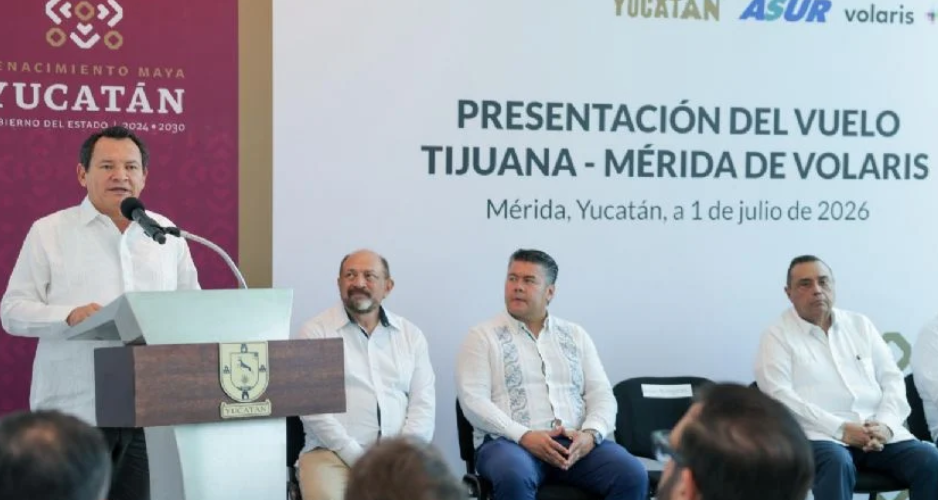

Yucatán’s air connectivity continues to strengthen with the operation of Volaris’ new Tijuana-Mérida route, a connection that aims to boost tourism, trade, attract investment, and facilitate family reunions between southeastern and northern Mexico, as well as improve connections with the San Diego, California region.
During the official launch of the route, Governor Joaquín Díaz Mena emphasized that this new flight is part of the Mayan Renaissance strategy, aimed at consolidating Yucatán as a competitive destination for tourism and investment. With this addition, the state now has 13 active domestic routes, strengthening its air connectivity network.
The governor noted that the increase in connections represents a greater influx of visitors, which translates into increased economic benefits and new opportunities for Yucatecan families. He also highlighted the important social component of this route, facilitating travel for those with family ties to Mexican communities located along the northwestern border and in the southern United States.
The new route has been operating since June 1st with four weekly flights—Mondays, Wednesdays, Fridays, and Saturdays—aboard Airbus A320 aircraft with a capacity of 180 passengers.
“Yucatán is now a state that inspires confidence and attracts investments that will translate into better-paying jobs. The Mayan Renaissance means more connections, more tourism, more employment, and closer ties between families,” said Díaz Mena during the event held at the Mérida International Airport “Manuel Crescencio Rejón.”
The governor also acknowledged Volaris’s confidence in the state, as well as the coordinated work with the Southeast Airport Group (ASUR) and the tourism business sector to expand the state’s connectivity. He also expressed his gratitude for the support of the Mexican government and Mayor Claudia Sheinbaum Pardo, noting that infrastructure projects, such as the modernization of the Progreso Port, complement the strategy to strengthen the state’s economic development.
For his part, the Secretary of Tourism Development, Darío Flota Ocampo, emphasized that the reactivation of this route connects Yucatán with new markets and strengthens the state’s tourism, economic, and social growth. Meanwhile, the CEO of ASUR, Héctor Navarrete Muñoz, reiterated the commitment to continue working with the state government to attract new routes that will solidify Mérida as one of the main connectivity hubs in southeastern Mexico.
Source: quintanaroo.heraldodemexico