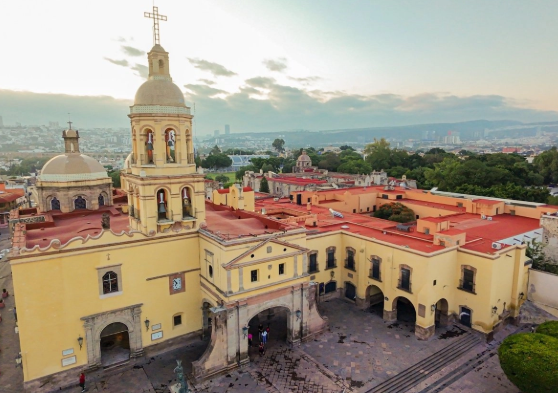

According to legend, the city of Querétaro was founded on July 25, 1531, after Indigenous inhabitants and Spanish conquerors agreed to settle their conflict in an unarmed, hand-to-hand battle on Cerro del Sangremal, where the Temple and Convent of the Holy Cross of Miracles, belonging to the Franciscan order, now stands.
According to the legend, the foreigners emerged victorious thanks to the miraculous appearance of Saint James the Moor-slayer (Santiago Matamoros), who reportedly appeared in the sky on horseback carrying a cross during an eclipse. However, researchers and historians dispute this origin story, even as the city government and the Catholic diocese organized a weekend of celebrations commemorating the Spanish conquest.
The historian, journalist, and professor at the Faculty of Philosophy of the Autonomous University of Querétaro (UAQ), Ana Cecilia Figueroa Velázquez, told La Jornada that myths in contemporary society “serve us in every era because they provide us with identity. They are not useless; historically they have helped create a sense of origin because people, regardless of the period they live in, feel uncertainty about where everything came from and why it is important to feel proud of being from Querétaro.”
Regarding the founding myth, Figueroa Velázquez agrees with UNAM researcher Antonio Rubial García that the events said to have occurred at Cerro del Sangremal “are an invention of the eighteenth century, meaning they were created two centuries after the supposed founding.” She adds that no account of this founding appears “in the chronicles written by the Franciscan friars themselves at the time. It is only two centuries later that references to the Battle of Sangremal and this narrative about the city’s founding begin to appear in Franciscan writings.”
She explains that the narrative emerged in the context of a conflict “between the secular clergy, represented by the archbishopric, and the regular clergy, namely the Franciscan monks. For the Spanish Crown, these mendicant orders had already fulfilled their mission of evangelization, so it was time to reduce their power and replace them with diocesan clergy. It was in this context that the Franciscans created the founding myth to legitimize their presence at what would become the College for the Propagation of the Faith, now known as the Temple of the Holy Cross of Miracles.”
Ana Cecilia Figueroa also explains that historian Marco Antonio Peralta Peralta reviewed wills and notarial documents preserved in the Historical Archive of the State. At that time, “wills in colonial society typically began by invoking patron saints and saints of personal devotion who would guide the deceased into eternal life. Yet throughout the sixteenth and seventeenth centuries, not a single dying person entrusted themselves either to the Holy Cross of Miracles said to have appeared at Sangremal or to Saint James the Apostle.”
Conquest Through Bloodshed
Historian Ana Cecilia Figueroa emphasizes that “people speak of the founding of Querétaro as though nothing existed before the Spaniards arrived, and that is simply not true. This was already an Indigenous settlement where the merchant Conín, later baptized as Fernando de Tapia, came with Otomí people from Nopala and established Tlaxco Querétaro in what is now known as La Cañada. This conclusion is based on historical documents, since there is no archaeological evidence.”
She adds that semi-nomadic Xi’úi people, commonly—and pejoratively—known as Pames or even more derogatorily as Chichimecas, also lived in the region. “They were all here when the Spaniards arrived and conquered the area through bloodshed. It was not a peaceful conquest accomplished through kindness—that simply is not true.”
The Monument to Conín Is Not Actually Conín
The iconic figure of Conín, considered one of the principal founders of the settlement, has a stone monument located at kilometer 203 of Federal Highway 57, at the entrance to the state capital. However, according to historians, the monument does not actually depict him.
Historian, author, and honorary municipal chronicler Valentín García Márquez told La Jornada that during a colloquium on the founding of Querétaro, former National Institute of Anthropology and History (INAH) director Diego Prieto recounted the story behind the sculpture.
According to the account, the statue was originally a gift from the federal government to the state government during the administration of Governor Rafael Camacho Guzmán, and it was believed to represent Cuitláhuac, the Aztec tlatoani.
García Márquez explained that the governor reportedly questioned why they would keep such a figure in Querétaro. Local stone sculptors were then summoned to “Querétaro-ize” the monument by carving a scroll featuring the city’s aqueduct. The governor supposedly declared, “Now this is Conín,” and the modified monument was installed at the city’s entrance.
García Márquez, also a member of the Association of Municipal Chroniclers of the State, argues that the concept of “founding” is incorrectly applied because the area was already inhabited.
“There are documents showing that the Otomí people had already settled and established this region around the early 1400s, and that it was later conquered by Spanish forces on July 25, 1531. If I suggested celebrating—not commemorating, but celebrating—the conquest of Tenochtitlan on August 13, 1521, people would probably look at me with resentment. Yet in Querétaro, that is essentially what we do every year: we celebrate the conquest, not the founding.”
He added, “If you carefully analyze the famous founding story, you’ll find that it functions largely as a discourse of indoctrination.”
Toward Historical Truth
Both researchers argue that the city’s founding myth should be contrasted with historical evidence.
“What should happen is that the historical version and the founding myth should be presented together through discussion forums, panel debates, and public conversations that explain these lands were already inhabited,” Figueroa said.
For his part, García Márquez stated that “perhaps we can begin questioning what tradition really is. It may be beautiful, commercially successful, attractive to tourists, and economically beneficial. But if we moved a little closer to historical truth, we might stop accepting traditional stories as unquestionable facts and instead recognize them as part of local folklore.”
As part of the religious celebrations, a procession carrying the relics of Saint James the Apostle walked from his parish church, built by the Jesuit order in the seventeenth century, to the current state cathedral, San Felipe Neri Church, which was blessed in 1805 by Miguel Hidalgo y Costilla.
The official celebrations also included a concert program and an honor guard at the monument to Saint James, located in front of the Church of the Holy Cross of Miracles. The apostle gives his name to the state capital following the 1996 decree that officially changed the city’s name from Querétaro de Arteaga to Santiago de Querétaro.
Source: jornada