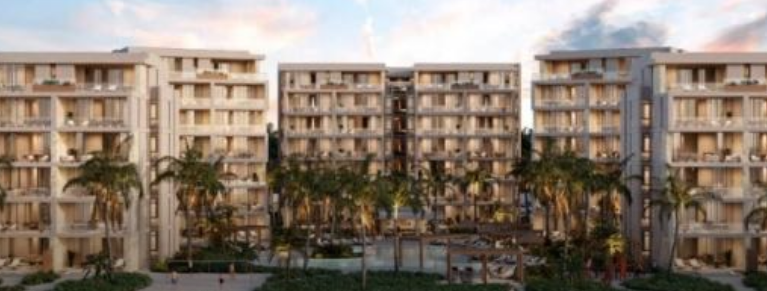

Following the start of construction, various citizen groups and environmental organizations, including the collective “Salvemos las Dunas” (Save the Dunes), have raised concerns about the project’s potential impact on sea turtle nesting areas, coastal dunes, and wetlands.
The development, commercially known as “Dunas,” is promoted by the real estate company Designia Desarrollos (also marketed through Grupo BCI). The controversial project is located on cadastral property number 1913, next to the beach area of Chuburná Puerto.
The company advertises it as a luxury resort-style complex featuring six residential towers with 74 apartments, swimming pools, paddle tennis courts, and other high-end amenities. The developer submitted its Environmental Impact Assessment (MIA-P) under the following registration in Yucatán:
File Number: 31/MP-0063/12/24
(The “31” corresponds to the state of Yucatán, while “24” indicates the year the project was submitted for evaluation.)
Authorization Number: 726.4/UGA-0371/000675
According to the Semarnat Ecological Gazette, where the project was registered under file 31YU2024UD109, the legal area submitted for environmental review covers 92,017.30 square meters.
Although the project’s commercial advertising highlights six towers, the original technical proposal submitted to the Ministry of Environment (Semarnat) contemplated the construction of up to 14 buildings containing 138 residential units, in addition to commercial areas and conservation zones.
The project did receive environmental approval from Semarnat, and the developer placed signs stating that it had been “authorized by Semarnat.” However, strong public opposition and complaints regarding the clearing of coastal vegetation quickly intensified.
On July 25, 2026, the Government of the State of Yucatán clarified that local Urban Environmental Feasibility permits impose strict conditions on the developer.
Of the property’s 92,017 square meters, 45,728 square meters of coastal wetlands and 2,880 square meters of Federal Maritime-Terrestrial Zone (Zofemat) cannot be disturbed or altered under any circumstances. In other words, more than half of the property must remain under absolute conservation.
The permits also prohibit any damage to mangrove species present in the area, requiring full compliance with NOM-022-SEMARNAT-2003.
For this reason, Governor Joaquín Díaz Mena formally requested that Profepa and Semarnat send inspectors to verify on-site that the developer is not exceeding the authorized construction boundaries and is fully complying with all environmental permit conditions.
However, local fishing cooperatives and long-time residents claim that the developer has already caused environmental damage in an area where sea turtles nest. They are demanding the immediate suspension of construction and legal action against the company.
The coastal corridor between Chuburná Puerto and the neighboring community of Chelem, in the municipality of Progreso, has historically been considered a high-risk area by Profepa due to two ongoing pressures: real estate speculation and illegal land invasions.
Profepa’s inspections and closures along the Chuburná–Chelem coastal strip are primarily based on three major precedents.
Between January and February of this year, following complaints from residents and community organizations such as Las Chelemeras, Profepa intervened in the Chelem–Chuburná corridor.
Authorities confirmed the unauthorized clearing, logging, and burning of more than 18,000 square meters of mangrove and wetland ecosystems for illegal land subdivision and unauthorized land sales. As a result, officials imposed Temporary Total Closure orders and initiated administrative proceedings.
In the same area, inspectors identified illegal settlements where construction materials and wire fencing had been installed inside protected wetlands.
Profepa has also sanctioned projects affecting the coastal dunes of Chuburná due to construction that either exceeded approved Environmental Impact Assessment limits or lacked environmental authorization altogether.
In one case, the agency imposed a Temporary Total Closure after discovering the construction of a 19-meter masonry perimeter wall located only 10 meters from the high-tide line, along with the unauthorized removal of 250 square meters of native coastal dune vegetation.
During other enforcement operations along the Progreso coastline, Profepa shut down properties intended for developments of up to 1,200 square meters after developers removed protected native vegetation—including uikib (sea grape), sak chuum, riñonina, and tabaquillo—to establish commercial lots without prior authorization from Semarnat.
The main difference between those previous enforcement actions and the current Las Dunas project is that the latter does possess an approved Environmental Impact Assessment (MIA).
Therefore, the inspection requested by the Government of Yucatán is not intended to determine whether the project has environmental authorization, but rather to verify that construction remains within the approved boundaries and that more than 4.5 hectares of protected wetlands remain completely untouched, as required by the project’s environmental permit.

Source: lucesdelsiglo