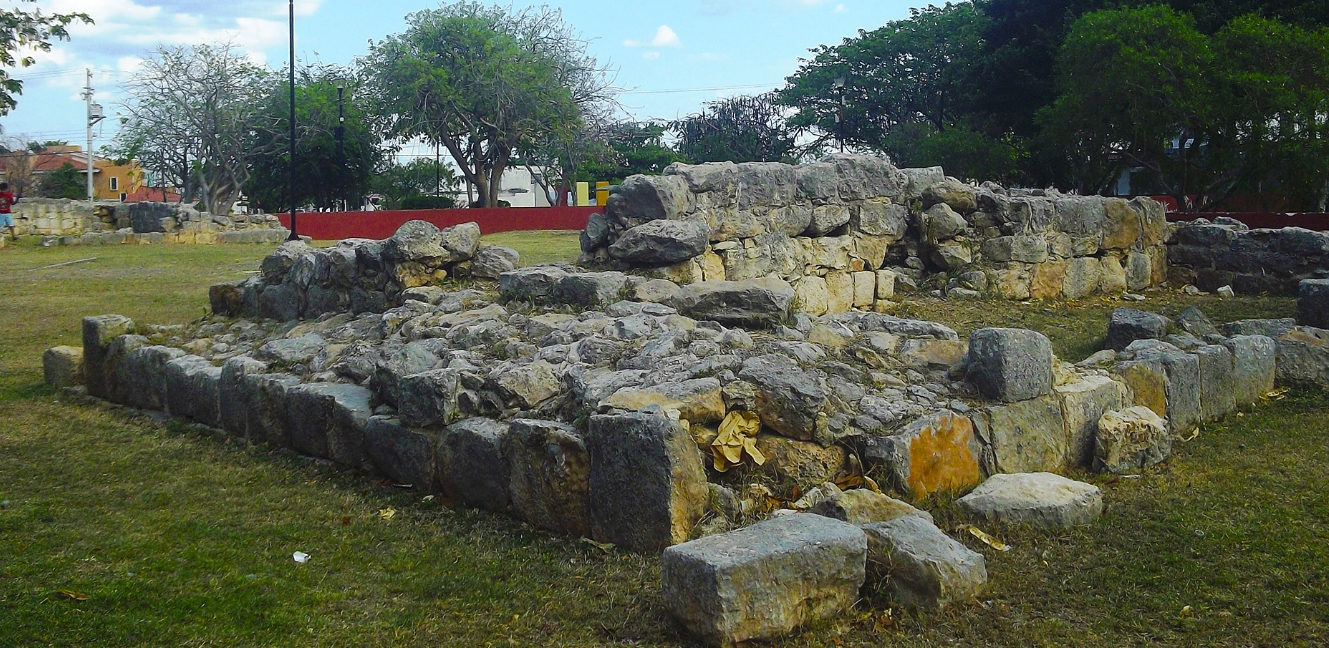

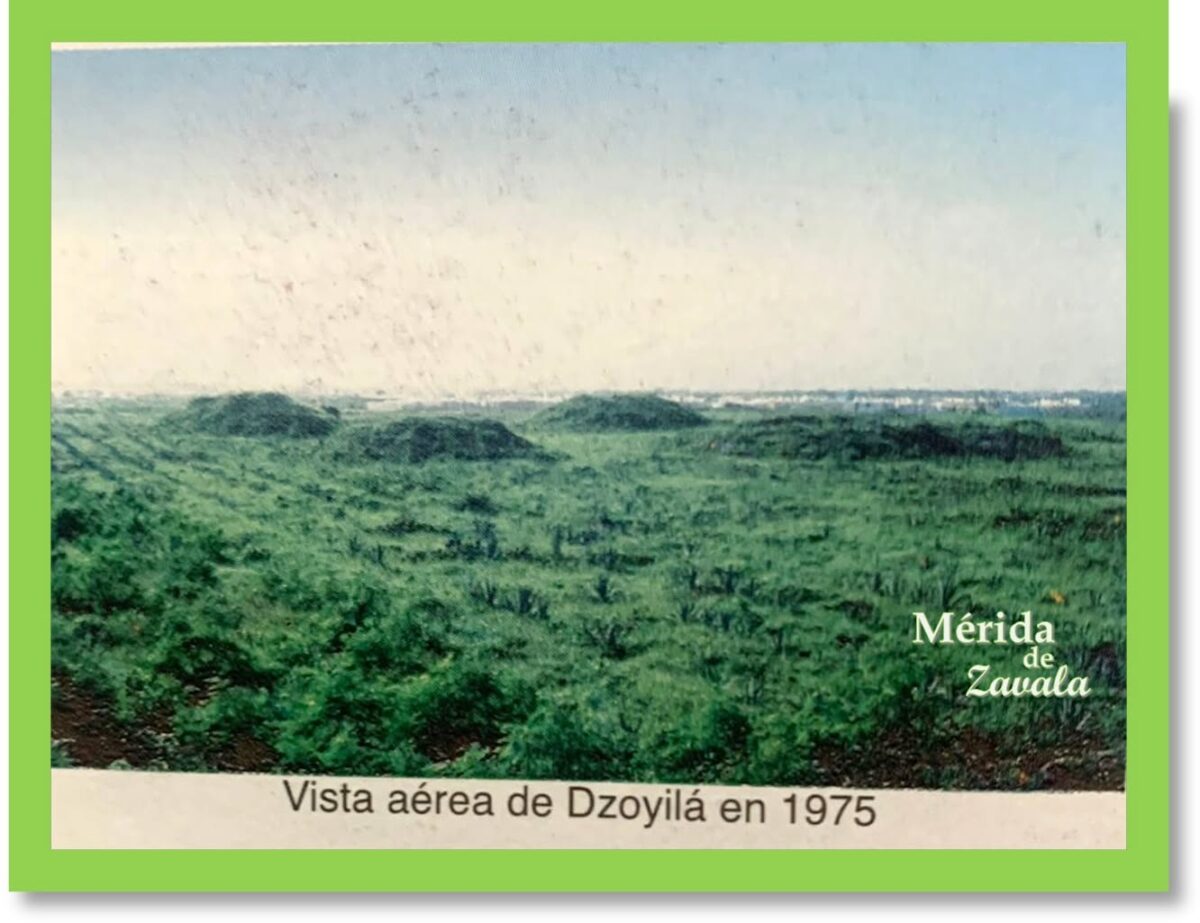
In the sacred book of the Chilam Balam, Dzoyilá appears as one of the Preclassic cities through which the first Itza people passed before settling in Chichén Itzá. In the modern era, Dzoyilá is known as the first archaeological park within the city of Mérida, Yucatán. It is classified as a Rank IV site in the state’s Archaeological Atlas and contains numerous structures, residential platforms, mounds up to five meters high, ceramic remains, altars, and substructures with offerings and human burials. Today, business interests are destroying it to build a supermarket.
“In Mediz Bolio’s version of the Chilam Balam, Dzoyilá appears on page 11, in the chapter describing the migration of the Itza. If someone reads that section of the story, they will see that many of the towns have preserved their Preclassic names. Losing Dzoyilá means losing something sacred, losing the recognition that human beings lived here long before the arrival of the Spaniards,” said Professor Susana Polanco in an interview.
The Historic Struggle of the Neighbors
Susana Polanco is part of a neighborhood committee created twenty years ago to defend sixteen hectares of low tropical forest and Maya ruins located between the Granjas, Morelos, and Salvador Alvarado Sur neighborhoods in Mérida.
In 2005, a businessman with the surname Canto proposed building a shopping plaza surrounding the archaeological remains. At that time, Josep Ligorred, an archaeologist with the Mérida City Council, conducted a public consultation with local residents, who strongly opposed the project.
The neighbors argued that it was absurd to leave structures such as the pyramids completely disconnected from what had once been a Maya city, surrounding them with commercial developments. Thanks to the residents’ organization and the fact that the consultation process was respected, their voices were heard and the construction project was halted.
This time, no one asked them.
Residents say the forest was first set on fire, and afterward they saw bulldozers entering the area where previously restored structures were located. Approximately four hectares have already been cleared.
When they realized what was happening, residents reactivated WhatsApp groups and neighborhood networks to organize themselves, report the situation, and document with photographs and videos the excavators that leveled the mounds and hauled away ancient stones in dump trucks. The area has now been fenced off so neighbors can no longer see or document what is happening inside.
Since the dispute over building on the Maya ruins began twenty years ago, nearby neighborhoods have consistently demanded the same thing: the protection of the sixteen hectares, which they believe should be preserved or expropriated for public benefit. Their goal is not only to stop the construction of commercial stores but also to transform Dzoyilá into an ecological and cultural community park that promotes herbal medicine, Maya science, and coexistence with nature.
The original Maya city covered approximately fifty hectares, of which sixteen remained after the first archaeological rescue efforts. In 1997, Mexico’s Commission for the Regularization of Land Tenure (Corett) sold twelve hectares to private individuals, leaving only two hectares under the protection of the National Institute of Anthropology and History (INAH).
Only a portion of those sixteen hectares had previously been lost, when an ancient Maya pok ta pok ballcourt—a ritual and sporting tradition more than three thousand years old—was destroyed to build a gas station.
The New Owners of the Maya Ruins
The company Proyectos de Vivienda de Yucatán, S.A. de C.V. is identified as the owner of significant portions of Dzoyilá, including the property on Calle 18 Norte where construction is currently taking place. The company belongs to members of the prominent Yucatán families Abraham Mafud and Abraham Xacur. Residents allege that these lands were acquired decades ago at symbolic prices through what they consider to have been political favoritism via Corett.
Residents have also filed public information requests seeking to learn exactly what is being built in their neighborhood, as they have only heard rumors about the supermarket. They requested copies of construction permits, land-use authorizations, environmental impact studies, and evidence of prior consultation with the Maya people.
The Mérida City Council confirmed that it granted a land-use permit for the property on Calle 18 Norte for a “Category B self-service store (medium impact) and commercial spaces” to Inmobiliaria Kira, S.A. de C.V., represented by Antonio Chedraui Obeso.
Regardless of who owns the land, archaeological monuments are, by law, the property of the nation. In theory, landowners must allow INAH supervision and may not damage or alter archaeological remains, as doing so constitutes a federal crime.
For many years, several municipal offices in Mérida and INAH itself protected and promoted the importance of Dzoyilá. In the park where the interviews with residents took place, there had been a map explaining the size of the site and its historical importance. Recently, that sign was painted over in white, erasing all of its information.
“There were even printed materials from the City Council celebrating Dzoyilá and explaining its value. We felt there was cooperation between the federal and municipal governments to protect the site. That changed in 2026, when the machinery began entering, although who knows how long they had been planning it,” said Leonardo Guerrero.
He insists that there should be a consultation process involving business owners, neighbors, and the authorities responsible for the site “so that everyone’s opinions are considered and together we can create solutions that benefit the community, not only speculators and investors.”
History Repeats Itself
Thirty years ago, teachers from Pedro Pablo Echeverría Elementary School used to bring students to a nearby cenote and cave to teach them about wildlife and Maya culture. Those places no longer exist because the owners filled the cenote and caves with concrete.
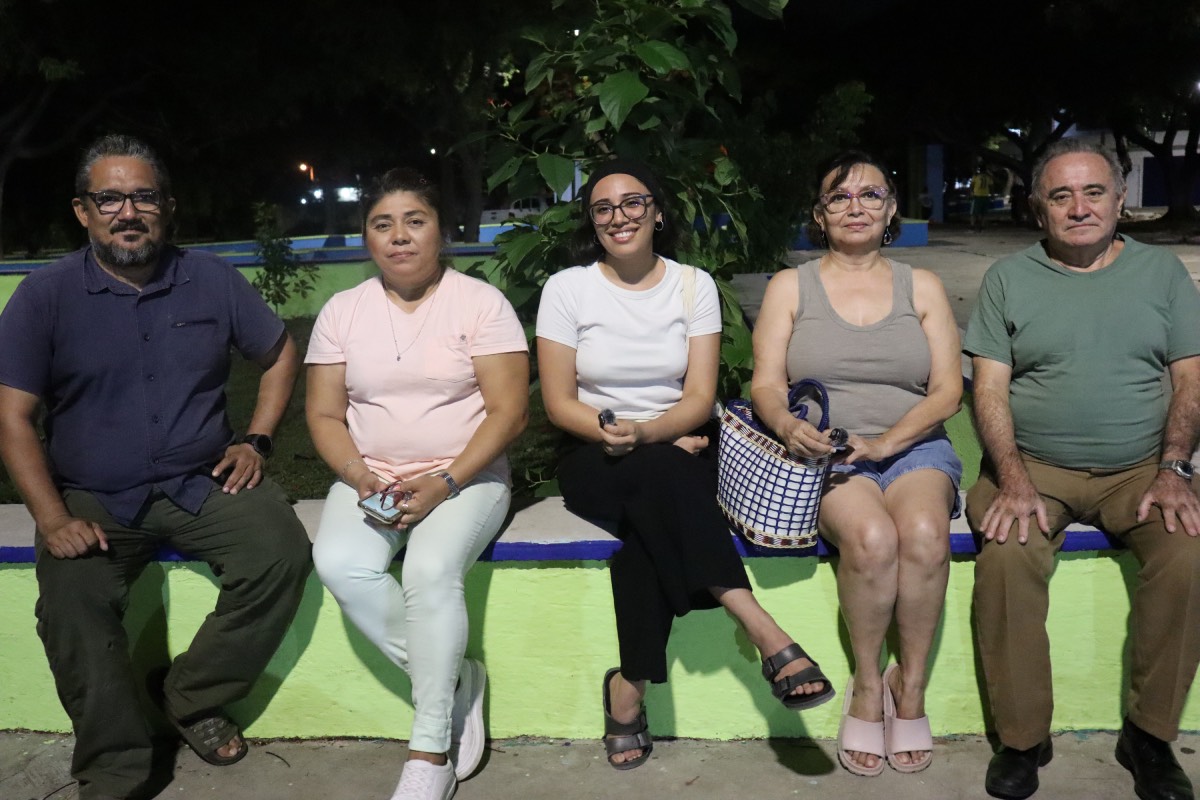
The teachers who led Dzoyilá’s neighborhood movement twenty years ago are now elderly and rarely leave their homes. However, younger generations continue to honor them. One of the youngest members of the neighborhood committee is 27-year-old architect Alejandra Echeverría, who has lived in the Morelos neighborhood for most of her life.
“I had always known about the Maya remains, but it wasn’t until this past May, when the neighbors started organizing, that I realized there was a much broader history than we had known,” she said.
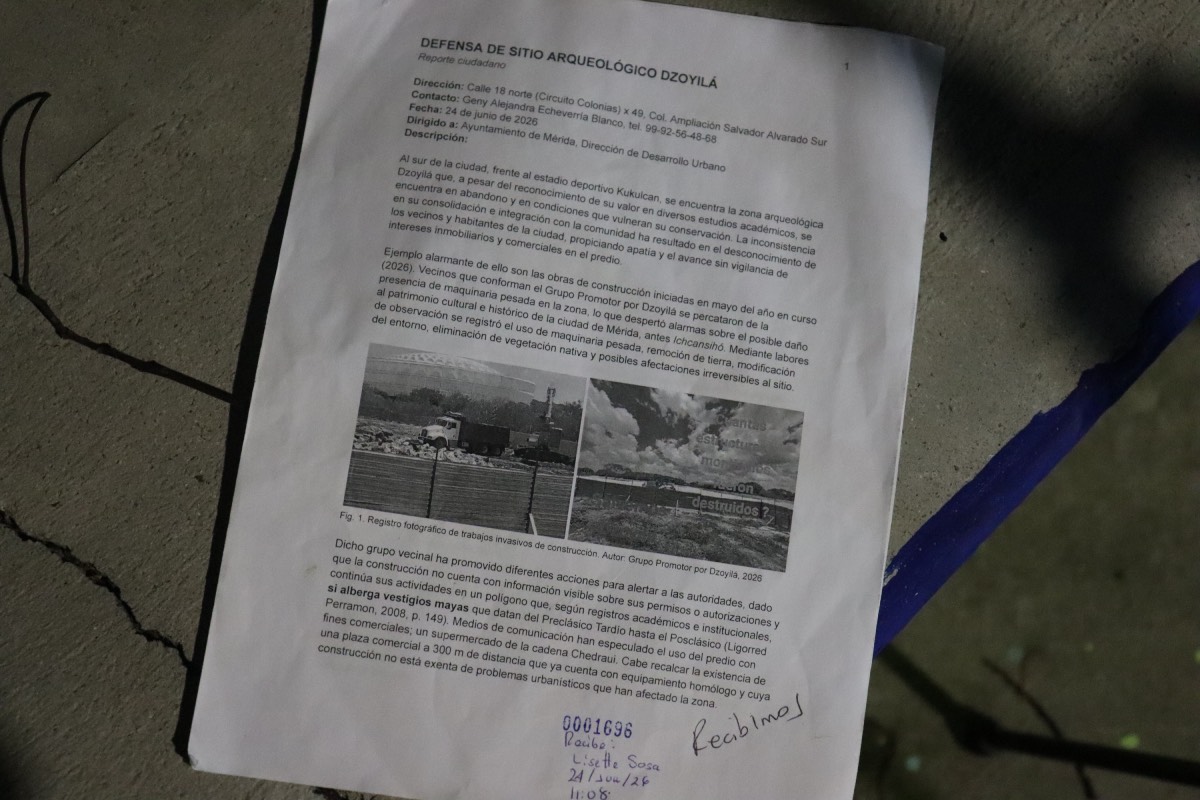
On June 24, Alejandra attended one of the public hearings held by Mérida Mayor Cecilia Patrón Laviada. She presented a document signed by forty neighbors summarizing the problem and requesting working groups involving the City Council, the INAH Yucatán Center, and the private landowners to better understand the project and ensure the community’s participation.
Mayor Cecilia Patrón briefly met with them and stated that the company only had authorization for land clearing, not construction—something residents say does not match the bulldozers and dump trucks they have seen operating over the archaeological remains.
“They received us defensively. We had to explain why this matters to us and why we need dialogue with different government departments. The mayor’s response was that she couldn’t do anything about it,” Alejandra recalled.
During the meeting, she felt the mayor failed to understand the issue because she could not relate to the residents’ perspective. The mayor commented that nature was also very important to her and that she would do everything possible to preserve the Maya site “like the Costco cenote,” referring to a cave discovered in the parking lot of a Costco store in northern Mérida that the company chose to preserve.
“I couldn’t believe the comparison. It made me realize the perspective she was speaking from—not because of her office, but as a person whose worldview was completely different from ours,” she said.
The INAH’s Betrayal
“The INAH archaeologists kept their tools in my house,” recalls Susana Polanco. She remembers bringing water, snacks, and soft drinks to the archaeologists who first worked at the ancient Maya city.
Eunice Uc González, archaeologist, professor, and INAH researcher, became especially well known for leading investigations at the site between 2004 and 2014. Thanks to her work, monumental structures were restored and the importance of Dzoyilá was widely promoted.
Residents considered her an ally within INAH because they believed that, after studying the site for so many years, she understood what would be lost if a supermarket were built. For that reason, when the destruction began, neighbors Manuel Rosado and Fátima Gamboa went to speak with her.
Manuel Rosado remembers the meeting on May 13, 2026, at two in the afternoon, describing it as “shocking.”
“I found a completely different Eunice. She told me she was simply following orders and that INAH had instructed her to clear the land and carry out the archaeological salvage. She showed us the salvage files, but ‘salvage’ doesn’t mean what people think. It sounds like preserving something. For INAH, it means documenting what existed before destroying it and building over it. That’s what archaeological salvage means,” he said angrily.
Residents feel betrayed that the same researcher who spent decades promoting the site’s importance was the one who, in February 2026, signed the technical opinion declaring that the Maya remains would not prevent construction and authorized the commercial project to proceed.
On February 9, 2026, Eunice Uc signed a document stating that no archaeological remains had been found in the area known as “Polygon 3” (covering more than 22,000 square meters), meaning there was no obstacle to construction there. She restricted development only in Polygons 1 and 2, where the most significant structures she had restored years earlier are located.
She also signed official responses to residents in May 2026, in which INAH declared that it had no authority to carry out public or community consultation with the Maya people, limiting its role strictly to technical and legal matters.
The Constitutional Lawsuit and the Court’s Response
In May 2026, attorney and resident Fátima Gamboa filed an amparo (constitutional protection lawsuit) on behalf of the neighborhood.
The lawsuit argued that residents’ right to prior public consultation had been violated, maintaining that any project affecting an inhabited community should first be subject to consultation. It also invoked the right to a healthy environment and denounced the cultural damage caused by the destruction of archaeological remains.
Despite more than twenty years of protecting Dzoyilá, identifying as members of the Maya people, and living near the site, the Fifth Federal District Court dismissed the case, ruling that the neighborhood movement lacked sufficient legal standing.
One of the court’s arguments was that it did not recognize the plaintiffs’ self-identification as Maya, a decision that deeply angered the community, which asked: what determines whether authorities recognize someone as Indigenous?
Fátima Gamboa emphasized that this issue is particularly serious given that Maya communities continue to live in Mérida.
“If they refuse to recognize us, what does that mean for the rest of the Maya cultural heritage that still exists within the city?” she asked.
The residents appealed the ruling before a collegiate court for review.
They also sent letters to Mexico’s federal executive branch and the governor of Yucatán requesting the immediate suspension of construction, the expropriation of the remaining fifteen hectares for public benefit, and an investigation into the damage caused to the nation’s cultural heritage.
In June 2026, they organized environmental awareness activities to demonstrate that the site is not simply “vacant land,” but rather a biodiversity refuge containing threatened species.
“The narrative we’re facing is that certain procedures are being followed, but they clearly prioritize private property over cultural heritage. There’s also a deeply racist view that sees this place as isolated objects that can be documented and destroyed, whereas we see it as a complete biocultural landscape,” the attorney said.
A Forest Full of Life
Dzoyilá is also a green refuge of tropical forest in the middle of the city, with a long historical relationship to the people living in southern Mérida.
Maya New Year ceremonies have been held there. Scout groups and children have climbed its ruins and explored its caves. Archaeologists have documented and shared its biocultural significance for decades.
“When I was in the Scouts, we came here to watch birds, visit the ruins, and appreciate the natural richness. Our troop leader brought us to explore the caves. We’ve had a connection with this place since childhood. Dzoyilá is a biocultural space. It’s incredible to feel connected to ancient generations while also seeing how life continues to thrive. The amount of life here is astonishing,” said biologist Leonardo Guerrero, who lives across from the site.
Southern Mérida is widely known for deficiencies in public services. Residents point out that these green areas not only preserve cultural heritage but also provide vital ecosystem services such as absorbing rainwater to reduce flooding, mitigating extreme heat, and providing habitat for wildlife that has nearly disappeared elsewhere in the city, including deer, hairless pigs, and wild turkeys.
“There are numerous studies documenting the plant, animal, and insect species that have found refuge in these urban wild areas. This isn’t the same as a city park with concrete paths and a few trees. This is a genuine natural ecosystem where species have survived for hundreds of years,” Guerrero added.
The Future Residents Want for Dzoyilá
Residents fear that the city is becoming increasingly indifferent to the loss of its historical memory, as well as to the impact these projects will have on essential services such as water and electricity. They already experience power outages whenever there are games at Kukulkán Stadium, which borders Dzoyilá.
Meanwhile, southern Mérida continues to lack adequate public recreational spaces.
“Why is commercial development considered the only possible future for a biocultural site like this? Why can’t we imagine other uses that preserve native species and create an ecosystem where people learn to coexist with nature? Why can’t landowners imagine something different? What will happen to everything else?” the residents asked throughout the interview.
So far, only four hectares have been devastated, but they fear this is only the beginning of the private exploitation of a place they consider sacred both historically and in the present day.
“I hope this place has a future. I want people to know its archaeological remains, its native trees, its birds, and all the living beings that have found ways to survive here, just as Maya culture and the Maya people themselves have survived,” concluded Professor Susana Polanco.
Source: piedepagina