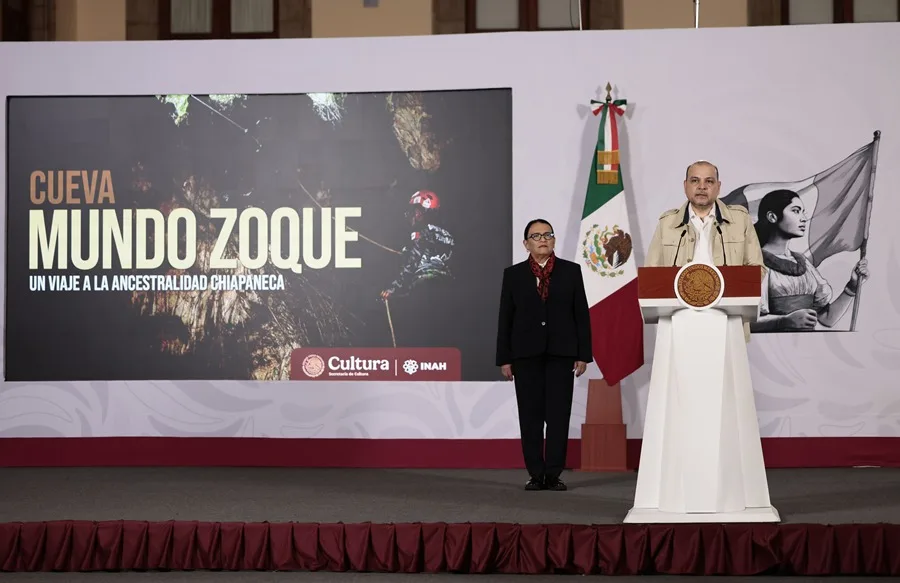

The National Institute of Anthropology and History (INAH) of Mexico announced this Friday new studies on 179 pre-Hispanic artifacts dating from between 600 and 900 AD, found in a ritual cave belonging to the Zoque culture in the southern state of Chiapas. The site is considered one of the most significant archaeological discoveries in the region in recent decades.
INAH Director General Joel Omar Vázquez Herrera explained during the government’s morning press conference that the objects were found in 13 offerings inside the so-called Mundo Zoque cave, in the community of General Lázaro Cárdenas, in the municipality of Cintalapa.
The cave, approximately 100 meters long and requiring a descent of more than 10 meters to access, is believed to have functioned as a ceremonial space where the ancient Zoque people carried out rituals associated with rain and good harvests.
Among the artifacts are urns, bowls, and incense burners featuring representations of jaguars, owls, snakes, human figures, and plant motifs, such as ceiba thorns.
Vázquez Herrera particularly highlighted a censer whose 32-centimeter handle ends in the figure of a snake and whose dish contains a quincunx, a Mesoamerican symbol associated with the four directions of the universe.
“It is an exceptional piece, a very beautiful and representative piece, in this case, of the Zoque culture,” he said.
Studies to Come
Archaeologists also identified stalactites and stalagmites that had been modified by the ancient inhabitants to give them human-like appearances or to represent the jaws of the so-called “earth monster.”
The guide Jairo Díaz Barreiro discovered the cave and notified INAH of the finding in January. Specialists subsequently carried out verification and documentation work between February and June. Its difficult access helped the site remain intact and protected from looting for centuries.
Vázquez Herrera said that upcoming work will include a study using lidar technology, a three-dimensional scan, and analysis of the contents of the urns and bowls.
In addition, researchers found traces of charcoal inside the vessels that will allow them to conduct studies to determine the age of the remains more precisely, which have been preliminarily dated to the region’s Late Classic period.

Source: efe