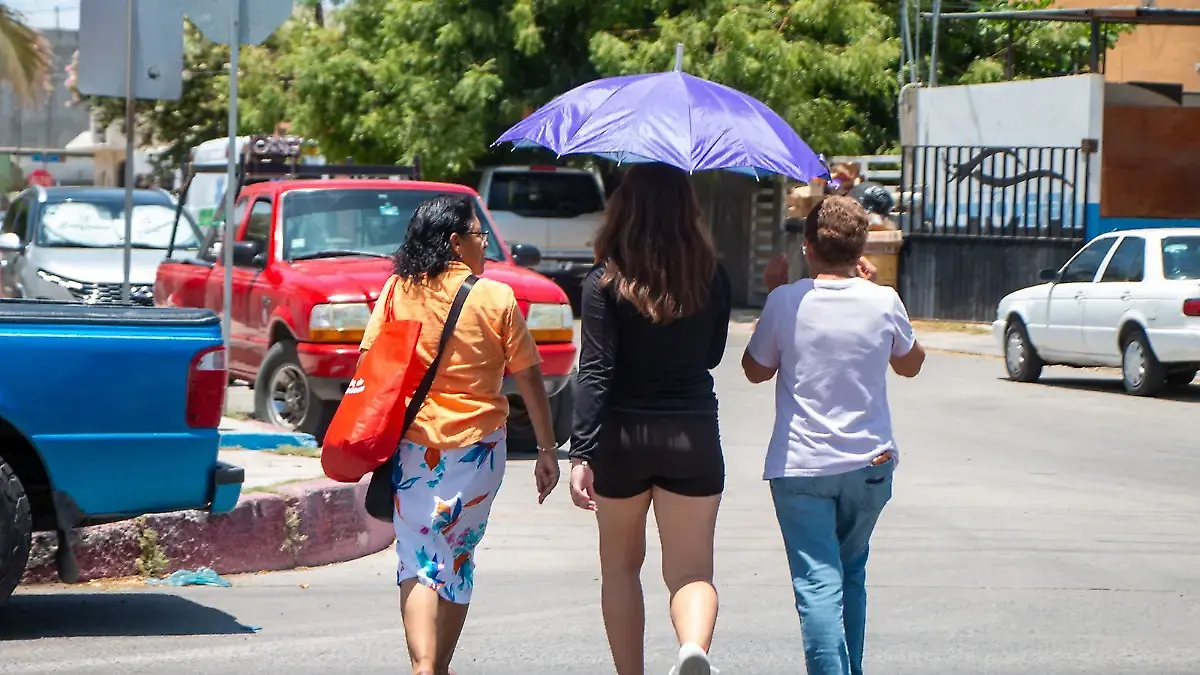

Cabo San Lucas and Loreto broke their historical records in 2026 for the number of days with extreme maximum temperatures during heat waves, according to the journal of the Center for Scientific Research and Higher Education of Ensenada (CICESE), La Paz Academic Unit, and the Tropical Oceanography Group and Remote Sensing and Autonomous Unmanned Vehicle Laboratory (SERVANT).
As of August 21, Cabo San Lucas had accumulated 90 days above this threshold during 13 heat waves, surpassing the 88 days recorded in 2006, which represented the highest value in the historical series from 1991 to 2025.
Loreto recorded 58 days distributed across nine heat waves, one more than the 57 reported during 2025. In La Paz, six heat waves and 32 days above the 90th percentile were identified, a figure close to the maximum of 35 days recorded in 2009, 2017, and 2025.
The data are part of the section prepared by researcher Jorge Cortés Ramos for the BCS Climate Bulletin, year 2, issue 8, corresponding to August 2026. The publication is edited by the La Paz Academic Unit of CICESE, through SERVANT.
How Do They Identify a Heat Wave?
The analysis uses information from the weather stations in La Paz, Cabo San Lucas, and Loreto, as well as thresholds constructed from the 1991–2020 reference period and calculated the 90th percentile for each month.
This indicator marks the limit below which 90% of historical maximum temperatures fall; exceeding it means that the recorded temperature falls within the 10% of the highest values for that time of year. The bulletin identifies a heat wave when this threshold is exceeded for at least three days, with the possibility of including one consecutive bridging day.
During the first eight months of 2026, the three stations experienced different periods with maximum temperatures above climatological values, although with differences in duration and recurrence. “It should be considered that the 2026 values correspond to a year that is still ongoing,” Cortés Ramos specified in the publication.
Temperatures of Up to 43 Degrees
Cabo San Lucas recorded new historical monthly highs during June and July. The highest temperature of the year at this station was 43 degrees Celsius.
One of the longest periods occurred from June 19 to July 6, with a duration of 18 days and a maximum temperature of 43 degrees. Another event, from July 21 to 24, once again reached 43 degrees.
In Loreto, the maximum temperature of 42.6 degrees recorded during June was among the highest historically observed for that month. The period extended from June 24 to July 5.
The highest temperature reported in La Paz during 2026 was 42.2 degrees, reached during the heat wave identified from May 25 to 29.
“Taken together, these records document both the magnitude and persistence of the warm conditions observed during 2026, without attributing, at this time, the mechanisms responsible for their occurrence,” the researcher stated.
During August, these events continued in Loreto and Cabo San Lucas. In the former location, a heat wave was recorded from July 27 to August 2, with a maximum of 40.6 degrees; while in Cabo San Lucas another occurred from August 15 to 20, with temperatures of up to 40 degrees.
Extreme Rainfall in La Paz
Precipitation events were also documented at the three weather stations. In La Paz, 15.6 millimeters of rain were recorded on August 9, classified as a strong event, and 19.9 millimeters on August 17, considered extreme precipitation.
For Loreto, 15.1 millimeters were reported on August 17, classified as a moderate event. In Cabo San Lucas, 19 millimeters were recorded on August 2, also within the moderate category.
Source: oem