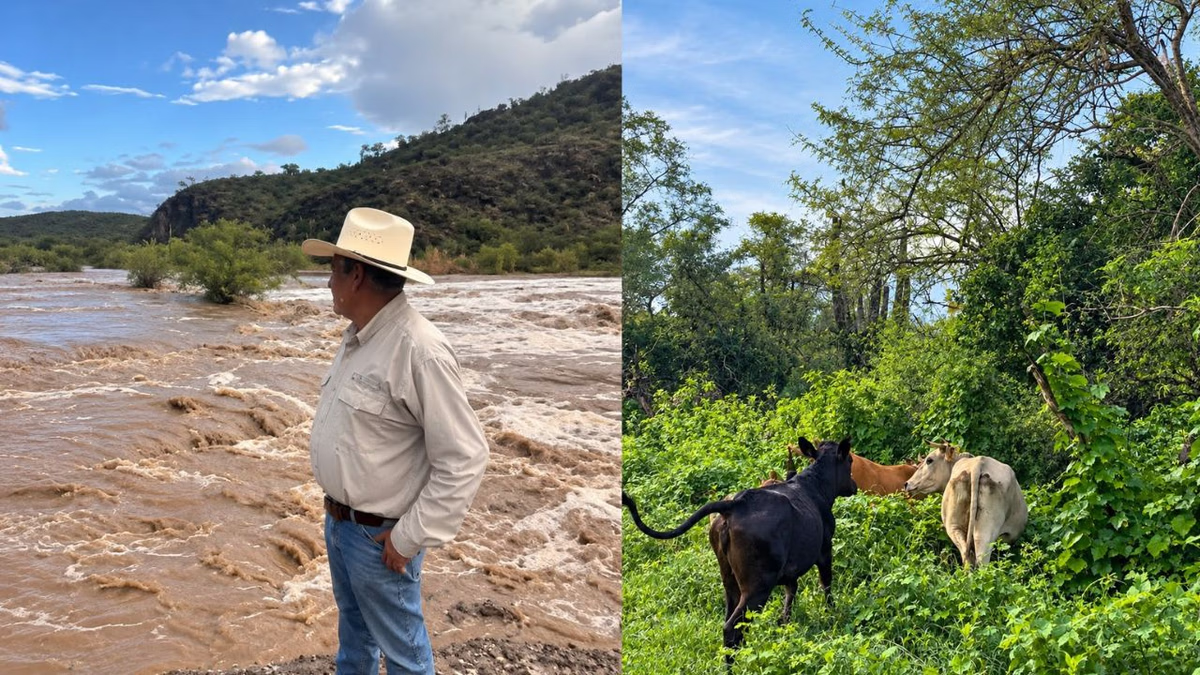

The Mexican monsoon and the effects of Hurricane Marie gave the agricultural sector of Baja California Sur a respite. Over the past eight days, rainfall totals reached as much as 495.8 millimeters in different areas of the central and southern parts of the state, according to data from the National Water Commission (Conagua).
The rainfall represents a relief for the livestock sector, one of the hardest hit by the recurring drought that affected the state between 2019 and 2025 and caused the deaths of thousands of livestock.
Currently, Baja California Sur has a livestock population of 393,788 animals: 226,810 cattle, 104,208 goats, 19,461 sheep, 19,933 pigs, and 23,376 horses. The figure represents a considerable reduction compared with 2019, when, according to data from the State Government, there were 626,236 head of livestock.
In response to the severe drought conditions recorded during 2025, the State Government, through the Secretariat of Fisheries, Aquaculture and Agricultural Development (SEPADA), allocated an investment of more than 20 million pesos to support the livestock sector through the Strategic Drought Response Program.
SEPADA head José Alfredo Bermúdez Beltrán highlighted that the rainfall recorded in central and southern Baja California Sur has benefited the livestock sector and represents relief from the drought conditions that the state continues to face.
The official announced that an evaluation will be conducted of the benefits brought by the rainfall and that authorities are considering modifying the guidelines of the Strategic Drought Response Program, with the goal of allocating part of those resources to planting forage on livestock ranches.
“We will now have extensive vegetation coverage throughout the region to strengthen our livestock activity. This is extremely important because it allows us to ease all the problems we have been facing due to a lack of forage, and with this, forage is guaranteed for the remainder of this year and the first half of 2027 in these areas where it has rained,” he said.
Bermúdez Beltrán recalled that Ciudad Constitución alone recorded a historic rainfall of 106 millimeters, providing relief to the agricultural sector. Significant rainfall totals were also reported in communities such as San Antonio, El Triunfo, the mountain ranges, and San Bartolo.
Ranchers call for infrastructure to take advantage of the water
For ranchers, the rainfall has made 2026 a beneficial year. However, they believe the rains also highlight a problem that persists in Baja California Sur: the lack of water infrastructure to store and take advantage of the water.
For this reason, they have repeatedly urged authorities to build water retention dams, containment structures, and other alternatives that would make it possible to retain rainwater in rural areas.
“It is an impressive sight, as always, to see the desert filled with water, and it reminds us of the need for a water infrastructure plan in Baja California Sur. This water leaves, comes down from our mountains, and goes directly into the sea without anything stopping it, even though we live in a desert with a great need for water. We continue demanding that there be a water infrastructure plan for the agricultural sector so that we can take advantage of it,” said Ricardo Salomé Fuerte.
Despite the significant rainfall totals and Conagua forecasts anticipating the possible continuation of precipitation associated with the El Niño phenomenon, Baja California Sur’s reservoirs have still not benefited proportionally from the amount of water that has fallen.
Rainfall has not yet been reflected in reservoirs
As of August 1, 2026, the six main reservoirs in Baja California Sur had considerably low storage levels. La Palma reservoir, in Los Cabos, stood at 1.20%; General Agustín Olachea Avilés, known as Santa Inés, in La Paz, was at 0%; Buena Mujer, also in La Paz, had 19.13%; Alberto Andrés Alvarado Arámburo, La Higuerilla, in Comondú, stood at 7.96%; El Ihuagil, in Comondú, was at 0%; while San Lázaro, in Los Cabos, had a storage level of 75%.
By September 8, the levels showed significant changes only in some of the reservoirs. El Ihuagil reached 48.64% storage, while Buena Mujer decreased by 18.50%.
The rainfall has provided relief to livestock and encouraged the recovery of vegetation, but for producers, rain alone does not solve the problem. The real challenge, they warn, is to ensure that a greater amount of that water remains in the territory and can be used during the dry months.
Source: radioformula