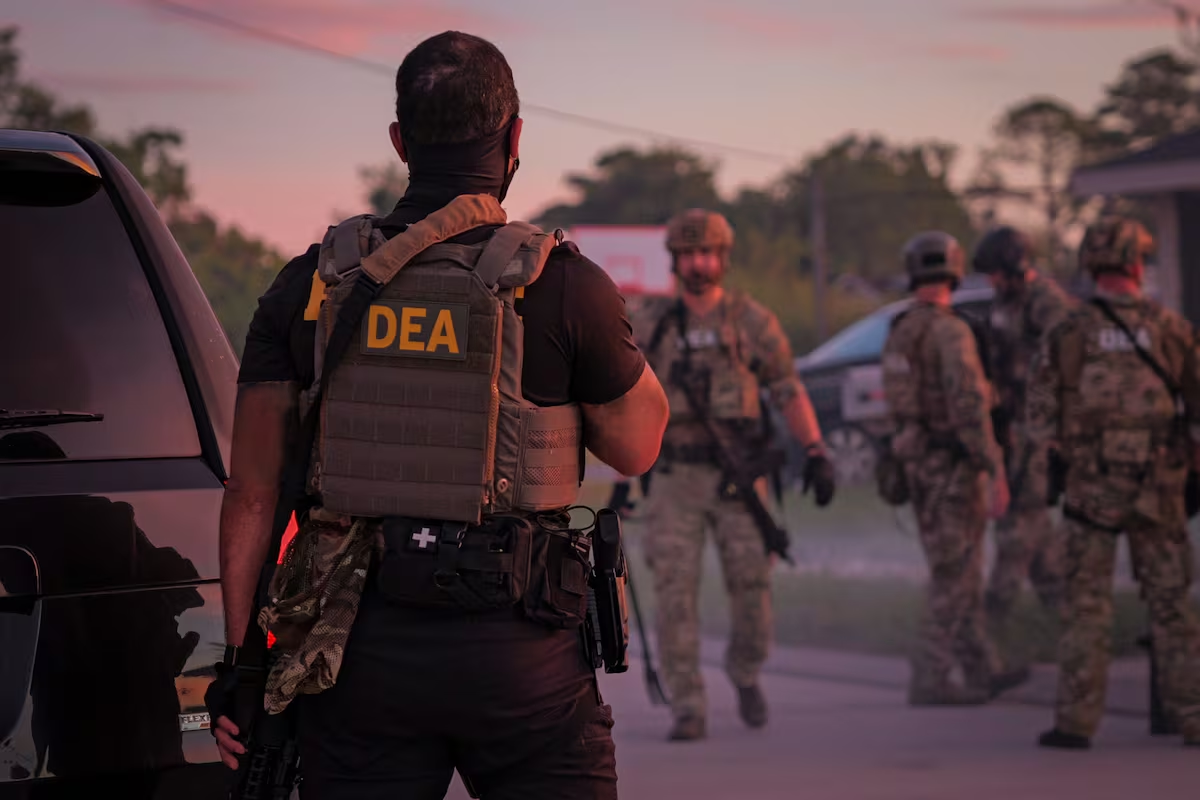

The practice was known as fentanyl walking: “allowing fentanyl to move through.” It was a precise order that agents of the Drug Enforcement Administration (DEA) were supposed to follow while prosecutors attempted to build strong criminal cases against networks involved in distributing the synthetic drug in New Mexico. In at least one operation, they allegedly allowed shipments of up to 74,000 opioid pills to remain in the hands of traffickers. They only monitored them and collected evidence. This occurred in the midst of an overdose epidemic that has claimed the lives of thousands of people in that state. According to testimony from two former DEA agents cited in a report by Associated Press, this controversial strategy allegedly operated between 2023 and 2025, during Joe Biden’s administration and until the beginning of Donald Trump’s second term.
In response to the scandal, Republican Congressman James Comer and New Mexico Attorney General Raúl Torrez have demanded that the DEA and the U.S. Department of Justice (DOJ) provide investigative files, internal communications, and other records related to the policy. Torrez’s request also includes information about its possible consequences for public health in New Mexico, although it will be difficult to determine precisely the extent of the harm this practice may have caused.
“While DEA agents may not have the resources to intercept every single shipment, a policy ordering them not to intercept large shipments is unacceptable and undoubtedly caused considerable harm and loss of life,” Comer said in a statement. The Kentucky congressman, who chairs the House Committee on Oversight and Government Reform, focused his request on the DEA’s actions during the Biden administration, which he accuses of having ignored a DOJ directive requiring agents to immediately seize fentanyl because of its dangerous nature.
Standing by and watching
One of the operations in which anti-narcotics agents limited themselves to monitoring traffickers as they delivered fentanyl pills and received bundles of dollars took place in Albuquerque in June 2023. The drug traffickers sold 74,000 pills at a mobile home park. The agents had tracked the organization’s communications and were prepared to intervene, but they did not. The same network had carried out another fentanyl delivery days earlier, this time hidden inside a spare tire. There was no police intervention in that case either.
“All we did was stand by and watch,” David Howell, a former DEA agent who filed a complaint in 2023 documenting these alleged irregularities, told The Associated Press.
A former DEA supervisor, who spoke with AP on condition of anonymity, said that he and other agents at the Albuquerque office turned a blind eye to “millions” of fentanyl pills that were distributed during an investigation conducted in 2025 and extended across several states.
The DEA has rejected these allegations and maintains that the decisions made during those investigations were “legal,” “reasonable,” and “consistent with the government’s guidelines.” “Public descriptions suggesting that the DEA deliberately allowed fentanyl to reach communities are false and fundamentally misrepresent the facts,” agency spokesperson Amanda Wozniak said in a statement cited by AP.
Another controversy related to the fight against fentanyl has also emerged. The Trump administration’s shift in priorities has reduced criminal investigations into networks dedicated to distributing the synthetic drug and seizures, while agents from Homeland Security Investigations (HSI), a division of Immigration and Customs Enforcement (ICE), have been incorporated into operations to detain undocumented migrants at various points across the country, according to a recent report by the Department of Homeland Security (DHS) inspector general.
More fatal overdoses
The policy of not seizing certain fentanyl shipments in New Mexico has been compared with the disastrous Fast and Furious operation, implemented during Barack Obama’s administration. In that operation, the Bureau of Alcohol, Tobacco, Firearms and Explosives (ATF) allowed more than 2,000 rifles and handguns to be purchased and cross the southern border, but later lost track of most of them. Some of those weapons ended up in the hands of gunmen working for powerful Mexican cartels. One of them was used to kill Border Patrol agent Brian Terry in 2010; another was used the following year in the murder in Mexico of ICE agent Jaime Zapata.
For now, there is no certainty in New Mexico about how many of the pills that were not seized ended up being sold on the streets or, worse, how many may have contributed to fatal overdoses. What is known is that, during the period when the DEA policy was in effect, the state recorded a 21% increase in deaths from drug overdoses, while nationally such deaths decreased by 14%.
“Fentanyl is devastating families throughout New Mexico and we deserve to know the truth about the DEA’s practice of allowing that poison to reach our communities,” state Attorney General Torrez said. Last week, the official filed a lawsuit in federal court in Albuquerque asking a judge to force the Department of Justice and the DEA to disclose all information related to the practice.
According to Torrez, federal authorities have refused to cooperate and have ignored his requests for information. His objective, he said, is to determine who was responsible and bring them to justice. “Instead of being transparent with the public, the Department of Justice is once again obstructing our efforts to clarify this unacceptable practice,” the attorney general complained.
Source: elpais