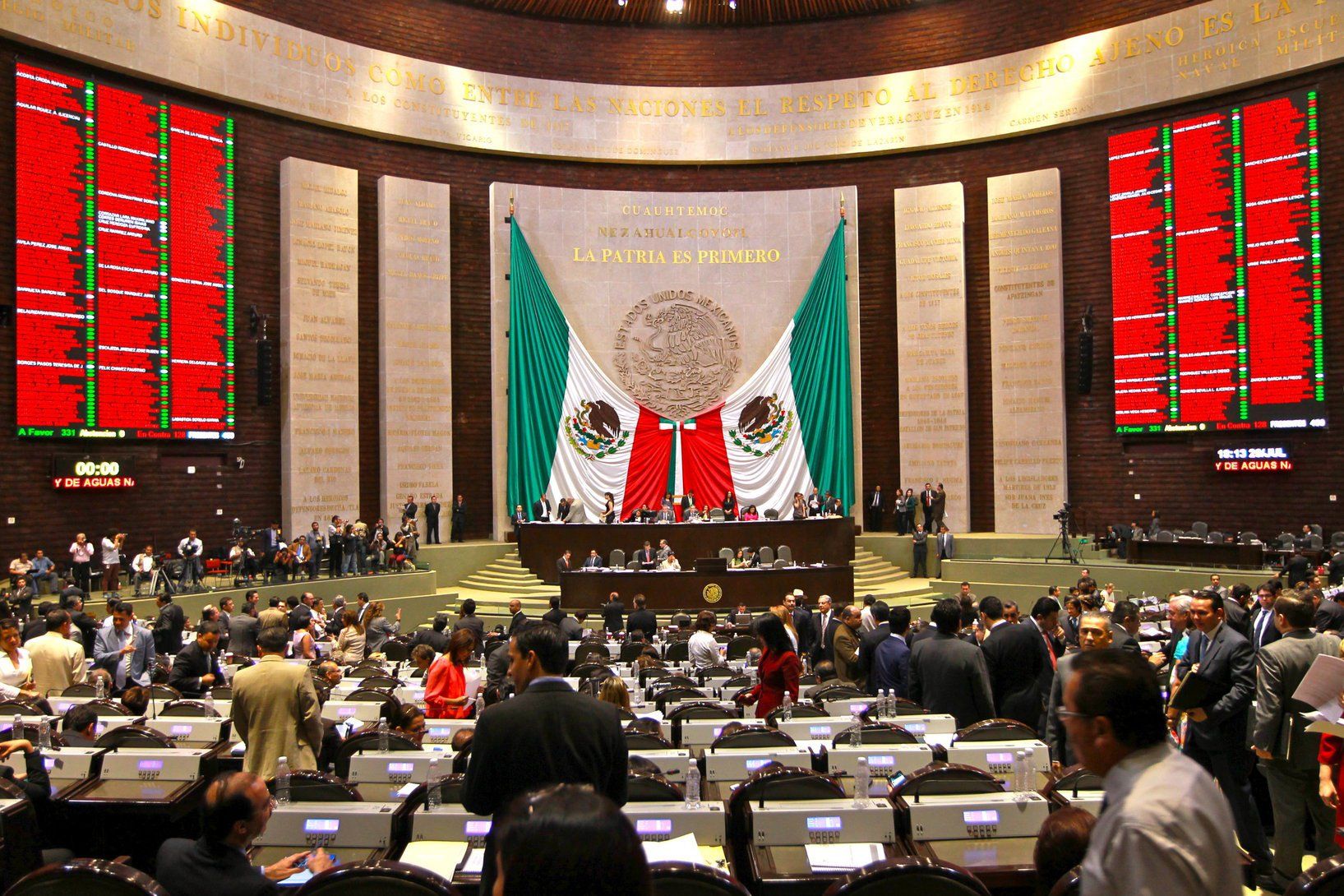

(Spanish CNN) – The federal elections of June 2 in Mexico not only put in dispute the presidency of the Republic, but also the composition of the two Congress cameras is also at stake, in addition to many other positions at the state level and local.
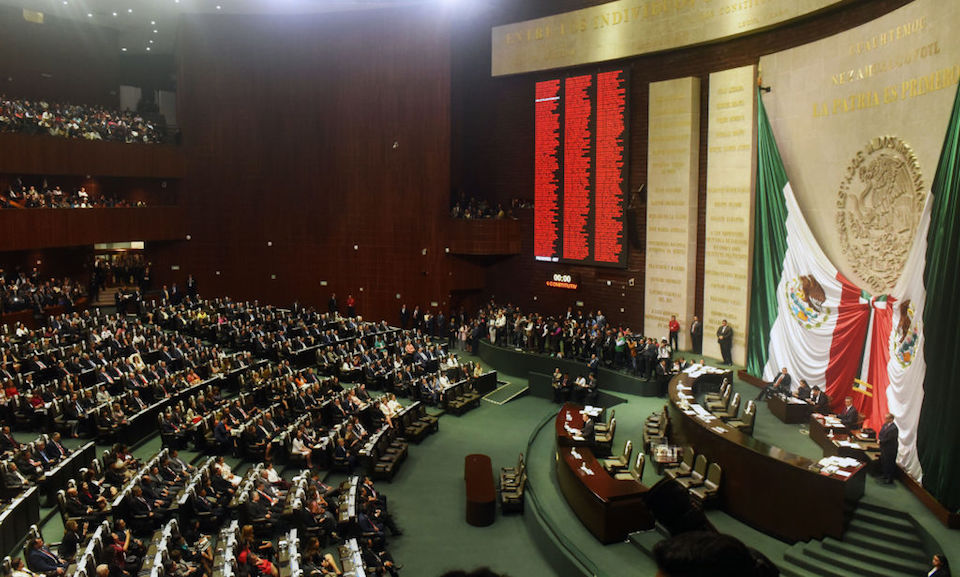
The importance of the conformation of the congress lies – among other things – in the possibility of being a counterweight to the Executive, for example, in the approval of constitutional reforms; as well as in the approach and discussion of law initiatives or decrees.
And although both cameras have the same range, and their main task is the elaboration of laws, there are several differences between them, including their composition, wages and exclusive work of each.
How is the Senate of Mexico and what are its functions?
The Senate of the Republic was born from the hand of the First Political Constitution of the United Mexican States in 1824, in part, to achieve a better representativeness of the states of the Federation.
This institution represents the 32 federative entities of the country – including Mexico City – those who send 3 legislators each, of which two are elected in formula through the popular vote, and a third party that is granted to second place. And the rest of the seats is distributed through the principle of proportional (or multinominal) representation from a list delivered by the matches.
The so -called Upper House is made up of 128 senators. But how are they distributed?
The Morena ruling party, founded by President Andrés Manuel López Obrador, currently has the leadership with 59 seats, not counting five seats of his ally the Labor Party (PT); 8 of the Green Ecologist Party of Mexico (PVEM); and 5 of the Social Encounter Party (PES).
In addition, there are 18 senators of the National Action Party (PAN); 13 of the Institutional Revolutionary Party (PRI); 10 of the Citizen Movement (MC); 5 of the Party of the Democratic Revolution (PRD) and 5 without parliamentary group. These 51 legislators do not necessarily vote united as an opposition block.
The Senators’ Chamber has attribution of initiating laws or decrees, which it shares with the Chamber of Deputies, with the President of the Republic, with state legislatures and even citizens.
But there are two large items in which this organ has exclusive competence: international security and politics.
The Senate has the power to analyze and approve the Annual Report of the Executive Power on the activities of the National Guard, in addition to approved the National Public Security Strategy presented by the President at the beginning of his mandate.
The senators designate the ministers of the Supreme Court between a list sent by the President of the Republic and also appoint the Attorney General of Mexico.
This Chamber is responsible for analyzing the foreign policy of the Executive and approves or modifies the international treaties of which Mexico participates. By the way, senators can make international work trips paid with the treasury.
How does it work inside? The Board of Directors is the governing body of the Plenary and the senator that the presidency is responsible for conducting the debates and signing the laws issued. For its part, the Plural Integration Political Coordination Board promotes agreements to the possible discords. As well as the Chamber of Deputies, the Senate has commissions that dispatch issues according to the subject.
Except when the Executive Power is renewed, the senators work during two types of periods of sessions: the ordinary, from September 1 to December 15; and the extraordinary, from February 1 to April 30.
The Senate headquarters is located on Paseo de la Reforma Avenue, one of the most emblematic of Mexico City.
And how is the Chamber of Deputies formed?
The roots of the modern Mexican Congress and even the origin of federalism date back to the Constitution of Cádiz of 1812 – in which positions of provincial councils elected by suffrage were established for the first time – and to the insurgent Congress of Chilpancingo of 1813. that is, The deputy figure precedes that of the senator.
Once as an independent nation, it was the constitutions of 1824 and 1917 that have shaped the Chamber of Deputies that we know today.
The Legislative Palace of San Lázaro has 500 deputies, 300 of them chosen directly by the popular vote, while the others are distributed through the principle of proportional representation. Applicants who are at the beginning of party lists are more likely to reach one of those 200 places as long as their party achieves more than 3% of the valid vote cast. The voter can consult the names of the plurinominals to the reverse of the voting ballot.
The president of Mexico unsuccessfully proposed to eliminate those 200 seats of multinominal deputies so that the figure is reduced from 500 to 300 legislators. A similar proposal raised for the Senate, in which in addition to the plurinominals, the seats occupied would be eliminated through the concept of first minority, so they would go from 128 to 64.
Article 15 of the General Law of Electoral Institutions and Procedures (Legipe) establishes that “no political party may have more than 300 deputies for both principles.” This implies that a majority party could not approve constitutional reforms, which require a qualified majority, without the support of other political forces.
The majority parliamentary group is that of the official Morena, with 202 deputies; followed by bread (111); PRI (70), Green Party (41), PT (33), Citizen Movement (28), PRD (12) and 3 deputies without party.
Unlike senators, deputies are in office for a period of three years; although they can be elected by up to four consecutive periods. This Chamber also has a Board of Directors and a Political Coordination Board.
One of the exclusive powers of this Chamber is the approval of the Expenditure Budget, as well as the review of the expense (public account) through the Superior Audit of the Federation.
During the recess of the Congress there is a permanent commission with 37 members as a whole: 19 deputies and 18 senators.
How much do Mexican senators and deputies win?
Senators receive a net amount (after discounts) of about US $ 7,500 (126,955 Mexican pesos) for the monthly diet (salary) concept, according to the information reported by the Senate on the national transparency platform until the last quarter of 2023 .
They also receive other concepts such as Aguinaldo, whose net amount amounts to almost US $ 14,500 annually (243,117 Mexican pesos). Plenary members also have social security benefits.
On the other hand, the deputies earn just over US $ 4,500 nets per month for diet (75,763 Mexican pesos), according to information from that chamber in force last February. While the annual bonus perceives US $ 8,370 net (140,504 Mexican pesos).
Source: cnnespanol