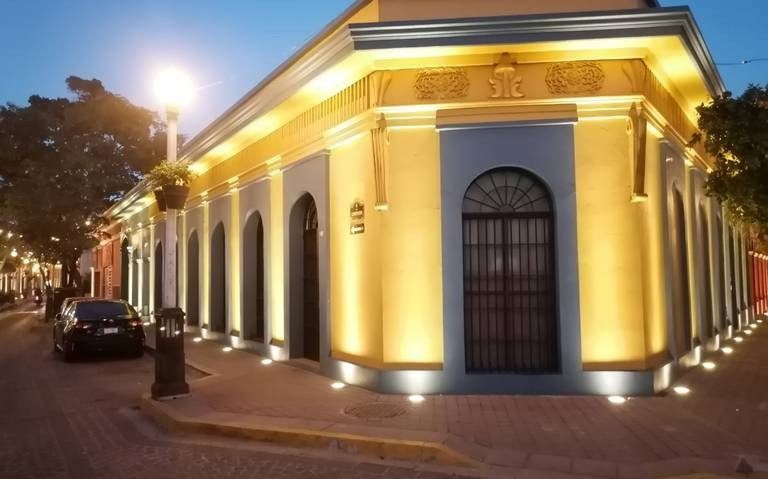

The purpose of public lighting is to illuminate streets and sidewalks, but some luminaires emit light above the horizontal line, illuminating the night sky and contributing to what is known as light pollution
Mazatlán, Sin.- The artificial brightness in the city increases every year, because in addition to pollution from solid waste or noise, in the port there is another type of pollution that is little or not talked about: light pollution.
This is generated by light emissions that come from artificial sources with high intensity, which can cause havoc on health and ecological imbalance.
With the flag that an illuminated neighborhood is equal to a safe neighborhood, year after year the authorities have promised to improve the public lighting of the city, however, today this public service in Mazatlán remains obsolete and inefficient.
At the end of 2023, it was estimated that 40 percent of the public lighting network was not working. Complaints about dark streets are a constant, while spaces where lighting is not necessary, at least at certain hours of the night, disturb the comfort of different species of fauna.
Sodium vapor for LED light, yellow light for white light, is the idea of a more and better illuminated Mazatlán, but is it efficient? Is it the most appropriate? Is it sustainable?
At the end of 2022, the current administration began the Public Lighting Conversion program, which consists of replacing sodium vapor lamps with LED lamps; At first, businessmen donated the pieces, then the City Council acquired 10,000 and 13,000 lamps between 2023 and 2024.
“They considerably reduce power and light pollution because it is considered a LED technology with the best standards on the market,” says the Public Lighting Department in response to a request for information that was made.
They illuminate beautifully, but they are not the recommended ones
David Esquivel Hernández, president of the Mazatlán Astronomical Association, pointed out that the LED light that is usually purchased is a very white light, with a high color temperature, from 6000 to 7000 Kelvins, a very intense and dazzling light that illuminates beautifully, but should not be used.
“The recommendation is that the light be of low temperature and tend towards orange tones, warmer lights than cold lights, even red lights, they do not generate a chain effect or affect birds, it is the healthiest light to use with the environment,” he said.
The objective of public lighting is illuminating streets and sidewalks, but due to the design of some luminaires, light is emitted above the horizontal line, illuminating the night sky and contributing to what is known as light pollution.
This type of luminaires can be seen on the boardwalk and the Historic Center, with a spherical design that projects light in all directions, as well as the floor lamps for sidewalks located in this polygon.
“All lights should have a protective hood that prevents the light from dispersing upwards, you only have to illuminate below,” he added.
The reconversion of public lighting should be more than just replacing sodium vapor with LED, rather, it requires a redesign of the service and there are lamp posts that are so high that on the median strips of avenues they get lost among the foliage of the trees, and it also disturbs the birds that rest there.
“On Avenida Ejército Mexicano, try to be pedestrians. You want to cross there at eight o’clock at night and no one sees you. It is poorly lit. The light is between the trees. You can’t see it well and it wears out because you have to turn it on. It illuminates poorly and doesn’t serve its purpose. Public lighting needs to be redesigned,” he said.
Light pollution
In Mazatlán, a growing city, the level of light pollution has not been measured, but it would be an interesting exercise, said Esquivel Hernández.
He explained that in astronomy the Bortle scale is used, which measures the brightness of the night sky with nine levels, level one being the darkest skies and level 9 being the brightest sky.
Mexico City is an example of a night sky with a high level of brightness, that is, it is on scale 9 and can never get out of there. There are fewer and fewer areas where light pollution is at number 1, you would have to travel several kilometers in the middle of nowhere to find completely dark skies, in a more encouraging scenario, the ideal would be to be on a scale between 2 and 3.
“There are a series of guidelines about public lighting that has to do with light pollution and the key concept here is ‘intrusive light’, which is that which is out of control, that is, if you want to illuminate a street you have to make sure that the light is directed to the lighting of that street, that light should not enter through people’s windows or should not interfere, for example, in parks.”
According to the General Law on Ecological Balance and Environmental Protection, intrusive light is part of the light from an installation with a lighting source that does not fulfill the function for which it was designed and does not prevent light pollution, that is, the light that is projected in various directions outside the terrestrial area to be illuminated.
It is also mentioned that in order to achieve the prevention, reduction and control of light pollution in the atmosphere, it is necessary to preserve as much as possible the natural conditions of night hours for the benefit of fauna, flora and ecosystems in general; reduce light intrusion in areas other than those intended to be illuminated, mainly in natural environments and inside buildings and promote the application of new technologies to those responsible for the polluting sources.
Intrusive light
Mazatlán’s Central Park is a highly illuminated park, a nesting area for birds: the public lighting remains on all night, even though there is no public entry after 10:00 p.m.
The Mazatlán boardwalk, a nesting area for sea turtles, in addition to public lighting, there are other sources of light pollution such as the lights of hotels and apartment buildings, and screens or illuminated billboards, both of which are not regulated.
The sources of light pollution can also be mobile, in this case rental vehicles; it became fashionable to decorate lungs with colored LED lights; they are also not considered within the regulatory framework.
Effects of light pollution
- It alters the circadian cycles of people and animals
- It can cause disorders, such as insomnia due to little exposure to darkness
- It makes astronomical observations of celestial objects difficult
- Excessive energy consumption
Source: elsoldemaztlan