
The Rueda Designation of Origin was created in 1980; however, the Verdejo grape, the emblematic strain of the region, has grown in the municipalities of Castile and Leon that today make up this territory for more than ten centuries. Knowing this long history is certainly pleasing, but what is really surprising is hearing it during a tour of Xochimilco. On board the trajinera, we are accompanied by Santiago Mora, General Director of the Regulatory Council of the D.O Rueda, who has traveled to Mexico on the eve of World Verdejo Day and to continue building a close relationship between Rueda wines and the national public.
Santiago tells us that the Mozarabs introduced Verdejo to Castile and Leon and that Dorado, a wine made with this strain in the 14th century, was the favorite of Isabel of Castile and Fernando of Aragon, the Catholic Monarchs. Between ahuejotes and apantles, on the waters where the axolotls still survive, the relationship between these wines produced on the other side of the Atlantic and one of the last strongholds of the ancient Anáhuac seems distant. However, the moment the first bottle of Rueda wine is uncorked, the doubts begin to clear up.
In both Xochimilco and Castilla y León, you have to go back to the source to discover what makes a product outstanding. Santiago explains it clearly by mentioning that the sandy soil, as well as the presence of pebbles, are part of the unique characteristics of the D.O. Rueda, which are expressed in the quality of the Verdejo grape. Of course, the climate and the human hand have also been fundamental in the formation of the identity of Rueda wines, elements that it shares with the lake area of Xochimilco because it also has soils that were transformed over generations in favor of agricultural development and the creation of chinampas.
To continue connecting the dots that unite the D.O. Rueda with Mexico, we head to the chinampa of the Xochimilco a Color ecotourism project. On the way, aboard the trajinera, they serve quesadillas, tortilla chips with guacamole and sopes made with corn grown by local producers. And while the Xochimilco a Color team introduces us to the historical and ecological importance of the chinampa area (considered a World Heritage Site and part of the list of Ramsar Sites for its great environmental value), we accompany the food with Blume Verdejo Selección 2020, from the Pagos de Rey winery. Its acidity and notes of citrus and dill pair perfectly with the spicy and herbal flavors of Mexican food, and that is when the other reason why Rueda has called us is revealed.
Mano a mano
That Mexican food can be accompanied with wine is nothing new. However, there is a belief that only barrel-aged red wines are capable of “withstanding” the spicy, robust and spiced flavours of the national gastronomy. The reality is different, or at least it allows for new interpretations, as we confirmed during the tour of Xochimilco with Santiago Mora and Rueda wines.
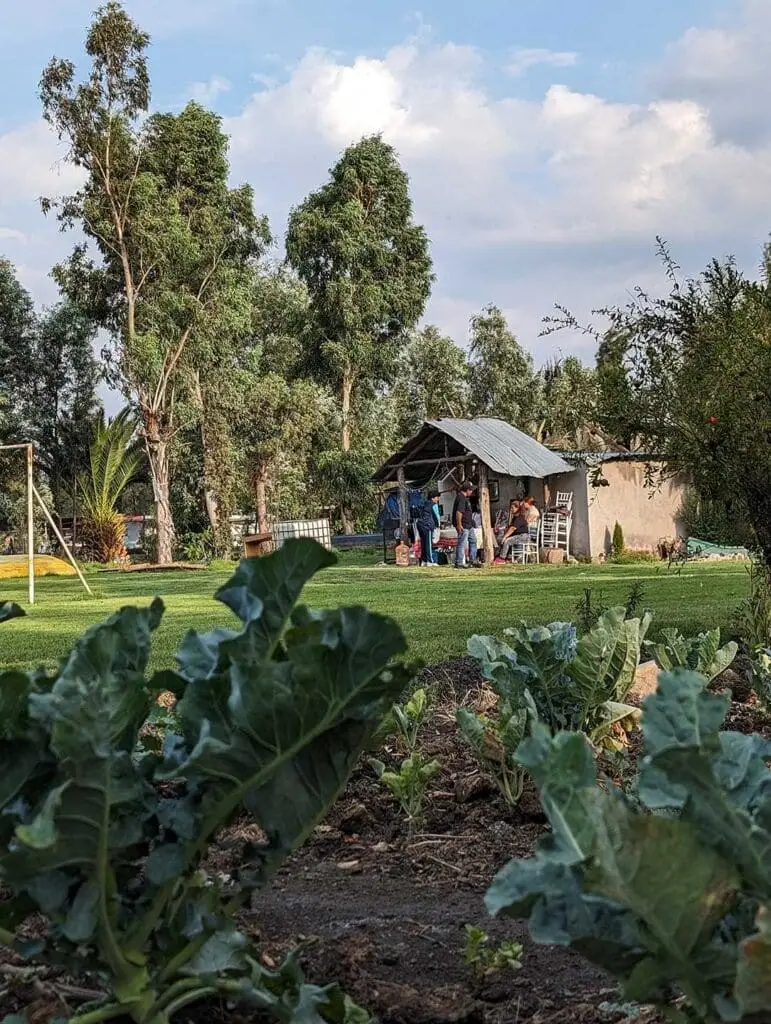
At the edge of a brilliant sunset, we arrived at the chinampa of Xochimilco a Color, a fragment of the mosaic in shades of green that complete the thousands of “floating gardens” in this sector of Mexico City, an orchard in the middle of the metropolis. In its fertile land they plant vegetables, corn and flowers using the chapines method and in accordance with agroecological techniques, an activity that they complement with the possibility of making visits, camping and private meals.
There, meters from the calm water, they offer us a tasting of Mexican specialties made with ingredients from the surroundings, which we pair with the refreshing Rueda wines.
In the middle of a pleasant conversation, a huauzontle bathed in red mole arrives, a grilled fish wrapped in corn leaves and an amaranth cake that we pair with labels from the Marqués de Cáceres, Marqués de Riscal and Bornos wineries. In addition to confirming that, in effect, the acidity, body and juiciness of Rueda wines complement the taste profile of Mexican food, we discover the great versatility of the Verdejo grape, which, depending on its origin, treatment and climate, can provide different sensations without losing its essence.
Rueda wines as an example
Night falls, but the meeting drags on, allowing Santiago to share more interesting information about Rueda wines. We learn that one in two bottles of white wine sold in Spain comes from this Denomination of Origin, the most sought-after in the Iberian country, and that one of the reasons is the excellent quality-price ratio of its labels. Furthermore, according to studies carried out by the Regulatory Council, the conversion rate of Rueda wines is 65%: more than half of those who try its labels become loyal consumers.
Before leaving for the nocturnal quiet of the canals, Santiago Mora offers us a reflection on the additional benefits brought by the creation of areas with a designation of origin. In addition to producing greater income, the protection of indigenous goods and their production methods opens up new employment opportunities for young people to remain in rural and agricultural areas, integrates members of several generations into economic work and attracts the public to areas with exceptional features. According to the cases he has witnessed in Europe, these appointments not only revive the people, but also strengthen their roots.
This consideration echoes the still risky situation of the chinampa zone of Xochimilco, always threatened by the advance of urban sprawl, water requirements and the abandonment of its traditional cultivation areas. It seems to think that the solution may be found, unexpectedly, at the bottom of a glass of verdejo wine.
Source: foodandtravel