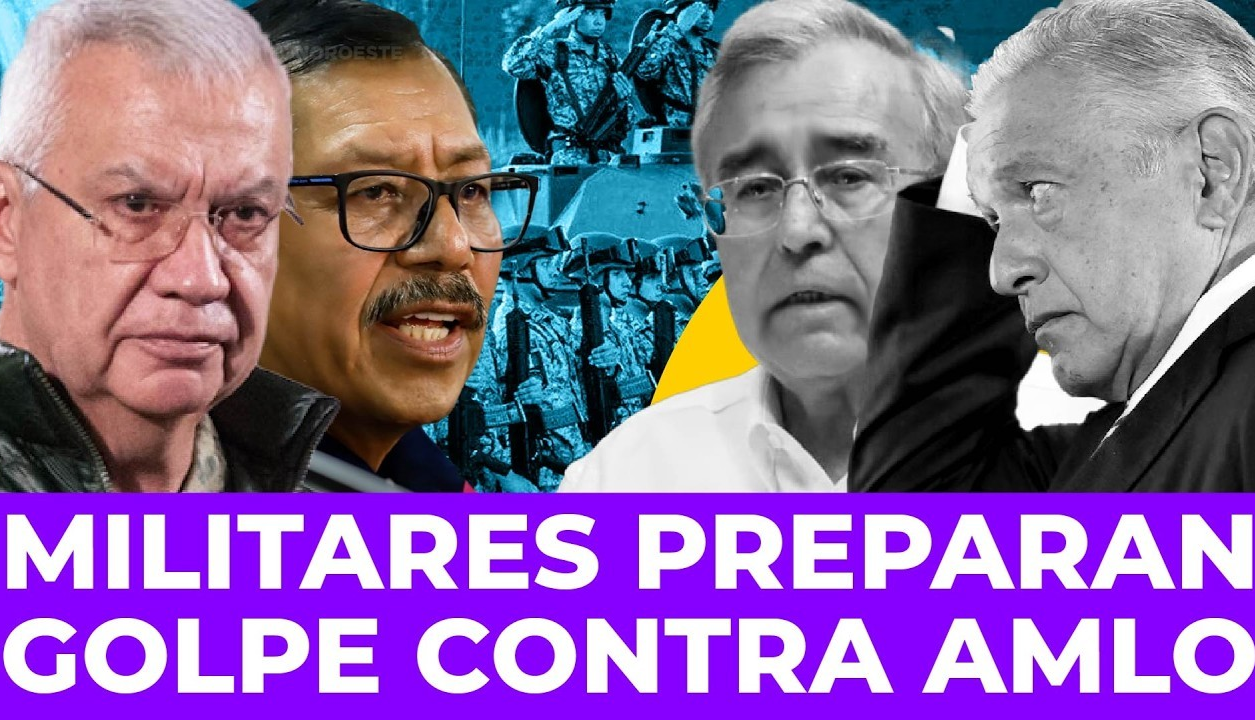

Mexico’s political and security landscape has entered a phase of extreme tension, a crisis of historic proportions that appears to be dismantling the foundations of the administration that came to power promising a radical transformation. What for years had been the subject of suspicions, rumors, and independent analysis is now materializing in judicial cases in the United States, where American authorities are not only targeting the political elite, but are also beginning to penetrate, with surgical precision, the structure of the Armed Forces. The arrest of high-ranking generals and the publication of reports alleging links to organized crime have raised a question echoing through the halls of power: where do Mexico’s Armed Forces stand as an institution?
A growing theory within intelligence and political analysis circles is deeply troubling. It suggests that the rise of the outgoing administration was not achieved without support, but rather through a strategic alliance in which organized crime played a decisive role. Under the banner of a security policy known as “hugs, not bullets,” an alleged non-aggression pact and tacit coexistence may have emerged, allowing criminal groups to operate with near-total freedom in exchange for maintaining political stability and ensuring the continuity of the ruling regime. This symbiosis not only eroded the State’s capacity to combat insecurity, but also initiated a profound corrupting effect within military institutions.
According to analysts, the dismantling of the control mechanisms that historically kept the military away from the temptations of civilian administration — specifically the constitutional limitations on military activities during peacetime — marked the turning point. By granting the military control over ports, airports, customs offices, infrastructure projects, and various collateral businesses, political power was not merely seeking operational efficiency; it was allegedly seeking co-optation. The logic appears to have been simple: if the Armed Forces were occupied managing businesses and collecting revenues, they would not interfere with organized crime and, in turn, would protect the regime from any threat to its continuity.
Comparisons with institutional degradation processes in other countries, such as Venezuela and the so-called “Cartel of the Suns,” have become increasingly frequent and uncomfortable. In that case, the military hierarchy effectively became the structure managing illicit activities under the protection of military authority. Experts now fear that Mexico may be moving down a similar path, observing with alarm how U.S. authorities have accused generals not only of accepting bribes, but also of providing privileged information to cartels about security operations. At its core, this represents betrayal from within: commanders allegedly warning criminal organizations about troop movements to prevent arrests and ensure impunity for criminal operations.
The case of General Gerardo Mérida, arrested in the United States alongside former Sinaloa Finance Secretary Enrique Díaz Vega, is presented as a striking example of this level of infiltration. According to these allegations, they were not merely recipients of money; they were active operators who knew exactly what security decisions were being made and allegedly worked to neutralize any genuine effort to combat drug trafficking. In this scenario, organized crime dictated the rhythm of the security agenda, while public officials, including military commanders, acted as agents within the system.
In light of this situation, the stance of the Armed Forces as an institution has become the central question. Many citizens and analysts believe that within the complex military structure there remains an institutional faction loyal to the Constitution and republican principles, one that watches with horror as the institution’s prestige is dragged down by the ambitions of a few commanders. This segment of the Armed Forces — still loyal to the country above any political party or leader — now faces perhaps the greatest crossroads in its history: to speak out, distance itself, or risk being swept away by the collapse of a political system shaken by pressure from the American justice system.
International pressure, led by the DEA and reinforced by strong statements from high-ranking officials in Washington, appears to have moved beyond the stage of diplomatic warnings. The message from U.S. authorities has reportedly been clear: “Washington expects the Mexican government to step forward so that we do not have to.” This pressure, in the context of a U.S. election cycle, has placed the Mexican government in an extremely difficult position. The political calculation by Mexican authorities to underestimate the influence of external factors, even in the face of a possible change in administration in Washington, is increasingly viewed as a risky gamble that could have catastrophic consequences for national stability.
The continued insistence on the “hugs, not bullets” policy and the refusal to modify a strategy that critics argue has shown clear structural failures have created a growing disconnect from the security reality faced by Mexicans. Official responses to accusations of criminal infiltration are often based on denial, but the evidence reportedly presented in U.S. indictments suggests that American authorities possess detailed information about corruption in Mexico that makes government denials increasingly difficult to sustain. This includes allegations concerning illicit financing, ties between officials in Sinaloa and the country’s central political leadership, and the active participation of military commanders in operations protecting criminal organizations.
The remaining question is what will happen if U.S. investigations move toward the highest levels of the political hierarchy. If the extradition or prosecution of state officials was only the beginning, what comes next? Who might break the silence if captured or extradited? Mexican politics is reportedly in a state of intense anxiety. There appears to be an effort to buy time, delay extraditions, and negotiate protections, while the judicial machinery in the United States seems determined to pursue the matter to its fullest extent.
It is undeniable that Mexico finds itself at a crossroads. The national project that was presented as a transformative change of regime now faces the harsh reality of criminal infiltration that appears to have penetrated deeply into security institutions. The loyalty that military commanders may have shown toward an individual or political project is now being tested against the loyalty they owe to the Constitution. In the coming weeks and months, the decisions made by military leadership and the actions taken by international justice systems could shape the destiny of a nation urgently needing to recover its dignity, security, and rule of law.

Complicity is no longer merely an open secret; it has become part of judicial proceedings. History may judge not only those who allegedly associated with organized crime to gain power, but also those within institutions who allowed institutional integrity to be dismantled in pursuit of personal ambitions and illicit business interests. The decline of this alleged model of complicity will not be simple, but many now see it as inevitable. Meanwhile, Mexicans continue to watch closely, hoping that the military institution can ultimately cleanse itself and that the truth, however painful, can become the starting point for a reconstruction that today still seems distant.
If an institutional rebellion were ever to occur, it would not emerge from the streets or from political declarations, but from the conviction that military honor cannot survive subordination to organized crime. The true rebellion would be the return of the Armed Forces to their constitutional mandate, distancing themselves from any particular or partisan interest and genuinely serving the peace and security of all Mexicans. Many believe this is the only path to saving institutions and restoring citizens’ confidence that the State alone holds the legitimate monopoly on force and remains the sole guardian of national sovereignty.
The time for evasions appears to be over. Recent events have demonstrated that regardless of speeches or political alliances, reality eventually imposes itself through justice systems. The current crisis represents an opportunity for the Mexican State, its institutions, and its political class to look in the mirror and recognize that a model of governance allegedly based on tolerance toward organized crime has failed dramatically. Rebuilding trust will be a long and painful process, but a necessary one. Mexico deserves more than a regime accused of negotiating with the shadows; it deserves transparent institutions, armed forces devoted to the nation, and a future free from the influence of those who, according to these allegations, have betrayed the trust of millions from within the structures of power.
Source: trendingnews24