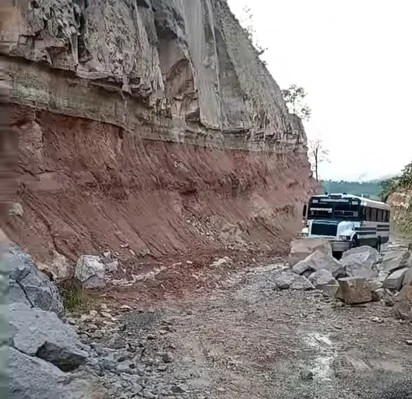

An example of this is the stretch from Guajolota to Durango, which before reaching the community of Santa María de Ocotán has landslides of different magnitudes that make transit difficult for all vehicles.
In this stretch, the inhabitants of the area complain that it seems “more like a stream than a road” and that if it takes less than 10 minutes between the communities, it takes up to 40 minutes more due to the obstacles.
Although there is paving in most of it, it is totally destroyed
They improvise roads
When a situation like this occurs, it is the community members themselves who agree to remove the stones, the smallest ones with their hands, in the case of the large ones they drag them with trucks.
They have to improvise, because if they wait for the authorities to arrive, it will take days or even months.
The risk is greater when traveling on parts of the road that are attached to cliffs, because it is necessary to avoid them.
Damage to vehicles
Even for the bus routes that leave Guajolota for the capital, they have to deal with different problems on the way, where passengers collaborate to be able to continue their trip.
In addition to the stones from landslides and the mountains of earth, in other parts there are holes that cause tires to go flat, something they also have to deal with.
The damage to the vehicles is for all those who circulate there, it does not matter if they are trucks, vans or cars, the affectation is general.
Residents report another important road that is Mezquital-Temoaya-Santa María, where the poor condition also makes the transfer time longer.
Source: elsiglodedurango