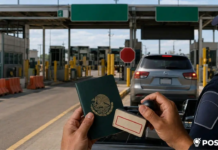


Starting this week, dog owners will have to go through a lot more paperwork to bring their pets into the United States, including those crossing the border from Mexico.
Under new rules from the U.S. Centers for Disease Control and Prevention (CDC), which went into effect Thursday, dogs coming into the United States from Mexico and Canada must appear healthy upon arrival, be at least 6 months old, have a microchip that can be detected with a universal scanner and be accompanied by an import form.
The news has caused some confusion on both sides of the California-Mexico border and has created an urgency among many dog owners to quickly microchip their pets, a practice uncommon south of the border.
“CDC import requirements apply to all dogs, including those leaving the country for short trips, such as to visit family or friends, or to receive veterinary care,” a CDC spokesperson said.
Since the requirements are primarily designed to prevent the reintroduction of canine rabies, the rules travelers must follow will depend on where the animal has been in the past six months. Dogs from a country considered rabies-free or low-risk, such as Mexico or Canada, have fewer requirements than dogs from high-risk countries. The list of high-risk countries can be found on the CDC website and includes several regions in Latin America, Asia, Africa and the Middle East.
It was unclear whether other documents, such as a rabies vaccination certificate, would still be necessary under the updated requirements. For years, dogs have been required to be vaccinated against rabies three months before entering the country, so it was common for border travelers to carry vaccination certificates as proof.
Dog owners who complete the form will receive a shipping receipt that they can present to border officials and airlines, either as a printout or a screenshot on their phone. The receipt can be used for multiple entries over six months, as long as the dog has not been in a high-risk country during that time. Each dog must have its own form, officials said.
Customs and Border Protection said this week that wait times at the border would not be affected by the changes.
“CBP in San Diego will not be checking for microchips, and we do not expect wait times to increase as a result of the new regulation,” spokesman Wilson Portocarrero said. He added that officers likely won’t question every dog owner who goes through the line, but that travelers should be prepared.
“However, I caution travelers that if a dog appears to be visibly ill it would be cause for concern, and officers may open additional lines of questioning that may delay that traveler as a result,” he said.
In Tijuana, a binational nonprofit has begun microchipping dogs at low cost to help owners comply with the new rules. Cynthia España of Dog Rescue Without Borders said last week that of the more than 30 microchips they have recently put on dogs in Tijuana, all were because their owners wanted to bring them across the border.
“She is my companion dog,” said Tijuana resident Ana Laura Galicia, who recently had her Chihuahua microchipped. “We go for walks more in the United States than in Tijuana because there aren’t many dog parks here.”
Galicia said that while she had previously considered the idea of microchipping her pet, it was the CDC announcement that made her act.
España noted that before the new border rules were announced, it was rare to see dog owners in Tijuana microchipping their dogs, so she believes the changes will ultimately be positive, especially for lost dogs.
She added that there won’t be any major changes for the nonprofit because for the past 10 years, all rescued dogs sent to the U.S. for adoption have been microchipped in Mexico. However, she said they used to send dogs to the U.S. starting at 4 months old, but now the minimum requirement is 6 months.
The rule changes have been most controversial along the U.S.-Canada border.
Earlier this month, a bipartisan group of 14 senators from northern border states sent a letter to the CDC, stating that their constituents have expressed concern about the “burdensome effects of this rule” and sought to obtain an extension “until a regulation can be drafted that adequately protects public health and allows for the importation of dogs from Canada and other low-risk countries.”
Days later, the CDC said it streamlined the process for dogs arriving from rabies-free or low-risk countries.
Canine rabies was eliminated in the United States nearly 20 years ago, but CDC officials said the new guidelines “will address recent challenges seen with international dog imports, including challenges posed by fraudulent documentation and dogs housed in unsafe conditions.”
“The rule will also align more closely with the World Organization for Animal Health standards for the international movement of dogs from rabies-endemic countries,” the CDC added.
Source: sandiegouniontribune