

The Mexican government’s official discourse on migration is one of compassion and empathy, with President Andrés Manuel López Obrador insisting on addressing the root causes that force people to flee their countries. However, the reality in southern Mexico paints a very different picture.
The migration policies that have been implemented in conjunction with the United States have turned Mexican territory into a minefield, an invisible wall, where migrants are not only rejected, but at every step they are also trapped in an endless cycle of vulnerability and forced displacement.
Especially southern Mexico has become a scene of humanitarian crisis, the limbo of migration policies imposed by the United States, and accepted by Mexico.
The objective is evident that it is the migrants themselves, tired and completely demoralized by their attempts to reach the United States, who undertake on their own, the return to their countries from where they are precisely fleeing the hell of political repression and crime.
In recent years, expulsions of non-Mexican migrants from the United States to Mexico have increased considerably. This migratory flow, driven by policies such as the Trump administration’s Title 42 and new measures under the presidency of Joe Biden, has placed Mexico in an uncomfortable and contradictory position.
Despite promises to respect human rights, Mexico has accepted thousands of migrants returned under questionable circumstances without transparency.
The background to this situation dates back to the implementation of Title 42 in March 2020, a measure that, under the pretext of protecting public health, authorized the immediate expulsion of people in an irregular migratory situation who arrived in the United States.
Although this policy was justified as a response to the pandemic, its true purpose was to stop the migratory flow to the north, without offering migrants the opportunity to request asylum, a fundamental right under international law.
When Title 42 ended in May 2023, instead of ceasing expulsions, the United States and Mexico agreed to continue a similar process, but now under Title 8. This means that expedited deportations continued, this time with the difference that those expelled would face a five-year ban on entering the United States.
The Mexican government, for its part, has played a crucial role in this process, accepting thousands of migrants of various nationalities, from Venezuelans to Haitians, without guaranteeing them regular immigration status or the possibility of requesting asylum in Mexican territory.
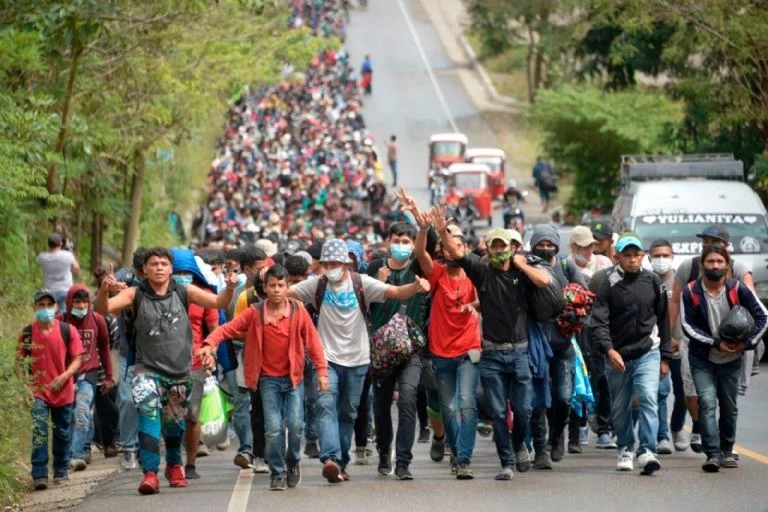
The situation in the southern states, such as Veracruz and Tabasco, is especially alarming. Thousands of people are relocated from Mexico’s northern border to cities such as Villahermosa, Tapachula, and Acayucan, in an effort to “depressurize” the border areas.
However, these relocations not only involve physical displacement, but also represent a deliberate strategy of attrition. Migrants are released in unknown cities, without resources, documentation or guidance on their rights, which leaves them in a situation of extreme vulnerability to organized crime and extortion by immigration agents.
The López Obrador administration has allocated millions of pesos to these relocations, while the budget of the Mexican Commission for Refugee Assistance (Comar), which should be at the forefront of protecting migrants’ rights, remains ridiculously low.
This disparity in the use of resources reflects an immigration policy that prioritizes control and containment over the protection and dignity of migrants.
The lack of transparency and the absence of a clear legal framework for these expulsions and relocations aggravate the situation. Neither the United States nor Mexico have published formal agreements explaining the terms of these policies, which has created a vacuum of responsibility and a climate of impunity. Migrants returned to Mexico are trapped in a legal limbo, without the possibility of regularizing their situation or returning to their countries of origin safely.
A report by the Institute for Women in Migration AC (IMUMI) reveals that groups of migrants are transferred from the United States to northern Mexico by land. Once in Mexican territory, immigration agents detain them and transport them by bus or plane to the south of the country.
This information is supported by flight tracking observations and internal data from the National Institute of Migration (INM), which document the relocations.
In addition, it confirms the intention of INM officials to “depressurize” the northern border cities by moving people south, mainly to Villahermosa, Tabasco; Tapachula, Chiapas; and Acayucan, Veracruz.
The expelled non-Mexican population has raised its voice against deportations from the United States and “hot deportations” in Mexico, which expose them to risks of violence from both organized crime and Mexican authorities, in their repeated attempt to return to the north of the country.
Southern Mexico has become a scene of humanitarian crisis, where the migration policies imposed by the United States, and accepted by Mexico, have created an invisible wall that traps thousands of people in a cycle of expulsion and displacement.
It is urgent that both governments recognize their shared responsibility and put an end to these practices that violate basic human rights. It is not just about complying with legal obligations, but about restoring a minimum of humanity in the treatment of those who, in their desperation, seek a safe refuge.
Source: lasillarota