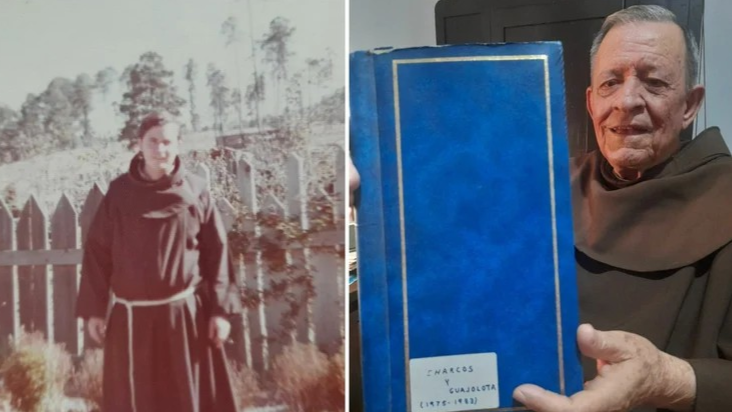

From his eight years of service as a missionary in the mountains, he brought together in images various landscapes, portraits, moments of daily life, activities and customs, but above all the essence of the O’dam people, outside of the stereotypes with which they have sometimes been wrongly labeled or even discriminated against.
Of the five indigenous ethnic groups in Durango, the largest in population corresponds to the Tepehuanos or O’dam people, who live mainly in the El Mezquital mountain range and another part in the municipality of Pueblo Nuevo, but there is ignorance about this culture even among the Durango people themselves.
There are few mestizo people or “Nabat”, as all those who are not from the community are called, who have earned the trust of the Tepehuanos and can say that they have thoroughly understood the culture and idiosyncrasy.
Fray Columbano, despite the fact that it was years ago when he was in the indigenous area, has an excellent memory and walked through part of the mountains to reach many communities, which he considers positive because it helped him get to know the people, who in most cases he remembers even by name.
“I think I did get to know the people well and became very fond of them. I was ordained on September 14, 1974. I arrived in the town of Charcos, in Mezquital in September 1975. It was the largest sawmill. There were mestizos and indigenous workers. One of my first steps was to go to the Xoconoxtle community to celebrate a wedding. The man’s name was Alberto Aguilar and his wife was Celia.
As for religion, people in the communities were not very close. In Charcos there was a priest who at that time had a lot of affection for the people and had a welfare vision. He tried to get medical help and visit families from other places.
At that time there was only one jeep, one brother who drove it, so we traveled by horse in logging trucks or we traveled to communities on horseback or on foot on the Santa María side. On one occasion I broke my ribs when I fell from a horse. On another occasion, from Charcos to Canoas, I was injured. I lost, I was scared but in the end I did arrive. In 1978 I went to live alone in La Guajolota.
The truth is that there were hard times, because at first there was rejection, not because I was a priest, but because I was ‘Nabat’, but that happens everywhere, for example it also happened when I was in Africa, but after they had confidence they included me in their celebrations or asked for help, for example near the Laguna del Burro community, they asked me to ‘run the soul’, that day was very tiring, I was far away and then on the way back, during the journey it included about 35 minutes through a ravine. To do the service I brought holy water and prayed so that the soul would no longer be suffering, that was when they asked for it, that under their customs they tried, but they said ‘I cannot run this soul’.
I also witnessed important celebrations like the ‘Mitote’, where even the smallest ones gather. Or when they have to fulfill certain commandments or celebrations for the Saints, when the family in charge of the celebrations has to raise money for everything, that day people ate everything, broth, tamales, you could see crowns, rockets, everything with effort and sacrifice, we ate very well even the missionaries. There is an atole that I had the chance to try, very good.
Before, the houses of the friars were known as convents, now they are known as curates, because they say that it is the house where the priest lives.
I did have to leave some communities because there was division in groups, some that did not accept that we were there. Since then I was bad at sleeping, I remember in a community where the house was already full, we slept in a little doorway where there were some boxes, I heard buzzing, but until the morning we realized that they were bees, but they did not sting us. Many people accepted to be baptized, now they tell me that the traditional governor of Santa Maria, I baptized him. In general, people lived quietly, life was simple, finally I left La Guajolota in 1983, to go on a mission in Africa, where I spent 20 years.”
Fray Columbano is originally from a town in Zacatecas, now lives in Durango capital, in the Temple of the Lady of the Angels and returned to the mountains last year, although he saw Santa Maria and La Guajolota very differently, communities that are not the same as back then, now there is even a bank, internet, schools, universities, some paved roads, but he hopes that this sense of community will continue.
In addition to his stay in Durango, in his more than 50 years of service he has been in different parts of the world, such as Haiti, where he stayed for nine years, in Belize for almost six years and in Cuba.
Source: elsiglodetorreon