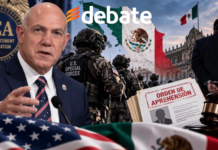
The political establishment in Washington does not want to deal with Mexico, and rarely has the mood or the time to do so. Its attention and ability to concentrate are focused on the wars in the Middle East, Russia’s invasion of Ukraine, and the geopolitical and technological struggle with the People’s Republic of China.
For decades, it was enough for Mexico not to ally itself with US rivals in the Cold War to keep Washington calm. Since the entry into force of NAFTA 1.0, the US has become accustomed to the fact that Canada and Mexico do not generate greater uncertainty regarding its interests, unlike what it faces in other latitudes.
This could be changing. Today, Washington’s three central bipartisan concerns regarding the Mexican government are:
i) That it collaborates to dismantle narcopolitics in Mexico as a platform and protection to manufacture, transport and introduce fentanyl into the US;
ii) That it exercises militarized migratory containment to prevent hemispheric and extracontinental migratory flows from reaching the common border;
iii) That it does not allow Chinese electric car manufacturers to establish themselves in Mexico to export to the US market.
In recent years, the links between actors in the Mexican political class and drug trafficking and organized crime have moved from tolerance and complicity to association and even subordination: I will finance your electoral campaigns in exchange for controlling authorities.
If in 2020 the commander of the Northern Command said that a third of the Mexican geography was under the control of organized crime, today the two mega-cartels are active in all the federal entities.
What happened in Sinaloa as of July 25, 2024 has upset the equation. The extraction of ‘Mayo’ Zambada by Washington is due to the decision to hit the key organization in the introduction of fentanyl to the United States.
The constitutional reform to politically control the Judiciary does not seem to directly violate the text of the USMCA, but it definitely contravenes its spirit, by introducing uncertainty due to the undermining of the rule of law.
The CSP government is betting that the review of the USMCA will be just that: reviewing point by point what needs to be improved. In contrast, Trump wants to turn the review into a renegotiation, so that Mexico conforms to Washington’s geopolitical and national security priorities, which include derailing China. Mexico’s bet on nearshoring has no prospects of taking off, whether Trump or Harris wins.
“Mexico is our partner, but it doesn’t seem like they’re putting their house in order” became a ubiquitous expression of American political leaders, diplomats, government officials and businessmen. It remains to be seen whether the change of administration here and there will change that reading.
The assumption that by definition two female presidents will get along better because they are women lacks foundation. A better bilateral relationship does not rest on trying to appease the bully or putting the embassy on hold because it did not share strategic information, but on rebuilding mutual trust, which is easier said than done.
Source: eluniversal