
A wooden fence knocked over by a vehicle is the only trace on a narrow dirt road of the deaths of six migrants after two soldiers opened fire on the cargo van they were traveling in in southern Mexico.
The most recent tragedy involving migrants occurred on the night of October 1, more than a thousand kilometers from where Claudia Sheinbaum was celebrating her swearing-in as Mexico’s first female president at a large popular party that day.
The event fueled the harsh debate about the role of the military in containing the growing flow of migrants crossing the country to reach the border with the United States.
In the small community of Lázaro Cárdenas, in Chiapas, very close to where everything happened, witnesses disagree with the Army’s version that the soldiers fired after hearing shots coming from the cargo van, in which 33 migrants were traveling in total, 10 of whom were wounded in addition to the six who died.
“First we heard them crash, then another loud noise like a gunshot and then many shots in a row, as they say in a ‘burst’,” a local resident told Reuters, asking to remain anonymous for fear of reprisals. Two other residents agreed with the man’s statement.
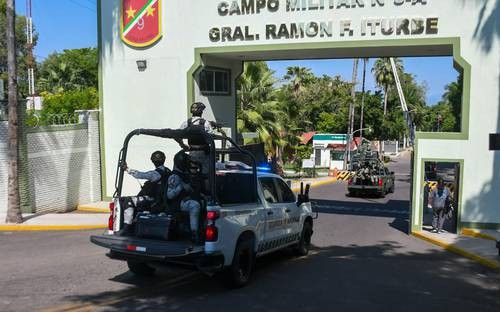
Sheinbaum condemned what happened the day after the attack by the two soldiers was reported. They were arrested and will be tried under military laws, which raises fears among migrant and human rights organizations that the Army will be lax, as they say has happened in other cases.
The president, who is also the Supreme Commander of the Armed Forces, refused to speak about the military’s account and observers are wondering what Sheinbaum’s immigration policy will be and what role the Army will play.
A local police officer who said he arrived at the scene of the attack minutes after it happened believes that the force used in this case was “excessive.”
“You can’t respond with gunfire to people who are not armed,” he said indignantly, telling Reuters that the military prevented local security forces from passing through, which he said was not usual.
Neither the Ministry of Defense nor the presidential office responded to Reuters’ requests for comment on what the witnesses said.
Sheinbaum has given few signals about her immigration policy. Whether she will continue with that of her predecessor and mentor, former President Andrés Manuel López Obrador, deploying thousands of members of the National Guard, a militarized police force under the control of the Army to contain migrants.
But also thousands of marines and soldiers along the routes that tens of thousands of migrants, mostly from Central and South America, but also from the Caribbean and to a lesser extent from Africa and Asia, use to try to reach the United States fleeing poverty and violence and in the hope of obtaining asylum in that country.
“URGENT” CHANGE IN POLICY
The use of the military to contain migrants, but also in security tasks and to confront organized crime has not achieved its objective, according to experts who say that, on the contrary, human rights violations have increased while criminal activity and drug cartels have expanded.
“It is urgent that the new administration of President Sheinbaum changes this scheme to avoid more abuses and violations of human rights (…) as occurred in Chiapas,” said Israel Ibarra, a researcher at Colef, a center for border studies between Mexico and the United States.
Chiapas has gone in recent years from being a place known for its great natural tourist attractions and archaeological sites, to the site of constant clashes between rival criminal groups that dispute control of drug and human trafficking, even forcing inhabitants of some areas to flee their homes due to harassment and violence.
From January to August, Chiapas recorded nearly 500 violent deaths compared to 309 during the same period in 2023 and nearly double the number recorded in 2022.
Between Huixtla and Tapachula, a city right on the border with Guatemala, Reuters was able to identify at least six border checkpoints manned by military personnel, local police and immigration agents along a stretch of about 40 kilometers.
Tapachula, which has become a huge refuge for migrants, many of them wait in their shelters to be called for their asylum application through the CBP One platform, instead of risking being victims of criminals again if they set out in a caravan.
“I’m not going to leave here until the day of my appointment arrives,” said Nadia, a 50-year-old Venezuelan, about her asylum application. “Even outside the houses (that help migrants) they are kidnapping,” she lamented and recalled how difficult it was for her to escape from the safe house where she was held captive along with 30 other people, just a few weeks ago.
Source: