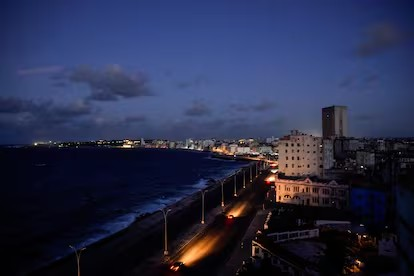

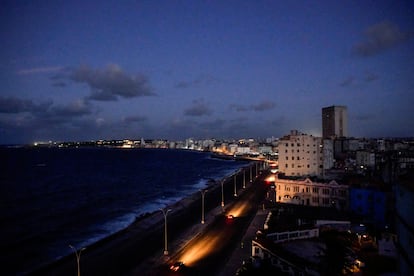
Cuba has been in the dark since last Thursday and Mexico has decided to lend a helping hand. The government of Claudia Sheinbaum has offered help in the face of the “energy emergency”, in the words of the Cuban Executive, that the Caribbean country has been experiencing since the 17th of this month. The situation on the island has become desperate after five days without electricity that have led to the massive closure of schools; the collapse of hospitals; it has forced its citizens to light bonfires to cook in the streets and has already left images of protests and caceroladas throughout the territory, protected from the political police thanks to the lack of light. Beyond the cuts of the last few days, the authorities believe that the energy crisis caused by the fuel shortage and the poor state of the infrastructure could last two years, while blackouts are increasingly common.
The Mexican Ministry of Foreign Affairs announced on Monday afternoon through its social networks that its embassy in Havana “opportunely expressed its willingness to the Cuban people to provide support, given the difficult situation they face.” The foreign minister, Juan Ramón de la Fuente, “is in permanent contact with his Cuban counterpart, Bruno Rodríguez Parrilla, and the Mexican embassy in Cuba is doing the same with the competent authorities to have updated information on the situation. Likewise, it has made available to the nationals in that country emergency lines for their permanent attention,” the foreign ministry added in the brief message.
The Federal Electricity Commission (CFE), the state-owned company that supplies electricity to all of Mexico, has also offered “its technical support for the prompt restoration of electric power.” CFE workers are used to dealing with emergency situations, especially during this time of year, hurricane season, when strong storms tend to knock out power lines wherever they pass. During the last month, this has happened in Oaxaca and Guerrero, both states on the Mexican Pacific coast, where Hurricane John left entire communities cut off and in the dark.
Rodríguez Parrilla has responded to the Mexican offer through his social networks: “We appreciate the efforts and immediate support offered by the governments of Venezuela, Mexico, Colombia, Russia and Barbados to deal with the current situation of the national electrical energy system. Cuba is in talks to finalize receipt of this aid.” This is not the only way Mexico helps the island: Cuba, a country that has suffered a strong economic blockade by the United States for more than six decades, depends on its few allies abroad to supply itself with fuel, which mainly comes from Venezuela and Mexico.
Although the Cuban government usually uses the US embargo to justify the very frequent cuts in the electrical system, it is not the only reason that explains the massive blackout. On this occasion, the Prime Minister, Manuel Marrero, acknowledged that “the state of the infrastructure, the lack of fuel and the increase in demand” are also among the causes. Cuban President Miguel Díaz-Canel has repeated the usual narrative of the government: that the culprits of the power cuts suffered by the entire island are “the economic war” and the “financial and energy persecution of the United States,” which “makes it difficult to import fuel and other resources necessary for that industry.”
Experts also point to the poor state of an obsolete electrical infrastructure after decades of lack of investment and maintenance as one of the causes. Also, its almost absolute dependence on fossil fuels (gas and, above all, diesel and fuel oil, both imported), which leave a carbon footprint, in a territory of 11 million inhabitants, greater than that of many countries of its size. The generation of electrical energy from oil, furthermore, entails a high economic cost in a nation in which, in 2024, 89% of the population lives “in extreme poverty,” according to the results of a study by the Cuban Observatory of Human Rights (OCDH), an independent organization based in Madrid, Spain.
Cuba produces crude oil, but in quantities insufficient for its needs. In addition, imports have declined in recent times, hand in hand with the state budget to obtain it. The Díaz-Canel government has assured that it has a plan to “maximize Cuban oil production” as well as the increase of renewable energies, although it has not offered details of its strategy. Marrero has pointed out along the same lines that the immediate measures to solve the crisis involve “eliminating dependence on fossil fuels, replacing it with clean energy.”
The long-term solutions proposed by the government do not convince the Cuban population. Nor does the systematic shifting of blame to the United States. Protests spread across the island under cover of darkness while food rots in unusable refrigerators, in a country accustomed to food shortages and rationing. During the month of August alone, the Cuban Observatory of Conflicts (OCC) documented almost 700 protests throughout the country, most of them caused by discontent over constant power outages, water cuts or the inefficiency of public transport. There is no data, at the moment, on how many improvised demonstrations have taken place in these dark days.
Source: elpais