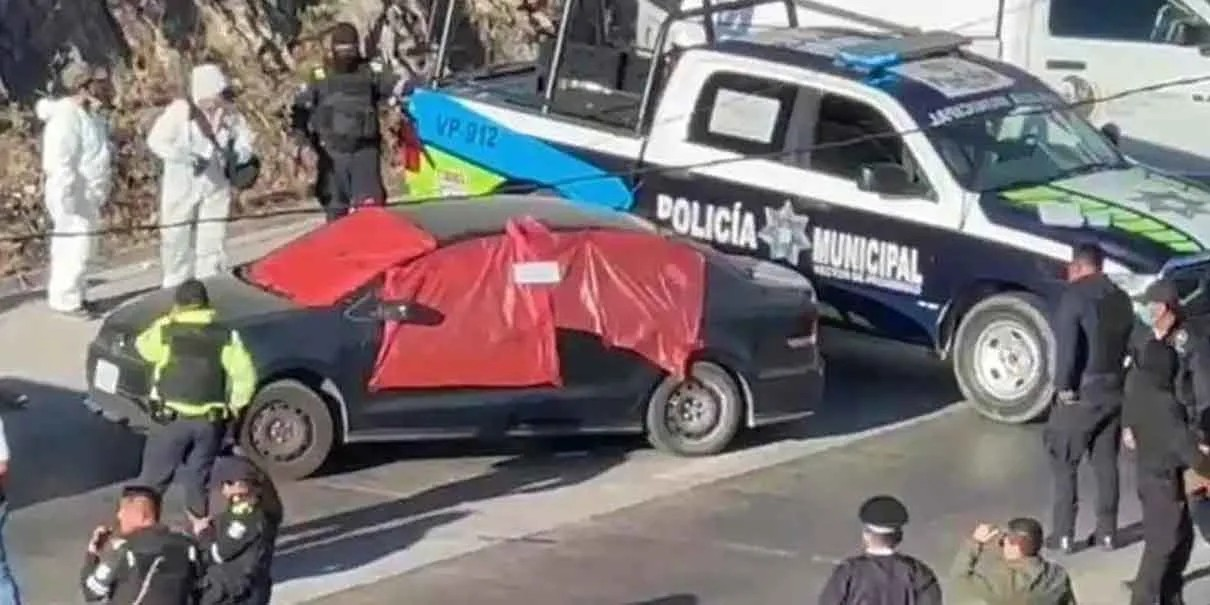

The head of the Public Security Secretariat of the State of Puebla, Daniel Iván Cruz, acknowledged that the criminal group known as ‘La Barredora’ does operate in the metropolitan area of Puebla, however, they have no connection with the Jalisco Nueva Generación Cartel.
“A group that is working there in the metropolitan area, we recently made arrests in Huejotzingo, in San Martín, where we have characterized that they are people who are not originally from here and are related to other entities,” he added.
The state official argued that, after the intervention carried out by the agency under his charge, 79 generators of violence in Puebla have been arrested, which come from states such as Jalisco, Nayarit, Michoacán and Chiapas.
Questioned about whether they have identified other groups, in addition to ‘La Barredora’, Daniel Iván Cruz said that it is the only one he knows of, that operates with these criminal characteristics.
“It is the only one we have identified that is designated as such, the others are local groups that also begin to generate or hang on to this inertia, or these videos that circulate on social networks and call themselves that,” he added.
La Barredora
The first time that La Barredora’s name resonated in the country’s underworld was in the second half of 2010, just after elements of the Navy (Semar) killed Arturo Beltrán Leyva in Cuernavaca and Edgar Valdéz Villarreal, alias La Barbie, was arrested in a safe house in the State of Mexico.
A report from the data and analysis platform on security, organized crime and social conflict, Lantia Intelligence, points to La Barredora as one of the multiple splits that arose from the fragmentation of the Beltrán Leyva Cartel, specifically from the faction that La Barbie headed.
As an already consolidated criminal cell, La Barredora continued to operate for the Pacific Cartel in the dispute for control of key “plazas” for the lucrative drug trafficking business.
Lantia Intelligence points out that the split came to have its own armed wing called the Death Command, whose operations extended to the states of Colima, Baja California and Mexico City, at least until 2020.
According to information from the doctor in Public Administration and intelligence specialist, Mauricio Saldaña, the arrival of La Barredora to Tabasco was revealed in 2009 when the family of the non-commissioned officer of the special forces of the Mexican Navy, Melquisedec Angulo Córdova, was murdered.
The military leader was originally from Tabasco and participated in the operation that the Armed Forces deployed in Cuernavaca to apprehend Arturo Beltrán Leyva. That night in December 2009, not only was El Barbas killed, but Melquisedec Angulo was also seriously injured after Beltrán Leyva hitmen threw a fragmentation grenade at the soldiers.
Hours after the operation, the Tercer Maestre died from his injuries. His body was taken to his home state, where he was given a farewell with honors, not expecting that La Barredora would retaliate by killing four members of his family.
In a report that the aforementioned specialist made for Newsweek, it is reported that the then president of Mexico, Felipe Calderón, launched an operation to apprehend those responsible for the murder of the military commander’s family, which yielded results at the end of 2011 when a man identified as Santos Ramírez, alias El Santo Sapo, was arrested.
To the surprise of many, the Mexican government did not present this criminal leader as a member of the Sinaloa Cartel or the Beltrán Leyva Cartel, but as one of Los Zetas, the violent cartel originating in Tamaulipas that, by then, had already gained ground in Veracruz and was expanding along the country’s east coast.
With this arrest, the federal government learned that not only the Sinaloa Cartel had arrived in Tabasco but also Los Zetas. However, as time went by, a criminal organization began to gain relevance in Michoacán and Jalisco and threatened to change the criminal dynamics of the state again: the Jalisco Nueva Generación Cartel (CJNG).
Fragmentation of La Barredora
In June 2022, a report by the United States Congressional Research Service placed Tabasco as one of the territories that the four-letter cartel disputed with members of Los Zetas and the Gulf Cartel.
Gradually, the then-called Secretariat of National Defense (Sedena) reported that the split of Los Zetas that remained in Tabasco was the Cartel del Noreste and its armed wing, which called itself the Tropa del Infierno.
Both the Cartel del Noreste and the CJNG had influence on the structure of La Barredora, which by then had already gone through a fragmentation process in which some of its leaders became independent to operate on their own or in alliance with said criminal organizations but using the same name.
The analysis carried out by the intelligence specialist, Mauricio Saldaña, indicates that one of the splits was headed by José Guizar Valencia, alias Z-43, who allegedly used La Barredora as an armed wing to take over specific points in Tabasco and later in Chiapas and the border with Guatemala.
Another cell that called itself in the same way was initially linked to the Jalisco Nueva Generación Cartel (CJNG) after a man identified under the alias of El Comandante 88 in Macuspana presented himself as a subordinate of Jesús “N”, alias El Lagarto, the CJNG plaza boss in Veracruz.
Through a video posted on social media, alleged members of the CJNG denied being behind La Barredora, which is why it came to be considered a local criminal gang that used the name of the CJNG to position itself in Tabasco, as described by Mauricio Saldaña in his report for Newsweek. Unofficially, local media have reported that the leader behind said local criminal group is identified as Daniel Hernández Montejo alias Prada or El H.
The recording was released to be interpreted as a fracture within the CJNG cells that operate in the southern state, however, what is certain is that La Barredora – whether local or Z43 – became the most fierce rival of the criminal organization headed by Nemesio Oseguera Cervantes, El Mencho, in Tabasco.
The conflict has been confirmed by the many narco-banners seized at crime scenes, but also by investigative files such as the one opened after the attack on the DBar nightclub in Villahermosa in the early hours of November 25.
Source: es-us.noticias.yahoo