
The migratory flow that enters through the southern border of the country and crosses the entire Mexican territory to reach the northern border, and that just a few weeks ago seemed endless, has diminished as immigration authorities seek to ensure that foreigners continue on their way.
Only since the first day of President Claudia Sheinbaum’s government, it is estimated that seven caravans have crossed on foot, made up of people originally from Honduras and Venezuela mainly, but also from Nicaragua, El Salvador, Cuba, Haiti, Colombia, Peru, Ecuador, Guatemala, some African and Asian countries.
These are people, men, women and poor children, without money to make the trip on buses, planes or with smugglers.
This Wednesday, for example, at least 60 migrants who were transferred in recent days to the Oaxacan capital, reported that they were deceived by the National Migration Institute (INM), which offered them permits to continue on, but gave them a document so that in seven days they could return to their countries.
Carolina del Carmen, a Venezuelan, said that on Monday night, INM agents offered them two buses to take 80 migrants to the Oaxacan capital. Of them, only 20 were able to buy tickets to Mexico City. The rest were returned to La Ventosa, where some 400 migrants have been waiting since last Saturday for help with transportation to get around.
“At some points where the trucks left, they told us: ‘we don’t take migrants’ and at others, they charged us two thousand pesos for the fare. They gave me a paper signed by Adriana Arguelles, stating that I have seven days to leave Mexico and leave through the southern border, where we entered to walk with the caravan,” she says.
Other migrants reported that on the way to the city of Oaxaca, the bus they were traveling in was stopped three times, where people in different uniforms asked them for money. “There, on that journey, the little money we had was gone,” they said, amidst the helplessness of not continuing to advance towards the north of the country.
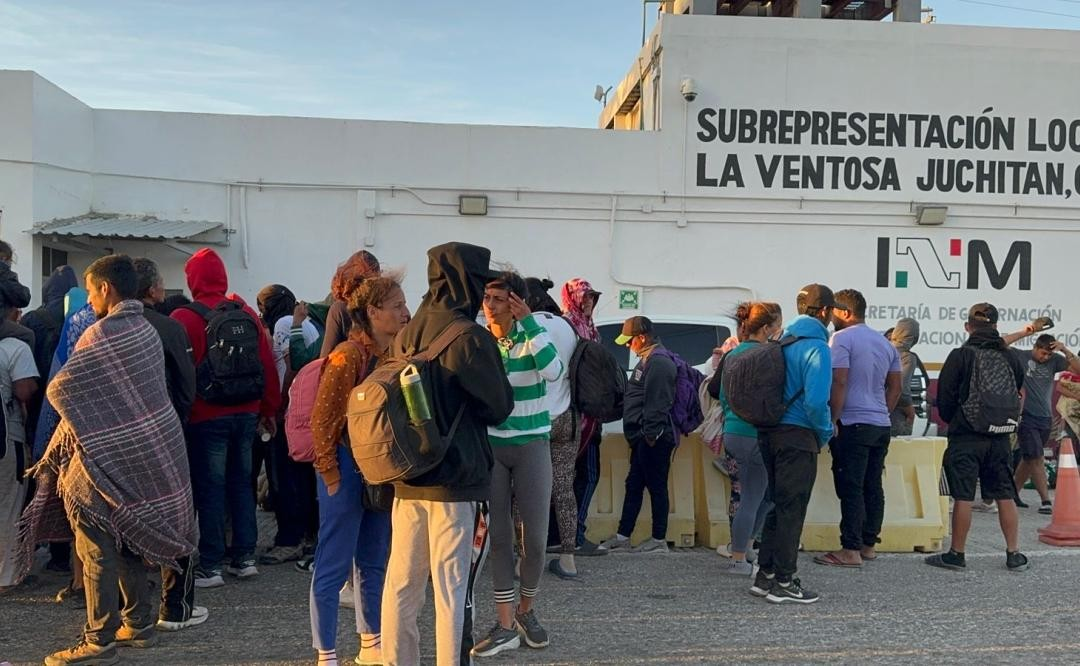
The almost 400 migrants stranded in La Ventosa, under strong winds of up to 120 kilometers per hour and cold, are still waiting for humanitarian aid from the government of Oaxaca, so that they can be provided with buses and continue towards Mexico City. The migrants are practically defeated by respiratory and intestinal diseases and can no longer walk.
“Here we are going to continue waiting, we no longer want to continue walking because we are sick and tired and because a man who came on behalf of the government of Oaxaca told us not to walk through Juchitán, because there they kidnap and assault migrants. We better wait for the other caravan.”
This Thursday, a new caravan arrived in San Pedro Tapanatepec, the largest of which was in Pijijiapan, where the INM provided the Multiple Migratory Form (FMM) document for 20 days so that they could advance towards the center of the country.
The majority of those who come in this group of 500 people do not have the aforementioned document.
After reporting that they were deceived by the INM, the migrants who had remained in the Zapotec community of La Ventosa (Juchitán), ended up dividing up and taking different routes on their walk towards the center of the country.
Yesterday morning, a group of 100 people headed from the La Ventosa gas station, where they improvised a camp in the open air, with winds of 120 kilometers per hour, towards Juchitán and another 150 more began to walk on the Transístmica highway, towards Matías Romero.
Both groups are moving forward alone, no longer accompanied by immigration officers, neither by Grupo Beta nor by the National Guard. Women are traveling with children in the midst of the strong winds of cold front 14.
Yesterday afternoon-evening, before going their separate ways, the migrants went to the local INM office in La Ventosa, where they protested because they were not given buses to travel to Mexico City and then they retreated to the camp they improvised.
Source: oaxaca.eluniversal