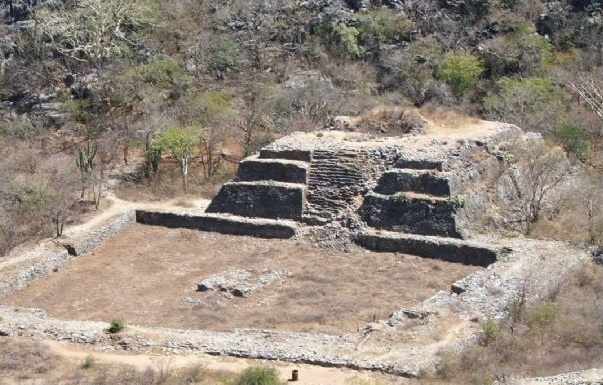

A 15th-century Zapotec enclave in southern Oaxaca, Mexico, once thought to be simply a fortress where soldiers were garrisoned was in fact a sprawling, fortified city.
A McGill University researcher determined that Guiengola, as the site is called, spanned 360 hectares, with more than 1,100 buildings, four kilometers of walls, a network of internal roads, and a clearly organized urban layout, with temples, communal spaces, ball games, and zones, meaning elites and common people lived in separate neighborhoods.
According to Pedro Guillermo Ramón Celis, a postdoctoral researcher in McGill’s Department of Anthropology and author of a paper in Ancient Mesoamerica, the evidence strongly suggests that the city was abandoned just before the arrival of the Spanish, and that its people moved just 20 kilometers away to Tehuantepec, a small town where their descendants still live today.
Ramón Celis said that investigating how the Mesoamerican city was organized on the eve of the Spanish conquest is only the first step. He said he is convinced that as work progresses at Guiengola, it will give researchers a better idea of the level of political and social organization of the Zapotecs and therefore a greater understanding of their level of intervention in the encounter with the Spanish.
The discovery was made using a remote sensing tool known as lidar, which relies on pulsating laser beams, in a process similar to sonar, to provide precise and detailed three-dimensional topographic information about what is on the surface of the earth, beneath the dense forest canopy.
“Although the site could be reached via a trail, it was covered by a canopy of trees. Until very recently, no one would have had a way of discovering the full extent of the site without spending years walking and searching. We were able to do it in two hours using remote sensing and scanning equipment from an airplane,” the researcher explained in a statement.
By analyzing the data generated by the scans and using McGill’s GeoAnalytics Lab, Ramón Celis was able to map the size and layout of the remaining built structures and infer their use, based on artifacts found at the locations.
To explore how power was distributed in the city, he calculated how much building space was allocated to elite areas, such as temples and ball courts, for example, compared to what was built in areas used by common people.
Ball courts were built in Mesoamerica for the purpose of practicing a ritual in which both the underworld and fertility are represented, as they are a way of connecting with ancestors and the seeds that grow beneath the earth.
Ramón Celis added: “As the city is only 500 to 600 years old, it is surprisingly well preserved, so you can walk there in the jungle and discover that the houses are still standing, you can see the doors, the hallways, the bars that separate it from the other houses, so it is easy to identify a residential layout. It is like a city frozen in time, before the profound cultural transformations brought about by the arrival of the Spanish.”

Source: proceso