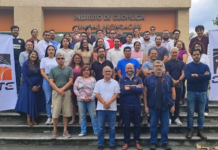
The International Tourism Fair (FITUR) in Madrid (Spain) was the perfect setting to highlight the cultural wealth and cinematographic vocation of the state of Michoacán, Mexico.
The event was attended by Roberto Monroy García, Secretary of Tourism of Michoacán; Luis Fernando Gutiérrez Lara, Director of the Film Commission of Michoacán and Alfonso Martínez, Mayor of Morelia.
In an atmosphere full of enthusiasm, everyone was in charge of highlighting the connection between cinema and the tourist promotion of the state, describing it as a “natural cinematographic set”.
Geography as a natural set
“Michoacán is located in the heart of the Mexican Republic. With 113 municipalities, 10 Magical Towns, six World Heritage Sites and a great diversity of natural settings, our state offers endless possibilities for the film industry,” said Monroy García.
Among its most notable treasures are the monarch butterfly sanctuaries, the spectacular Night of the Dead in the Lake Pátzcuaro region, and its traditional cuisine, which was the basis for Mexican gastronomy to obtain recognition as Intangible Cultural Heritage of Humanity by UNESCO.
Luis Fernando Gutiérrez Lara added that “the diversity of locations includes everything from virgin beaches and forests to hacienda buildings and colonial cities such as Morelia, which is the Mexican city with the most buildings declared World Heritage by UNESCO.”
Cinema and culture: a heritage that transcends borders
Cinema has been key to projecting Michoacán’s culture to the world. Gutiérrez Lara mentioned that “one of the first international projects that put Michoacán on the map was Disney’s The Three Caballeros, which showed the traditions and landscapes of the Lake Pátzcuaro area.”
Years later, the film Coco took up these same settings to portray the magic of the Night of the Dead, consolidating Michoacán as a cultural reference.
“The case of Coco is one of the most successful, since the streets of Santa Fe de la Laguna and other places in the state directly inspired several of its digital scenarios,” explained Gutiérrez Lara.
Infrastructure and strategic alliances
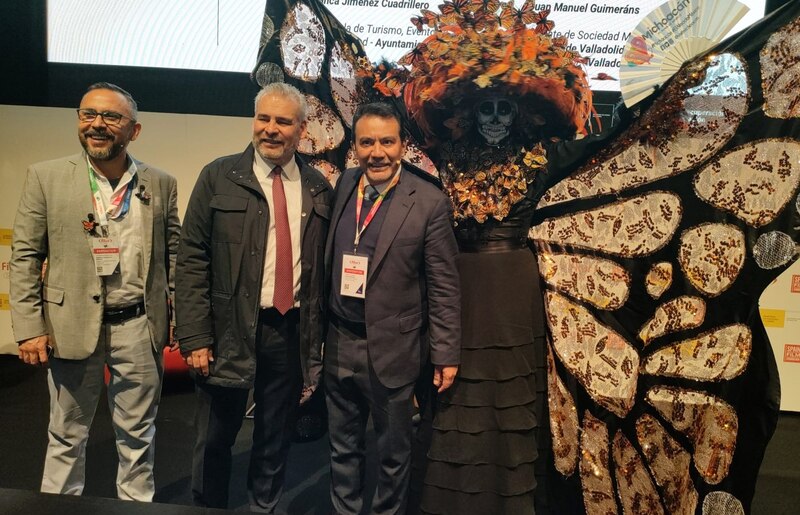
Another aspect that positions Michoacán as an ideal destination for cinema is its connectivity and the infrastructure necessary for international productions.
“We are only three hours from Mexico City and two and a half hours from Guadalajara, with direct flights from Cancún, Monterrey and Mexico City to Morelia,” explained Alfonso Martínez.
Collaboration with key institutions has also been fundamental: “The Morelia International Film Festival (FICM) and the Cinépolis chain, which has its origins in Morelia, have been great allies to strengthen the state’s cinematographic vocation,” he added.
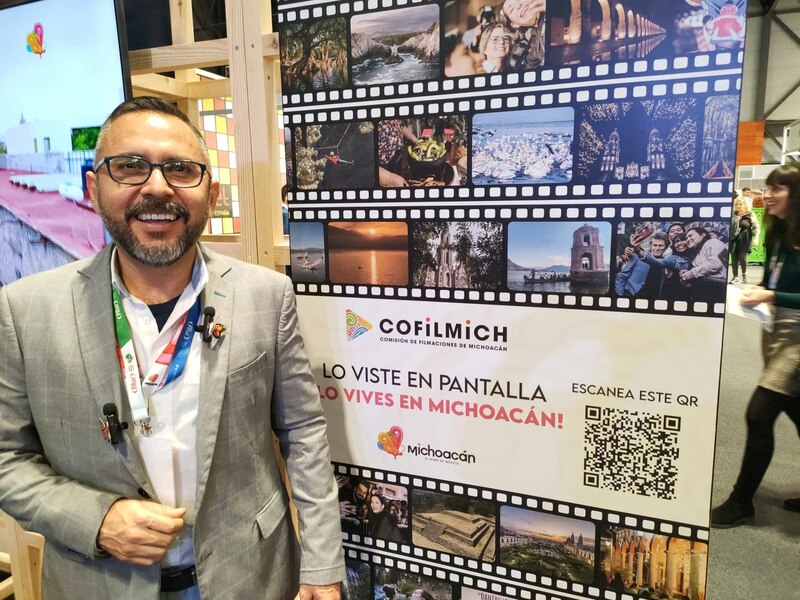
In an interview with this media outlet after the presentation, Gutiérrez Lara highlighted the importance of cinema as a tool to promote the cultural heritage, natural settings, and cinematographic vocation of this Mexican state.
“Cinema allows us, first, to make some kind of emotional connection as the story is presented. If you like a movie, it connects you, it hooks you, and if you have the opportunity to go to the locations where scenes were recorded, there is a very important communion and harmonization of feelings,” shared Gutiérrez Lara.
As already mentioned, one of the most emblematic examples of this impact is the Pixar movie Coco, which captured key elements of Michoacan culture.
In the words of the director: “Last year I witnessed how many people in the community of Santa Fe de la Laguna, where many of the digital sets of Coco were inspired, received huge amounts of tourists looking for, for example, Mamá Coco’s house,” he said.
“But in addition, they had the impact of learning about the worldview of the Purépecha ethnic group and of experiencing an authentic Day of the Dead,” he added.
This phenomenon has generated a significant economic impact and a notable increase in hotel occupancy.
Traditions to explore in the cinema
Despite the exposure achieved, Gutiérrez Lara emphasizes that Michoacán has much more to offer the world of cinema.
“It would be very interesting to approach in a tremendously super humanistic way the traditions of the native peoples, such as the Purépecha New Year, which has a unique mysticism. It speaks of the unity of the peoples, celebrating around the fire and the symbolism that this has for them. A documentary or a film based on this would be something extraordinary,” he commented.
Since its creation, the Morelia International Film Festival (FICM) has become a catalyst for the promotion of Michoacán.
“The festival has put a large part of what we are in the eyes of the world. Quentin Tarantino, Francis Ford Coppola, Willem Dafoe, among others, have not only visited Morelia, but also nearby communities such as Pátzcuaro and Santa Clara del Cobre, exploring the cultural diversity of the state,” explained Gutiérrez Lara.
FICM has also aligned itself with the Day of the Dead celebrations, offering cultural programs and immersive experiences in communities such as Santa Fe de la Laguna.
“This year, for example, visitors were able to learn how to make flower arches or clay plates with local artisans. It was an enriching experience that connected tourists with our traditions in a unique way,” he said.
Feratum: science fiction and horror in a magical setting
For lovers of science fiction, horror and fantasy, Michoacán also offers the Feratum Festival, which is held in Pátzcuaro, a magical town that provides the ideal setting for these themes.
“Among the most impressive activities is the March of the Beasts, a night parade with torches and characters dressed up from films of the genre. It is something spectacular,” said the director.
The Monarch Butterfly: A Natural and Spiritual Spectacle
Finally, Gutiérrez Lara invited visitors to take advantage of their stay in Michoacán to explore the sanctuaries of the monarch butterfly, a phenomenon that occurs from November to March.
“There is a mysticism surrounding the monarch butterfly, as it coincides with the Day of the Dead. In the region, it is believed that the souls of the deceased arrive in the form of butterflies to visit their families. It is a spectacle that must be experienced at least once in a lifetime,” he commented.
A call to discover Michoacán
Luis Fernando Gutiérrez Lara concluded with a clear message: “Michoacán has a fantastic cinematographic, historical and cultural vocation. If you have the opportunity, visit us, get to know our traditions, our landscapes and our heart. We are ready to conquer you,” he said.
Source: cronica