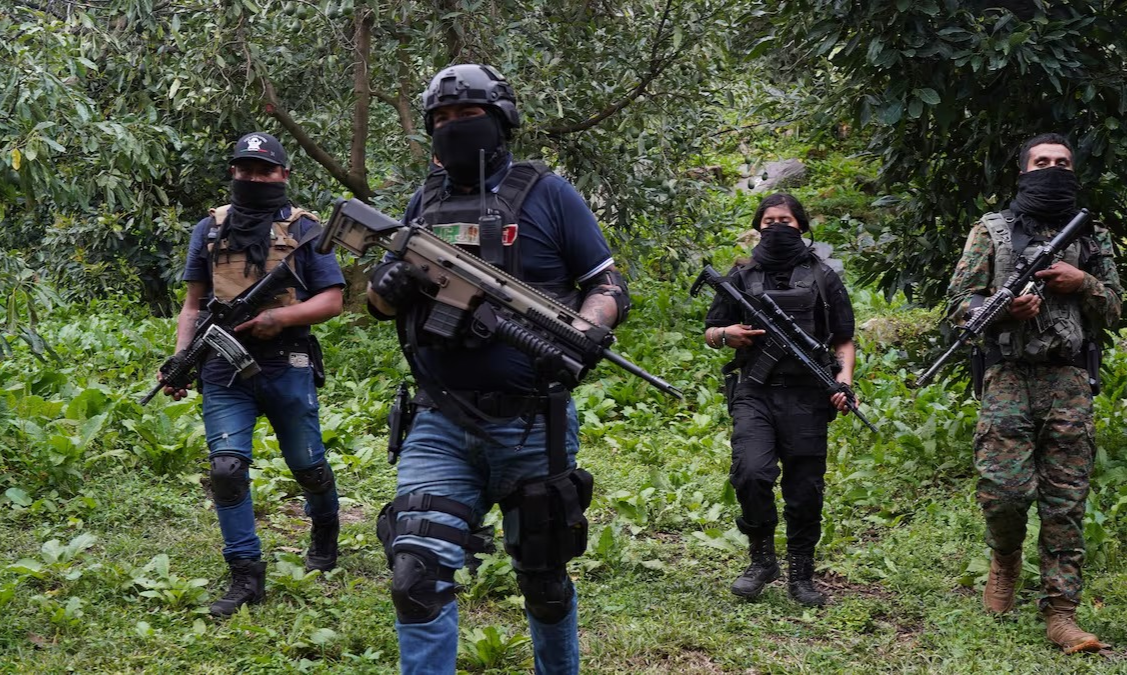

The Jalisco New Generation Cartel (CJNG) and the Sinaloa Cartel are once again the focus of the Drug Enforcement Administration’s (DEA) annual report. In its 2025 report, the U.S. anti-drug agency warned of a possible alliance between Los Chapitos, one of the warring factions within the Sinaloa Cartel, and the criminal organization led by Nemesio Oseguera, alias El Mencho, one of Mexico’s most powerful, influential, and ruthless cartels, as well as a key supplier of fentanyl to the neighboring country.
According to the DEA, the CJNG could seek to capitalize on the conflict between the Los Mayos and Los Chapitos factions of the Sinaloa Cartel, essentially siding with their former rivals, the sons of Joaquín Guzmán Loera, known as El Chapo, against the descendants and followers of another of its founders, Ismael El Mayo Zambada, both of whom have fallen into disgrace since their respective captures and extraditions to the United States.
“A strategic alliance between the CJNG and Los Chapitos has the potential to expand these groups’ territories, resources, firepower, and access to corrupt officials, which could result in a significant alteration of the existing balance of criminal power in Mexico and could serve to increase the flow of drugs northward and arms trafficking southward across the U.S.-Mexico border,” the report states.
For more than six months, Sinaloa has been besieged by a war between the different factions seeking control of that state’s main criminal organization. The confrontation between the sons of El Chapo and El Mayo ignited in September 2024 and continues to this day, resulting in more than 600 murders and nearly 800 disappearances. If the DEA’s investigations are true, the CJNG, which has been active for more than a decade and began as a cell serving Guzmán Loera, would see its operations beyond Mexico’s borders further strengthened, with a presence in more than 40 countries, according to the report.
The DEA has released its report amid renewed tensions with Claudia Sheinbaum’s administration, due to rumors of visa withdrawals for some Mexican officials, including Morena leaders, governors, and former Cabinet secretaries, for alleged ties to drug trafficking, according to ProPublica.
The tentacles of El Mencho’s criminal cell have already established a base throughout the country, confirming its power and influence. In central and southern Mexico, according to the DEA, the CJNG has a “significant presence.” While in the north, in states such as Sonora, Baja California Sur, Sinaloa, Durango, Coahuila, and Nuevo León, it is also present.
Another point the document addresses is how Los Cuinis, a family clan closely tied to the CJNG and its main financial arm, lead the cartel’s diverse network of operations and money laundering tactics to repatriate global drug trafficking proceeds to Mexico. “This group and other CJNG factions utilize Chinese money laundering networks, cryptocurrency exchanges, large-scale cash smuggling, trade-based money laundering, and other methods to launder drug trafficking proceeds,” the report notes.
Xylazine + fentanyl equals more revenue
For its part, the Sinaloa Cartel, despite the turmoil within its organization, continues its “lucrative expansion” into various markets in Europe, Asia, and even Australia. The criminal organization uses its vast distribution networks to transport drugs to the United States, primarily through ports of entry in California and Arizona. The cartel’s associates, facilitators, and affiliates operate in nearly all 50 states in the United States.
Its presence in Mexico is “significant,” especially in almost all of the north, with the exception of states such as Nuevo León, Tamaulipas, and Nayarit, as well as in southern Mexico and the capital. It is found in the center, but with a smaller presence. It also has a smaller presence in states such as Guanajuato, Michoacán, Colima, Puebla, and Hidalgo. The only state where it is absent is Jalisco, a stronghold of the CJNG (CJNG).
The DEA has emphasized and warned about some of the practices of some of the Sinaloa Cartel factions in the United States regarding fentanyl, which is being mixed with xylazine, a potent sedative, muscle relaxant, and non-narcotic analgesic for animals. “They began adding xylazine to fentanyl shipments smuggled into the United States, primarily destined for East Coast markets. U.S.-based traffickers also mix xylazine into their fentanyl supply, allowing both groups to optimize supply and generate more revenue,” the drug enforcement agency states.
In 2024, the DEA seized nearly 10,000 kilograms of fentanyl, approximately 29% less than in 2023. It also seized 61.1 million counterfeit pills, a 24% decrease from the previous administration. “The adulteration of fentanyl with highly potent and dangerous chemicals reminds us that this fight is far from over,” wrote DEA Acting Administrator Robert Murphy.
Annual Evolution of Fentanyl Seizures in the U.S.
Data from the El Paso Intelligence Center’s National Seizure System, which consolidates drug seizure information from federal, state, and local agencies across the United States, indicated a similar trend, with a total of 23,256 kilograms of fentanyl seized in 2024, a decrease from the previous year.
Other Cartels on the DEA’s Radar
Beyond the Sinaloa and Jalisco drug traffickers, Trump’s hit list, which includes six Mexican cartels as terrorists, remains on the DEA’s radar. The operations and territorial presence of La Familia Michoacana (with a strong presence in Michoacán, the capital, and Guerrero); The United Cartels, which are fighting over Michoacán, Mexico City, and Guerrero with the New Michoacan Family, are targeting the distribution of tons of methamphetamine, cocaine, and heroin to the United States.
Meanwhile, the DEA is monitoring the Northwest Cartel, with a “significant presence” in Nuevo León, Tamaulipas, and Zacatecas; as well as the Gulf Cartel, with significant influence in Coahuila, Nuevo León, Tamaulipas, and Veracruz. The cartel operates in approximately 16 states in the north, primarily in Texas, Oklahoma, California, and the southeastern United States, where drug trafficking, especially human trafficking, “represents significant revenue.”
According to the anti-drug agency, the cartels in Mexico maintain a network of couriers, border tunnels, and stash houses throughout Mexico and the United States to support their trafficking and distribution activities, which are reinforced by a wide variety of methods, including air cargo, sea cargo, and land transport.
Just as the Sinaloa Cartel uses various encryption methods through apps for its communication networks, other Mexican criminal organizations have increasingly used social media platforms to promote pharmaceutical products, recruit and train couriers and distributors, advertise drug sales, communicate with customers, and plan transactions.
The DEA explains that drug traffickers in the country and suppliers based in China use sophisticated shipping methods and multi-step processes to evade detection and national and international regulatory controls on chemical substances. “They employ a variety of international export agents, consignees, facilitators [such as transshipment companies or transporters], and financiers to operate in multiple facets of the fentanyl precursor supply chain,” the document states.
Trafficking methods and processes include mislabeling cargo on shipping manifests, using third countries as transshipment points, and exploiting legitimate companies to import chemicals and subsequently divert them. It also warns that the country’s criminal organizations could expand their precursor chemical supply chains to include manufacturers in India, Europe, and elsewhere, thereby reducing their dependence on Chinese suppliers.
Source: elpais