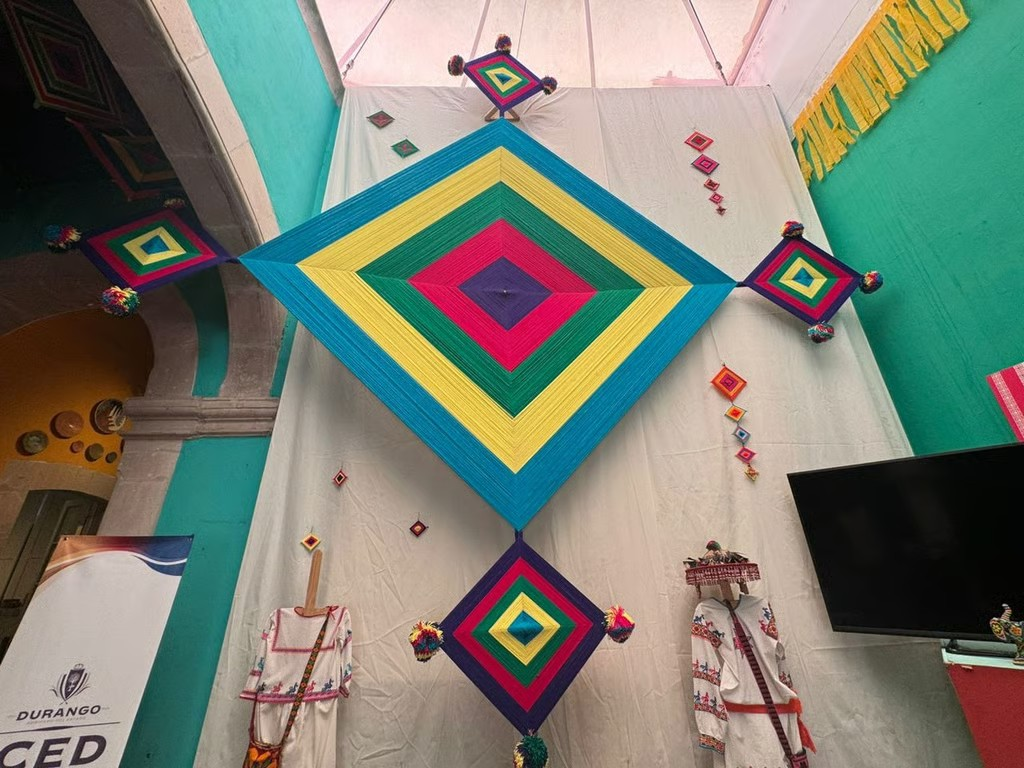

The museum’s director, Alfonso Villarreal, explained that this monumental piece was collaboratively crafted over two months, under the guidance of a Wixárika artisan. “This Eye of God was made by the people who came to visit us; even the workers here put their effort into making it happen,” he explained.
But it wasn’t just Durango residents who were behind this piece. “For two months, foreign and local visitors came and turned it over several times, then others came and did the same, until it was finally ready,” he said.
Is it the largest in the world?
The Eye of God, or tsikuri in the Wixárika language, is a sacred object that represents the ability to see the invisible, to contemplate the spiritual, and to protect. It is traditionally made with two wooden sticks forming a cross, wrapped with brightly colored threads in geometric shapes.
Each color has a symbolic meaning: blue represents water, red fire, black night, and white life. Its center represents the eye of the all-seeing deity that protects its wearer.
For the Wixaritari, the Eye of God is not just a handcrafted ornament, but an object of spiritual power and a symbol of connection with the universe and nature.
All these characteristics are present in the piece made in the museum, making it a unique creation due to its fidelity to tradition and its size.
“I did research, and there is no other with these characteristics. It’s handmade, everything was done by hand, no machines were used, so yes, Durango has the largest Eye of God in the world,” clarified Alfonso Villarreal.
A tribute to the Wixárika
The piece installed in Durango not only respects traditional forms and symbolism, but, due to its unprecedented size, has become a true monument to the Wixárika worldview.
This sacred object will remain in the museum until the end of the year. “Because it’s a bit difficult to remove,” the director joked. “That’s why we invite everyone to come and contemplate this Eye of God, a traditional Wixárika object, which is what they use for spiritual introspection,” he concluded.
The Museum of Popular Cultures is located at 903 Negrete Street, in the downtown area, and is open Tuesday through Friday from 9 a.m. to 6 p.m., and Saturdays and Sundays from 11 a.m. to 6 p.m., with an admission fee of 20 pesos.
Source: elsiglodedurango