
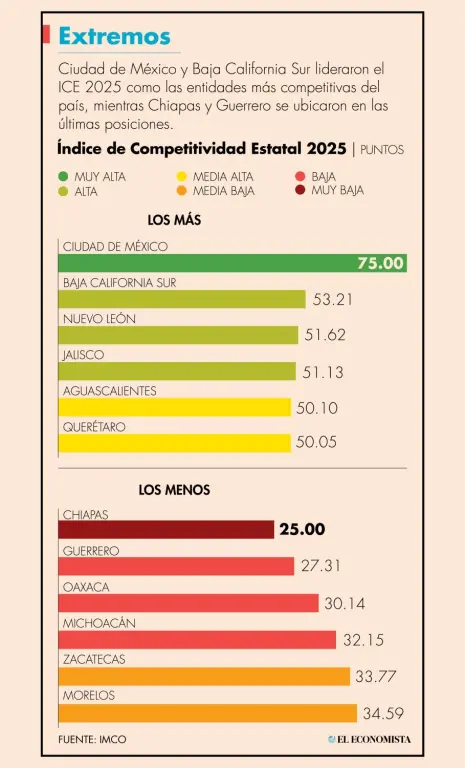
Mexico City stands out as the most competitive state (Very High), as it is the country’s administrative center, and excels in the economic sphere and for its infrastructure, according to the State Competitiveness Index (ICE) 2025 of the Mexican Institute for Competitiveness (IMCO).
The ICE is a snapshot of the strengths and weaknesses of the country’s 32 states in generating, attracting, and retaining talent and investment. “A competitive state is one that makes efficient use of its capabilities to trigger a favorable environment that contributes to improving its development and, consequently, the well-being of its inhabitants.”
With a High competitiveness rating, Baja California Sur remained in second place in the ranking, due to the tourism boom; followed by Nuevo León, an industrial powerhouse in the north; and Jalisco, which climbed six places in the ranking, due to its technological ecosystem.
The ICE measured 53 indicators based on official data, which were grouped into six sub-indexes.
Innovation and Economy evaluates states’ ability to compete in high-value-added sectors, such as patent registration, where Jalisco and Mexico City lead with four applications per 100,000 people; economic diversification, global connection, GDP per capita, and foreign investment.
Infrastructure, digital connectivity and logistics are analyzed. Mexico City dominates in banking terminals with 379 per 10,000 adults; Querétaro leads in air cargo, and Quintana Roo in passenger flow; Baja California and Quintana Roo lead in internet access and mobile telephony, while Chiapas has the greatest lag in both indicators.
The Labor Market reveals that labor informality reaches 78% in Oaxaca, Guerrero, and Chiapas, compared to 30% in Coahuila, Nuevo León, and Baja California Sur; the highest salaries are paid in Mexico City, with an average of 16,487 pesos per month; Chiapas reported the lowest average monthly average, at 7,059 pesos.
In Society and Environment, Nuevo León leads in life expectancy at 77.7 years, and Mexico City leads in hospital beds at 1.68 per 1,000 inhabitants. Chiapas ranked last in both indicators, with 73 years and 0.42 beds. Hidalgo treats 9.99 liters of wastewater per second per 1,000 inhabitants, while Campeche only 0.12.
The Law sub-index highlights public safety conditions, with Colima having a homicide rate of 99.16 per 100,000 inhabitants and 33.22 crimes per 1,000 inhabitants, while Yucatán recorded the lowest rates.
Political System and Governments shows progress in state debt as a proportion of total revenue. Nuevo León had the highest level at 52%; the perception of corruption exceeds 70% in 30 states.
The Medium-High and Medium-Low competitiveness categories each group 12 states. The largest movements in the competitiveness ranking are presented in the middle table. “A state can improve its absolute indicators but drop in the ranking if others advance more quickly,” clarified Valeria Moy, general director of IMCO.
Michoacán is ranked as Low competitiveness due to its institutional and citizen participation weaknesses; Oaxaca, due to lags in connectivity and basic services; and Guerrero, which “is a case of the consequences of a lack of diversification and a low economic sophistication,” she added.
Chiapas is the only state with Very Low competitiveness, having lower educational coverage, life expectancy, access to healthcare, among other factors.
Chiapas is the only state with Very Low competitiveness, having lower educational coverage, life expectancy, access to healthcare, among other factors.
The southern region faces greater challenges in implementing Plan Mexico.
The northern and central states of the country are better positioned to capitalize on Plan Mexico, which aims to replace imports through industrial development in 12 economic corridors, where Wellbeing Development Poles (Podebis) will be established, housing industries determined by the vocation and potential of each region.
“Plan Mexico speaks of regions, regardless of whether we agree or not with how the corridor was defined, it speaks of cooperation between states,” said Valeria Moy, director of the Mexican Institute for Competitiveness (IMCO), during the presentation of the State Competitiveness Index (ICE) 2025.
In this edition, IMCO linked the ICE results with the Plan Mexico proposals, because “when we look at the state of the states, it’s not clear whether there are specific ones that will be able to take advantage of Plan Mexico or whether it will be able to lift those states out of their current low level of competitiveness.”
The success of Plan Mexico will depend on its ability to implement strategies that take into account the characteristics of each region. The same policies cannot be applied in corridors such as the Border Strip, where the challenge is to scale up to advanced manufacturing, as in the Isthmus of Tehuantepec, where deficiencies in basic infrastructure and security must first be addressed.
ICE 2025 shows that the states with the lowest competitiveness—Chiapas, Guerrero, Oaxaca, and Michoacán—cross the Pacific, Central, Isthmus, and Mayan corridors. “Declaring an economic corridor is not enough; in the south, we need to first resolve the basics.”
The federal government’s priority is the southern region, where the Podebis related to the Interoceanic Corridor are already underway.
Source: eleconomista