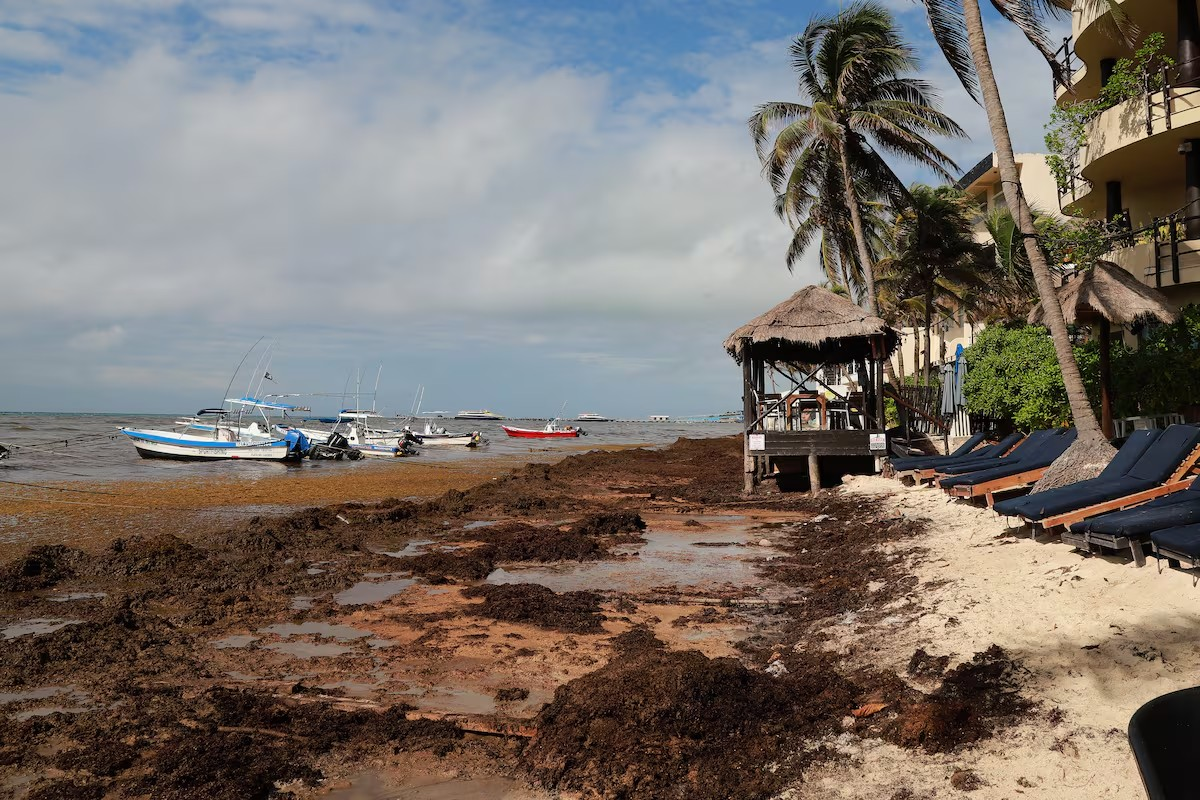

Seven years ago, 522,000 tons of sargassum washed up on Mexican beaches, a historic figure. Specialists Lorenzo Álvarez and Brigitta Ine Van, researchers at the Reef Systems Academic Unit of the Institute of Marine Sciences and Limnology (ICMyL) at UNAM, warned that this year’s arrival of sargassum could exceed the historic peak of 2018. The scientists made this prediction after observing, via satellite, a large belt of these algae advancing across the Atlantic; it is moving from northern Brazil and Africa, passing through the Caribbean Sea, and will reach the coasts of the southern United States. Despite their announcement, authorities estimate that only 60,000 tons will arrive, a conservative figure, since ICMyL experts expect at least 400,000 tons, in their most optimistic forecast.
Alicia Bárcena, head of the Ministry of Environment and Natural Resources (Semarnat), stated during President Claudia Sheinbaum’s morning press conference that they are preparing a plan together with the Ministry of the Navy to utilize the macroalgae: “What we want now is to change the dynamic and collect the sargassum at sea, alive, because by the time it reaches the beach, it’s already decomposed.”
Every year, thousands of tons of sargassum wash up on Mexico’s Pacific coasts starting in March, reaching its peak between May and August and ending in September.
Bárcena also said that the president has asked her, together with the government of Quintana Roo, to build a sargassum treatment plant to collect, treat, and generate biogas. “We are looking for the land; we already have some studies. I think it’s urgent, really. We hope to get it up and running this year,” she concluded. So far, the beaches of Cancún, northern Puerto Morelos, Playa del Carmen, Tulum, Mahahual, and Xcalak are the most affected, all in Quintana Roo.
Mara Lezama Espinosa, the state governor, and Óscar Rébora, head of the Secretariat of Ecology and Environment (SEMA) of Quintana Roo, also announced the establishment of an emergency working group to address the macroalgae. “The objective is to address the priority areas where the most intense sargassum buildup occurs, through a coordinated strategy with the three levels of government and the Secretariat of the Navy (SEMAR).”
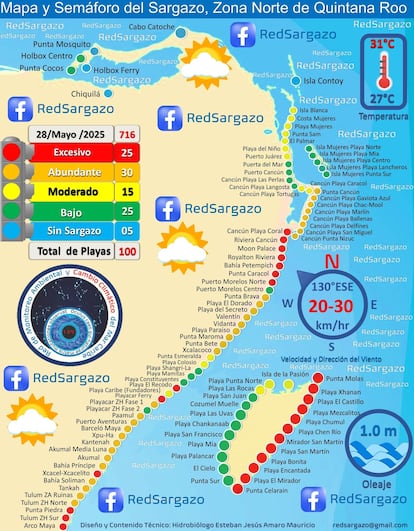
Every year, the Sargassum Monitoring Network in Quintana Roo publishes a map and a traffic light system to locate the areas with the highest concentrations of this algae. The traffic light system is divided into blue, which indicates no sargassum; green, low levels; yellow, moderate levels; orange, abundant levels; and red, excessive levels.
Although modest amounts of sargassum benefit marine life in the region, the massive influxes since 2011 are altering the ecological balance in ways that could be irreversible.
Source: elpais