The conquest of America is undoubtedly one of the historical episodes with the most contradictory versions and legends surrounding it that we know of. The terms “rose legend” and “black legend” are often used to refer to two opposing views of the process: the romantic idealization of those who conquered that territory, conceived as “untamed,” and the invasion, subjugation, and devastation of the indigenous peoples and their domains.
Little attention, however, is paid to the personal experiences of those who arrived there for the first time, whose testimonies have been relegated to the realm of university research or to the curiosity of historians and seekers of new knowledge, who have been able to read in awe how Cortés’s men, newly arrived in Tenochtitlán, compared the city’s great market with the commercial centers of Rome and Constantinople, even claiming to have never seen anything like it.
Is there perhaps something in their voices that allows us to interpret in new ways this crucial moment in the historical relationship between continents? What did Columbus and Cortés intend to tell us, however, that was buried by the uncontrollable flow of events, intentions, and the people who followed them?
Christopher Columbus is undoubtedly a controversial figure today. The stigma of having blazed a trail marked by the subsequent long-term human and material exploitation of the conquered continent is a mark difficult to ignore. However, beyond his iconic role in an invasion that would have repercussions to this day, there was a first man who set foot, incredulously, on a strange land, and who was surely more possessed by shock, emotion, and fear than he could have imagined, like any other navigator or explorer of unknown latitudes.
Given this assumption, it is worth asking whether he had anything to say, long before the historical construction that was made of his figure and that erected him as a symbol of the centuries that followed and that he never knew. Indeed, Columbus left us several travel journals and letters to the crown from his pen, reporting on his discoveries; one of these documents, of a more intimate nature, provides us with some clues about his particular vision.
At the beginning of 1493, having just set sail back to Europe after his first expedition to the Antilles, Columbus wrote in a letter to his friend Luis de Santángel, referring to the island of Juana (present-day Cuba): “There are many ports on the sea coast without comparison to any other Christian ones I know of […]; there are many metal mines in the lands and a considerable number of people […]; the sea ports, here there would be no belief without sight.”
His impression, of no lesser importance for being the first, only sheds light on the barbaric condition to which the indigenous people were later condemned in historical accounts, and immediately allows us to form a different idea about the pre-Hispanic American world. The navigator continues sincerely, referring to the people he encountered: “They, when asked for anything they have, never say no; rather, they invite the person with it, and show such love that they would give their hearts, and whatever it is, whatever it is of little value, then, for whatever, however it is given to them, they are content.”
Isn’t this condition he describes, perhaps, much closer to the Christian spirit he himself professed than to the “savagery” with which history, now undoubtedly under question and revision, stigmatized the inhabitants of the so-called New World? Certainly, Columbus’s words suggest a different conception of the emblematic encounter between the navigator and the inhabitants of what he believed to be the West Indies.
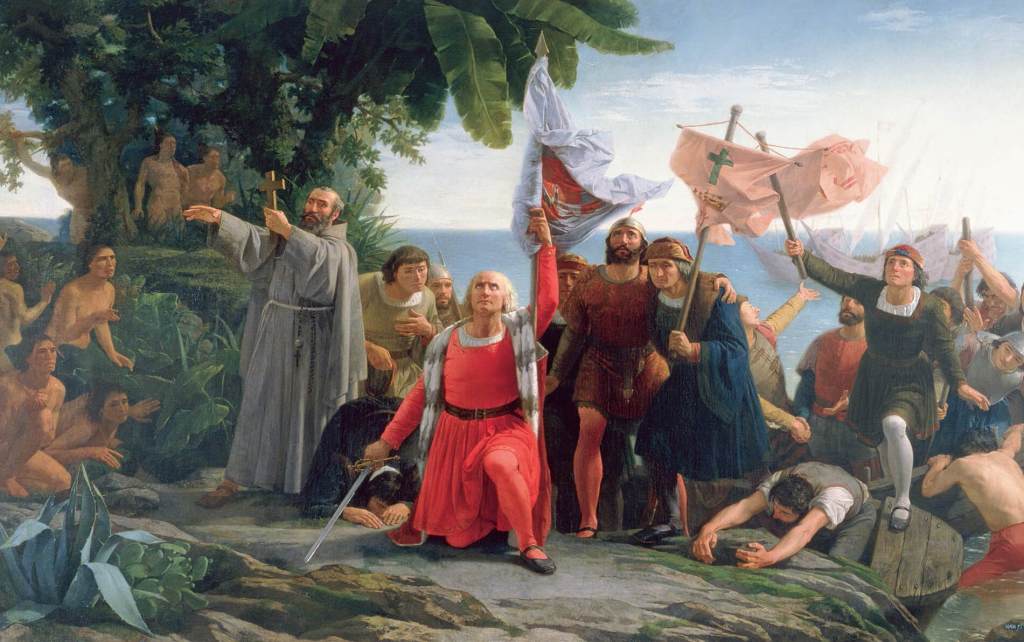
In fact, in his letter, as if doing justice to the newly discovered populations, he concludes: “And they firmly believed that I, with these ships and people, came from heaven, and with such respect they received me everywhere after having lost their fear. And this is not because they are ignorant, except for those of very subtle wit, and men who navigate all those seas, for it is marvelous how well they give an account of everything, except that they have never seen people dressed in clothing or such ships.”
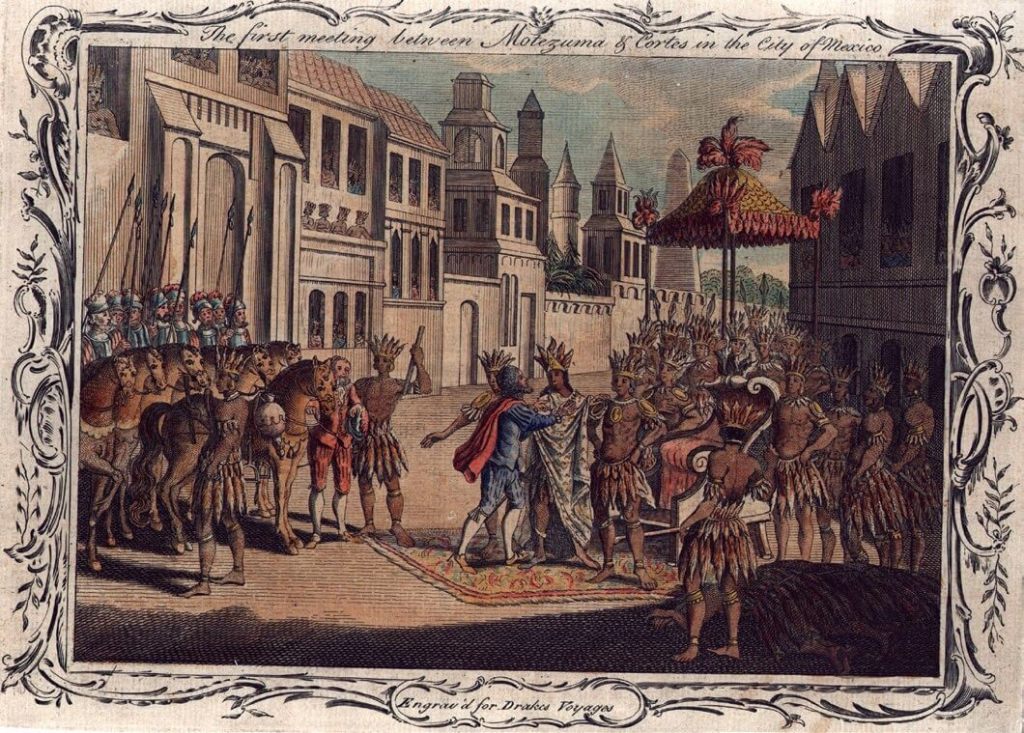
Hernán Cortés in a plaza
“I will tell you some things I saw, which, although poorly expressed, I know will be so admirable that they will not be believed, because those of us who see them here with our own eyes cannot comprehend them with our understanding.” Thus begins Hernán Cortés’ account of his arrival in the capital of the Aztec Empire. And, throughout his Letters of Relation, he spares no expense in expressing shock and impact. Having arrived, unlike Columbus, to urbanized territories organized under a vast imperial structure, Cortés pauses and examines other types of elements, linked to the advancement of Mexica civilization. This is how he describes Tenochtitlán:
“The city is as large as Seville and Córdoba […]. This city has many plazas, where there is a continuous market and buying and selling. It has another plaza as large as twice the size of Salamanca, surrounded by gates all around, where there are over sixty thousand souls buying and selling every day; where there is every kind of merchandise found in any land, including provisions and supplies, jewelry made of gold and silver, lead, brass, copper, tin, stones, bones, shells, snails, and feathers. Lime, hewn and unhewn stone, adobe bricks, bricks, hewn and unhewn wood of various kinds are sold. There is a hunting street where all kinds of birds found in the land are sold […].”
Cortés’s words are inspiring, especially in this multicultural and global present of the 21st century, for which the process of conquest of America appears as one of the undeniable turning points, whose imaginary is in transformation. Should we also be dazzled by the wide avenues and magnificent markets of the Aztec city? What would we think today if we arrived there?
Cortés is blunt in his verdict: “I wish to say no more than that in their service and treatment of their people, there is almost the same way of life as in Spain, and with as much harmony and order as there, and that considering these people to be barbaric and so removed from the knowledge of God and from the communication of other nations of reason, it is admirable to see the way they behave in all things.”
The Encounter with Difference
Undoubtedly, it is very difficult to unravel the complex nature and course of the human encounter with the other, with difference; the clash between civilizations. However, studying that moment through the humanity of the people who experienced it grants the reader the unique space for personal reflection, for face-to-face confrontation, from sensitivity to sensitivity.
Because reading it in its particular humanity does not exempt any person from their historical responsibility, but it certainly situates them in their circumstances and character and opens up for posterity the range of historical assessment, interpretation, and discussion. For ultimately, as the popular saying that has survived from the time of Columbus to the present day goes, everything that came after is a different kettle of fish.
Source: muyinteresante