
On February 14, 2024, Karla Estrella, a woman from Hermosillo, Sonora, wrote on X: “This is how Sergio Gutiérrez Luna threw a tantrum to get his wife included. They had to mess up the ticket to give him a candidacy. Zero evidence and zero doubts.” The tweeter was referring to Diana Karina Barreras, who at the time was a local deputy in Sonora, was running for the federal chamber, and is married to Gutiérrez Luna, a member of Morena and president of the country’s Chamber of Deputies. For that post, Estrella will have to apologize for 30 days, pay a fine, take a gender course, and be registered in the INE’s Registry of Sanctioned Persons for a year and a half. Barreras reported her for political gender violence, and the Federal Electoral Tribunal has sanctioned her. This case adds to a trail of lawsuits and legislative attacks against freedom of expression led by Morena governors and politicians.
Many pieces have come together in recent weeks. Journalist Jorge González has been disqualified and charged with hate crimes following accusations by Campeche Governor Layda Sansores; complaints and court rulings have emerged against journalists Héctor de Mauleón and Ángel Camarillo, against the media outlets Código Magenta, Tribuna, and SinEmbargo.mx, and against social media users Karla Estrella and Laisha Wilkins. Most were accused of gender-based political violence, and all were sued by figures linked to the ruling party. Meanwhile, the Puebla Congress, dominated by Morena, has passed a law on cyberbullying, dubbed the Gag Law, which threatens anyone who insults people on social media with up to three years in prison.
“From May to date, we have seen an exponential increase in these acts, particularly in the context of gender-based political violence. At the same time, we are seeing a series of initiatives, some already in force and others on hold, that have a clear censorious tinge,” explains Leopoldo Maldonado, director of Article 19. The organization defending freedom of expression has recorded an escalation in cases of judicial harassment of journalists and media outlets since 2019, reaching an average of 20 complaints per year—that is, one every three weeks against Mexican journalists. “We have seen with concern the increase in criminal, civil, and administrative proceedings against journalists, not with the aim of claiming the violation of a personality right (such as reputation or image), but with the aim of undermining the media outlet and the journalist,” Maldonado notes.
The Judicial Election, the Perfect Umbrella
One of the factors that has influenced the increase in complaints, both from reporters and ordinary citizens, is the scrutiny of the thousands of candidates running in the judicial election. On June 1, nearly 2,700 judicial positions were being elected, from Supreme Court justices to magistrates and circuit court judges. Despite the multitude of profiles, both civil society and the media managed to identify controversial figures, due to their ties or even their criminal records.
In early May, journalist Héctor de Mauleón was accused of slander and gender-based political violence by Tania Contreras, a former legal advisor to Tamaulipas Governor Américo Villareal, who was running for a magistrate position. In her column, Mauleón presented Contreras as “Morena’s strong candidate” to preside over the State Supreme Court and cited a leak from Guacamaya Leaks linking the candidate’s family to a corruption and fuel theft network in the state.
Quickly, the Tamaulipas Electoral Tribunal—where one of the members is Contreras’s first cousin—ordered El Universal to withdraw the column and prohibited them from publishing anything about the candidate again. Tania Contreras used the exact same strategy against the digital media outlet Código Magenta and its director, Rodrigo Carbajal, who criticized this “attempt at censorship”: “Código Magenta believes that citizens have the right to know who the candidates are who intend to take control of the Judiciary.”
Actress and host Laisha Wilkins has also been sued for a comment about a judicial candidate. In this even more surreal case, Wilkins had only responded to a tweet from the media outlet Aristegui. The news and the X-post from this outlet read: “Dora the censor: candidate for SCJN minister attempted to censor Televisa Leaks investigations”; to which the actress responded: “Haha, Dora the censor, haha.” For those five words, Wilkins has been sued for political gender violence.
The candidate in question, Dora Martínez Valero, who had called herself “Dora the Transformer”—hence the nickname—has denied being the one who accused Wilkins, although she has acknowledged that she did accuse three other people of slander and political gender-based violence. The actress must now respond to the Federal Electoral Tribunal’s questions. “What’s important here is citizen censure,” she wrote, “we must unite as a society to not allow the abuse of our rights and freedoms.”
Misused Political Gender-Based Violence
In 2024, of the 21 cases opened against journalists, Article 19 recorded that 28.5% used political gender-based violence as an excuse. “This is about the abuse and misuse of legitimate positions, which are the result of women’s historical struggles, against the press,” notes Leopoldo Maldonado. “They are using it as a form of censorship.”
Under this pretext, journalist Ángel Camarillo of Al calor político (Political Heat) was sanctioned on May 17 for publishing an investigation into ties between officials and candidates in Veracruz. The reporter recounts 10 cases of nepotism, involving both men and women, including a candidate for mayor of Teocelo, the daughter of the incumbent mayor, who reported him. The regional chamber of the Electoral Tribunal has sentenced him to a fine, the withdrawal of the report, and a public apology.
The misinterpretation of this concept reached a new peak this Monday: lawyer Miguel Meza, founder of the Defensorxs platform and who conducted an exhaustive scrutiny of the judicial election, was accused of “political violence” by Luis Castañeda, a candidate for labor judge in Mexico City. This crime does not exist in the law, but Castañeda argues this way: “Political violence against men, although less visible than political violence against women, does exist.” Castañeda was accused of sexually harassing 36 women, but the INE (National Institute of Statistics and Census) has accepted his complaint. “This is part of the intensification of attacks on freedom of expression that we have experienced in recent weeks,” Meza wrote.
Puebla’s Gag Law
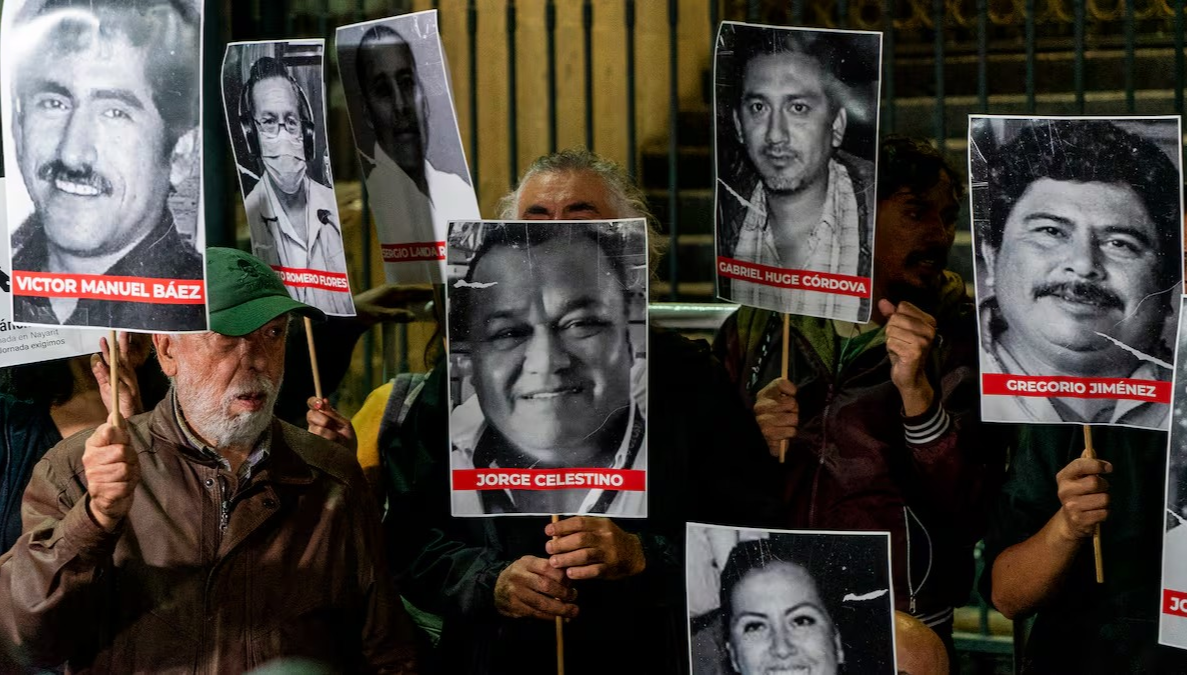
In a country known for its use of espionage against journalists, or for being the most lethal against the press, obstacles to critical stances now also come in the form of legislation. In early June, the Puebla Congress approved Governor Alejandro Armenta’s proposed reform to the Cybersecurity Law. The governor, who insulted a reporter at one of his press conferences and asked the Attorney General’s Office (FGR) to open an investigation for defamation and—again—gender-based violence, defined “cyberharassment” as punishable by up to three years in prison.
The ambiguity of the law, which defines cyberharassment as “using social media to insult, slander, offend, harm, or harass another person,” raised alarm bells. “It’s going in the opposite direction. From 2006 to the present, Puebla has sought to repeal crimes against honor, and now they are returning to these punitive measures against freedom of expression,” notes Leopoldo Maldonado.
Even the National Human Rights Commission, which is headed by the controversial Rosario Piedra Ibarra, who is very close to Andrés Manuel López Obrador, has urged the local Congress to review the legislation it has just passed: “The CNDH considers that the text of Article 480 presents ambiguities that could lead to undue restrictions on the right to freedom of expression.” The agency, which is already working on a constitutional challenge, has asked the Puebla authorities to prevent “the use of criminal law as an indirect means of censorship.”
Source: elpais