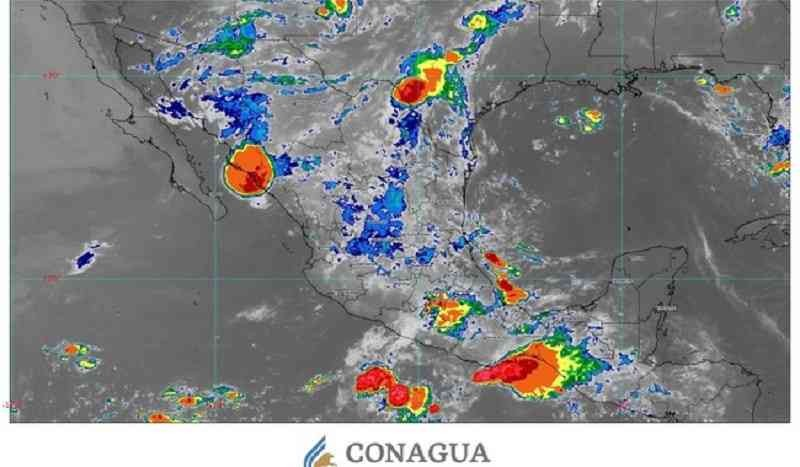

For Monday, heavy rainfall (75 to 50 millimeters [mm]) is forecast in Chihuahua (west and southwest), Durango (west, northwest, and north), and Sinaloa (north); very heavy rainfall (50 to 75 mm) in Sonora, Coahuila, Guanajuato, Querétaro, and Hidalgo; heavy rainfall (25 to 50 mm) in San Luis Potosí, Zacatecas, Aguascalientes, Nayarit, Jalisco, Colima, Michoacán, Puebla, the State of Mexico, Mexico City, Guerrero, Oaxaca, Chiapas, Tamaulipas, and Veracruz; as well as showers (5 to 25 mm) in Baja California Sur, Nuevo León, Morelos, Tlaxcala, Tabasco, Campeche, Yucatán, and Quintana Roo.
The rainfall could cause landslides, rising river and stream levels, as well as overflows and flooding in low-lying areas of the aforementioned states. Therefore, the public is urged to heed the warnings of the National Meteorological Service (SMN) and follow the recommendations of Civil Protection.
Winds of 30 to 40 kilometers per hour (km/h) with gusts of 50 to 70 km/h are expected in the Gulf of California, Sonora, Coahuila, Nuevo León, and Tamaulipas; 20 to 30 km/h with gusts of 40 to 60 km/h are expected in Baja California Sur, Chihuahua, Durango, Zacatecas, San Luis Potosí, Puebla, Oaxaca, Chiapas, Tabasco, Campeche, Yucatán, and Quintana Roo, and with possible dust storms in Baja California.
The forecasted strong winds could cause trees and billboards to fall. Therefore, the public is urged to heed warnings from the National Meteorological Service (SMN) and the National Water Commission (Conagua), and follow Civil Protection recommendations.
Likewise, maximum temperatures above 45 degrees Celsius are expected in parts of Baja California (northeast); 40 to 45 degrees Celsius in Sonora and Campeche; 35 to 40 degrees Celsius in Baja California Sur, Sinaloa, Chihuahua, Coahuila, Nuevo León, Durango, Nayarit, Colima, Michoacán, Guerrero, Oaxaca, Chiapas, Tamaulipas, Veracruz, Tabasco, Yucatán, and Quintana Roo; and 30 to 35 degrees Celsius in Zacatecas, San Luis Potosí, Jalisco, Querétaro (north), Hidalgo (north), Puebla (north and southwest), and Morelos (south).
The aforementioned will be caused by the Mexican monsoon in the northwest of the national territory, the entry of humid air from the Gulf of Mexico, the Pacific Ocean and the Caribbean Sea, a low pressure channel extended over the Northern and Central Tablelands, atmospheric instability, the gradual movement of tropical wave number (num.) 11 over the south and west of the country, the passage of tropical wave number 12 over the southeast of the Mexican Republic and a low pressure channel.
Source: hojaderutadijital