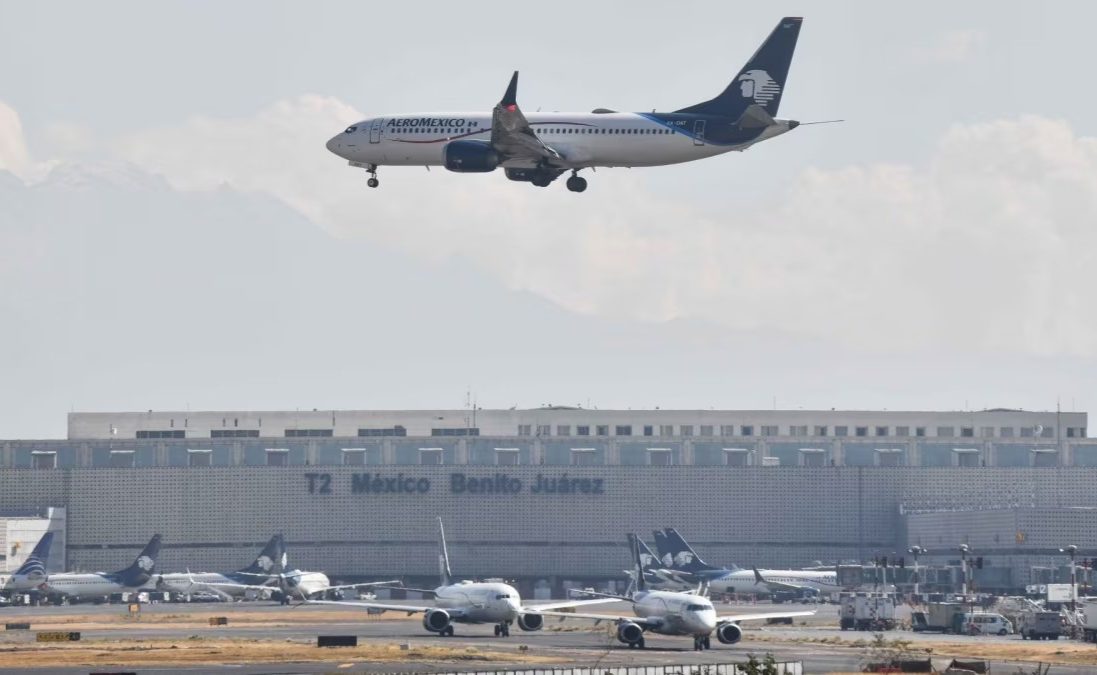

The United States government announced this Saturday, July 19, a series of sanctions against Mexico for alleged non-compliance with the Air Transport Agreement signed in 2015. It accuses anti-competitive practices that have severely affected US airlines.
Department of Transportation Secretary Sean P. Duffy explained that the sanctions are part of an “America First” policy promoted by President Donald Trump and aim to curb “Mexico’s abuse of the bilateral aviation market.”
“Joe Biden and Pete Buttigieg deliberately allowed Mexico to violate our bilateral aviation agreement,” Duffy stated.
Why are you accusing Mexico of violating the bilateral aviation agreement?
The Department of Transportation highlighted the forced relocation of US cargo airlines away from Mexico City International Airport (AICM).
“Mexico has been violating the bilateral agreement since 2022, when it abruptly rescinded slots (takeoff and landing time slots) and then forced US cargo airlines to relocate their operations,” he stated.
He noted that the government led by Claudia Sheinbaum argued that the measure was to allow construction to alleviate congestion at Benito Juárez International Airport, “a project that three years later has still not materialized.”
“By restricting slots and forcing the relocation of cargo operations outside the AICM, Mexico has broken its promise, disrupted the market, and left US companies with millions in additional costs,” he asserted.
Duffy charged that “Mexico has broken its commitments, distorted the market, and harmed our companies. That ends today. Let these actions serve as a warning to any country that believes it can take advantage of the United States.”
He added that he is even monitoring European airlines.
What sanctions could it impose on Mexico for the aviation agreement?
In the statement, the United States government details the three actions included in “America First” to sanction our country:
- Require Mexican airlines to submit their schedules to the Department for all operations in the United States.
- Require prior approval from the Department of Transportation before operating charter flights of large passenger or cargo aircraft to or from the United States.
- Remove antitrust immunity (ATI) from the cooperation agreement between Delta and Aeroméxico, as a corrective measure to address competition issues in the market.
The US could reject flight requests from Mexico
In addition, the Department of Transportation warned that it reserves the right to reject future flight requests from Mexico if immediate corrective actions are not taken.
If the revocation of antitrust immunity is approved, Delta and Aeroméxico would be able to maintain their partnership solely through activities such as codeshares or frequent flyer programs, but they would no longer be able to coordinate prices or routes as they did under the current agreement.
The sanctions mark an escalation of trade tensions between the two nations and could affect air traffic between the United States and Mexico, one of the busiest international corridors in the world. So far, the Mexican government has not issued an official response.

Source: elfinanciero