
In an unprecedented blow against institutional corruption, the State of Mexico Attorney General’s Office (FGJEM) dismantled a sophisticated criminal network dedicated to creating, selling, and illegally exploiting teaching positions through a so-called “ghost employee” (“aviadores”) scheme. According to authorities, the organization had been operating systematically since at least 2021, causing multimillion-peso losses to public funds.
In an official statement, the FGJEM confirmed that criminal charges have been filed against 33 individuals, including former public officials, current government employees, and private citizens. Between June 28 and July 4, 2026, the judiciary held the corresponding hearings, resulting in 26 suspects being formally charged and placed in pretrial detention at the Santiaguito Correctional Center in Almoloya de Juárez.
One additional suspect is awaiting a ruling on their legal status, while five others have filed constitutional injunctions (amparos).
The Investigation Began with Irregularities in the Education Ministry
The investigation began after February 11, February 26, and May 4, 2026, when the legal representative of the State of Mexico Secretariat of Education, Science and Technology (SECTI) filed formal complaints after discovering 459 irregular personnel appointments involving teaching positions.
Authorities found that many of the supposed employees were receiving salaries despite performing no teaching duties.
Technology Was Used to Sustain the Scheme
According to the investigation, the organization relied heavily on two government computer systems:
- SIGAP (Comprehensive Personnel Management System) operated by SECTI.
- META 4, administered by the State’s General Services Office for payroll processing, implemented in late 2017.
Despite lacking the required administrative documentation, professional credentials, and employment records necessary to hire teachers legally, operators allegedly entered false employee records directly into the systems while bypassing internal controls.
Family Connections and a Key Arrest in 2021
Investigators determined that the criminal organization was strengthened by family relationships and close personal ties.
When one trusted government employee left office, another member of the network allegedly replaced them, allowing the operation to continue uninterrupted.
Several suspects reportedly knew one another before entering public service and had even worked together developing the META 4 payroll platform, later obtaining strategic positions within the Secretariat of Finance and other government agencies.
A key breakthrough occurred on December 19, 2021, when authorities arrested Juan Alberto “N” at an ATM in downtown Toluca.
At the time of his arrest, officers reportedly found:
- 164 debit cards issued in the names of employees assigned to the State Security Secretariat.
- 180,000 pesos in cash.
According to prosecutors, his supervisors attempted to conceal the offense by falsely claiming he had been authorized to handle banking transactions due to defective debit cards. Other public officials allegedly supported this explanation by providing similar statements.
Recruiters, Data Entry Operators, and Ghost Salaries
The financial operation allegedly relied on an extensive recruitment network spanning positions within:
- The Secretariat of Education
- The Secretariat of Security
- Allegedly, the Secretariat of Health
Recruiters—including Sabina “N”, who herself reportedly received a fraudulent teaching salary between January 2025 and February 2026—were responsible for recruiting trusted relatives and friends.
Once fraudulent appointments were approved:
- Recruiters retained payroll debit cards.
- Accomplices withdrew government funds from ATMs.
- Most of the money was distributed among senior members of the organization.
According to investigators, an individual whose identity was used to obtain a fraudulent teaching position might receive only 6,000 pesos out of approximately 200,000 pesos deposited as salary, while organization leaders allegedly kept the remaining funds.
Payroll Data Operators Allegedly Violated Official Procedures
Investigators state that payroll data entry personnel ignored mandatory hiring procedures established under Procedure 022 of the Personnel Administration Manual.
Among the alleged violations:
- Hiring employees without official authorization.
- Processing appointments without the required Personnel Movement Form (FUMP).
- Entering records during overnight hours.
- Alternating user accounts monthly to conceal responsibility.
Some operators allegedly processed more than 70 fraudulent appointments, reportedly receiving 5,000 pesos for each.
Inactive Schools Were Used to Hide Fake Teachers
To avoid detection, senior members allegedly coordinated the exchange of SIGAP system passwords between employees of SECTI and the General Services Office.
This allowed fraudulent teachers to be assigned to inactive educational centers in municipalities including:
- Almoloya de Alquisiras
- Amecameca
- Ecatepec
- Luvianos
- Naucalpan
- Nezahualcóyotl
- Metepec
- Tejupilco
- Texcoco
- Toluca
- Zinacantepec
- Zumpango
Panic Messages During Government Audits
The investigation file reportedly consists of 30 volumes containing more than 12,000 pages, including text messages instructing ghost employees not to register with the ISSEMyM public health system.
Following the first official complaint filed in February 2026, organizers allegedly circulated messages urging participants to destroy evidence and deny any connection with government employment if questioned by investigators.
Lavish Lifestyles Allegedly Financed by the Scheme
According to prosecutors, every suspect also benefited personally by obtaining one or more teaching positions paying approximately 50,000 pesos per month, while remaining on irregular leave to preserve retirement and employment benefits.
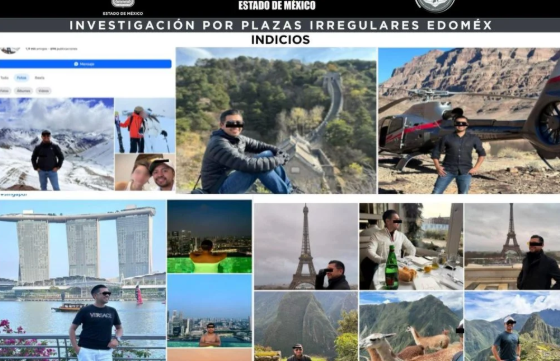
Socioeconomic analyses reportedly found that many suspects maintained lifestyles inconsistent with their legitimate income, including:
- Luxury trips to Paris, Dubai, Las Vegas, the Caribbean, China, and Egypt.
- Residences in high-value neighborhoods.
- Ownership of luxury vehicles, designer clothing, and expensive accessories.
Estimated Losses Reach 96 Million Pesos
The FGJEM classified the alleged conduct as abuse of authority and fraud.
Authorities estimate that between January 2025 and February 2026, the organization illegally obtained more than 96 million pesos, including:
- Approximately 4 million pesos every two weeks in payroll.
- Christmas bonuses.
- Vacation bonuses.
- Other employment benefits.
Investigators believe total losses could increase substantially if the scheme is proven to have operated continuously since 2021.
Because prosecutors argue that the crimes were committed repeatedly under the same criminal scheme, suspects could face cumulative sentences.
Estimated prison terms range from 10 to 26 years, with additional penalties potentially added for each fraudulent appointment attributed to an individual defendant.
Judiciary Expedited Arrest Warrants
The State of Mexico Judiciary established a special judicial operation to expedite:
- Arrest warrants.
- Search warrants.
- Initial criminal hearings requested by prosecutors.
Thirty-Three Individuals Under Investigation
The investigation includes former public officials, current government employees from multiple agencies, former security personnel, private citizens, payroll administrators, data-entry operators, recruiters, and individuals who have sought constitutional injunctions (amparos).
Death Under Investigation
The FGJEM also reported that José Daniel “N”, a public official who served as liaison between SECTI and the General Services Office’s Payroll Department and who was allegedly connected to the payroll scheme, was found dead inside his home on April 2.
Because of evidence found at the scene, prosecutors confirmed that his death remains under investigation under homicide protocols to determine whether it is directly related to the exposure of the alleged ghost employee fraud.
Source: comunicacionxxi