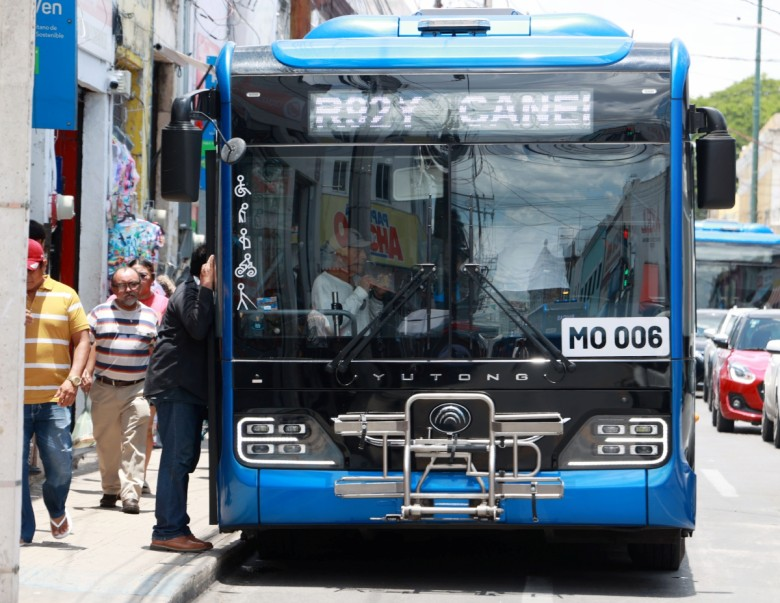

All of the Yucatán Transportation Agency’s (ATY) arguments regarding the Va y Ven system are refutable and questionable. We don’t understand why there is so much media fuss and disdain from the current government regarding this public transportation system, said Eduardo Monsreal Toraya, an urban development and mobility analyst at the Mérida Sustainable Mobility Observatory.
The specialist from this citizen technical organization does not rule out the possibility that the Va y Ven financial imbalance, denounced by the 4T government, is attributable to the excessive payment for the kilometers traveled by buses.
However, he noted, the ATY has the legal tool to correct and adjust the payment through Article 112 of the Mobility and Roads Law.
That law establishes in one of its paragraphs that every April a period of analysis and adjustment of this payment scheme for the public transportation system must be opened. The ATY has not used this mechanism to calibrate the payment for bus routes.
“It raises suspicions about why he hasn’t adjusted this payment, if he can do it privately and in meetings with the concessionaires without creating a huge media circus,” Monsreal Toraya said in an interview.
“Since Jacinto Sosa took office three months ago and appeared in the State Congress, the political line has been evident, but it’s already spiraling out of control and causing harm to users through the withdrawal of buses, non-payment to business owners, and statements that are completely irrelevant.”
“Blaming the Va y Ven transportation system as the cause of the increase in vehicle fleets in Mérida and Yucatán has no basis or connection with the crisis of the Va y Ven system, which has only been in place for three years, and the problem of the increase in motor vehicles has been going on for two decades,” he explained.
The Genesis of the Transportation Problem in Yucatán
According to Monsreal Toraya, “the growth of the Yucatán vehicle fleet began in 2000 and worsened with the COVID pandemic, because many people abandoned public transportation for fear of contagion and opted for private transportation.”
“This persists: public transportation use has not recovered, and it will recover even less with the distrust sown by the current government,” he stated.
He then added that the ATY’s major problem since Rafael Hernández Kotasek’s administration is its lack of transparency, openness to civil organizations, citizens, and university experts who are knowledgeable about financial matters, urban planning, mobility, and route design.
Although the ATY is obligated to be transparent about its management, neither before nor now does it post complete and comprehensive information, documents, financial statements, payment contracts with suppliers and concessionaires, the implementation of its budget, and everything related to the public transportation system on its website.
“Since Rafael Hernández’s time, they’ve only provided sketchy information, and this policy continues with the current director of the ATY,” he said.
“Without information, you can’t know how it works, what’s wrong, if there are errors, if it’s true that there isn’t money for the system’s sustainability, if the low occupancy of the routes is real.”
“We don’t fully understand the problem; we don’t know if the per-kilometer rate is excessive compared to other cities in Mexico and Latin America that prioritize and fund quality public transportation projects.”
Monsreal Toraya said that this ATY’s veto of citizens and experts prevents them from contributing their experience and knowledge and goes against the philosophy of the Morena government, which strives for improvements for the people.
With the Va y Ven (Va y Ven), it’s the opposite, he said. It’s generating discontent and mistrust and offers no solutions; they simply announce that they’re going to restructure the system, but they don’t say how they’ll do it.
“They never release the data, the route maps, or how it’s financed. Their website has little information, so citizens and those interested in learning about the Va y Ven system’s reality are unaware of the system’s implementation,” he noted.
“Perhaps it was a time bomb left by the previous administration, but it’s impossible to validate whether it’s true due to a lack of sufficient, accurate, and official information for free consultation.”
“Public transportation isn’t a matter of financial profitability, but rather of social profitability and well-being for the most vulnerable people, who are the ones who use the Va y Ven,” Monsreal Toraya emphasized.
“This is the aspect that current director Sosa Novelo hasn’t considered,” he lamented. “The lack of transparency generates speculation, assumptions, and uncertainty.”
What does the Va y Ven system need?
“It’s important that the ATY release all information related to the Va y Ven,” the analyst noted.
“We need figures to support the claims that the system is flawed. We need Sosa Novelo to comply with the creation of the Council established by the Mobility Law, and to open dialogue with experts to enrich and improve the project, not to set it back.”
“The Va y Ven is a national example for Sedatu. This model is part of a diploma program offered by that federal agency and gives Mérida international prestige, which encourages investment.”
The mobility analyst recalled that since the implementation of the Va y Ven program in Mérida began, doubts arose about how it would be sustained in the medium and long term. These doubts remained because Hernández Kotasek vetoed the organization due to the criticisms he made.
Nothing changed with the change of director, with the appointment of Sosa Novelo, because they also have no access to complete information about the Va y Ven program.
“We don’t know if the financial imbalance is justified by a lack of information, but in discussions with experts, we believe that the excessive payment per kilometer could be affecting the service.”
“There is a simple solution because the law authorizes lowering the fare, and they haven’t done so in the three months Sosa Novelo has been in power,” he emphasized.
“They say they’re making losses and that the system is unsustainable. We citizens can’t know because there’s no financial breakdown for a technical assessment.”
“What’s worrying is that they haven’t announced a solution or adjustment to the payment per kilometer. That’s what creates suspicion about everything the current government says.”
“The payment per kilometer model is applied in other cities around the world, and they know that public transportation requires a lot of funding and subsidies because it’s to serve people who need transportation for their activities.”
“If the Va y Ven bus service is eliminated, it will harm the most vulnerable people, and the system will fail to fulfill its mission of meeting the demand that arises in specific areas of the city with large real estate developments and the surrounding municipalities such as Conkal, Kanasín, and Umán,” he warned.
“The current buses serve a universal access function because 15% of Mérida’s population has a disability or is elderly and requires buses with low floors. The comfort of air conditioning and other digital services on the buses are intended to reconnect users who abandoned transportation due to its poor quality in the past or due to COVID-19.”
A “Cursed Inheritance”?
The Observatory analyst said that when valid arguments run out, labels emerge such as the “cursed inheritance” that Governor Díaz Mena attributed to the system for the Va y Ven problems, or the blame that Sosa Novelo attributes to the system for the increase in motorcycles and cars in the state, the increase in pollution, and the increase in traffic.
Monsreal Toraya considered it a good idea for Governor Díaz Mena to secure additional resources to maintain the Va y Ven (Va y Ven) because it is a financial emergency, but they should also turn to other sources of funding and turn to the Sedatu (National Transportation and Transport Authority) for project improvements because it is the federal agency responsible for mobility and road safety.
Sedatu even offers diplomas and specialized courses and uses the Va y Ven (Va y Ven) model as an example to follow in Mexico.
“If the Va y Ven (Va y Ven) has made a good impression on the federal government, it is contradictory that the state government demonizes it and generates so much concern and raises the tone of its criticism of the system,” he emphasized.
“The transportation system is modern and digitalized. Some areas need to be addressed and improved, but the worst thing that is happening is that bus frequencies are being reduced, they are being removed from the routes, and their transportation capacity is being reduced, because this will cause many users to abandon their use.”

Source: yucatan