
In cenotes on the Yucatán Peninsula, in southeastern Mexico, a team of scientists led by experts from the Institute of Geology (IG) of the National University discovered 22 fossil specimens of marine animals (bony fish, sharks, and manta rays), which reflect part of the region’s vast vertebrate diversity.
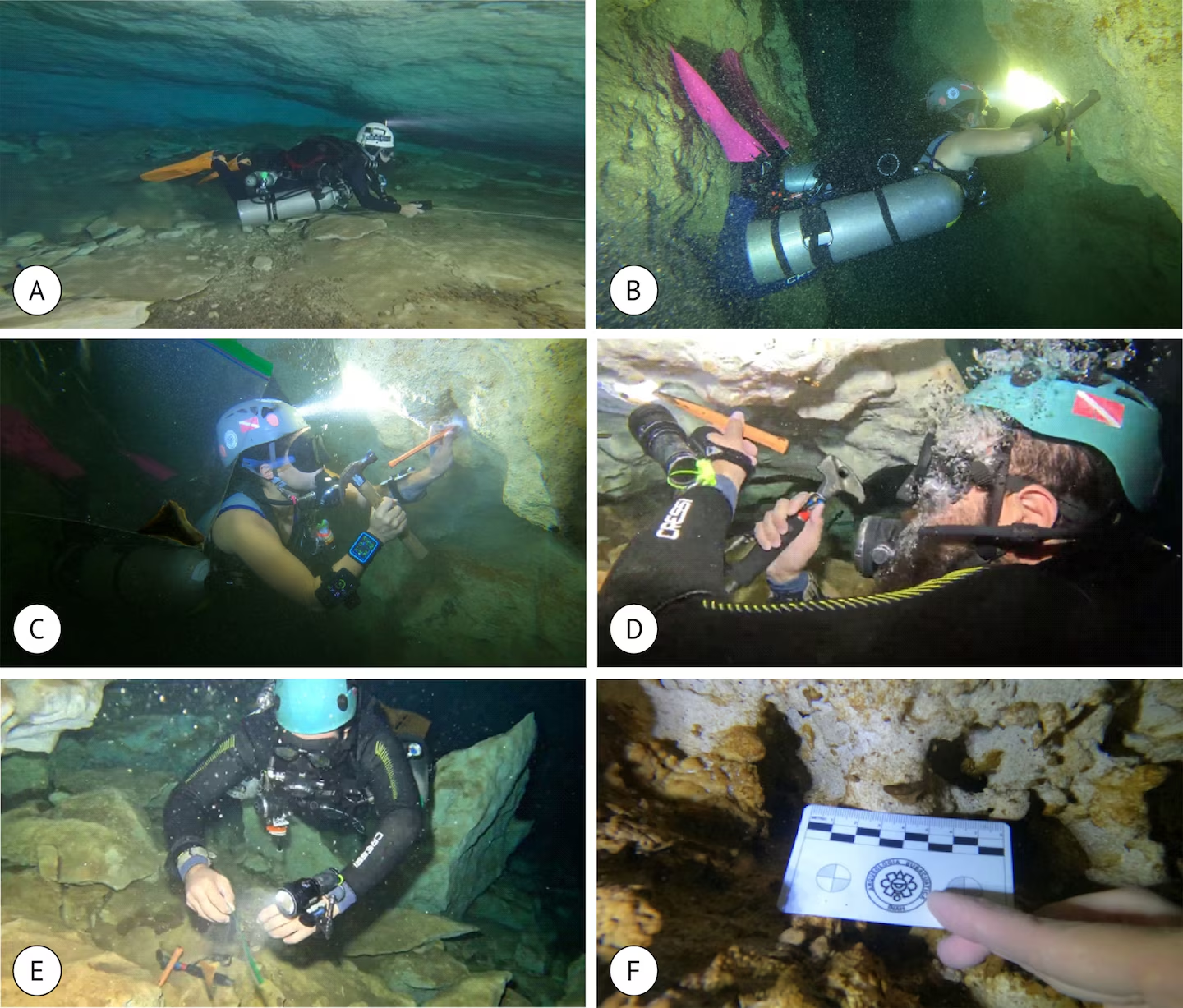
The work was carried out in collaboration with the Autonomous University of Baja California Sur (UABCS) and the Chicxulub Institute of Scientific Research and Advanced Studies of the Yucatán Science and Technology Park, as well as with divers specializing in underwater caves.
Cenotes are natural geological formations consisting of pits or depressions created when the roof of an underground limestone cave collapses, exposing the water contained in the aquifer, explained Kleyton Magno Cantalice Severiano, a paleontologist specializing in fish at the IG of the National University and project leader, in an interview.
The underwater cave system is formed by rainwater that, over time, penetrates the ground and erodes the sedimentary rock, called coquina, which is generally porous and formed by the accumulation of fossil organisms such as shells, corals, carapaces, and others, such as the teeth, bones, and jaws of the marine vertebrates we study, he commented.
On the Yucatán Peninsula, these natural sinkholes have formed on a carbonate platform from the Miocene (occurring between 11.6 and 5.3 million years ago) to the early Pliocene (approximately 5.33 to 3.6 million years ago) periods, in the geological formation known as Carrillo Puerto, the specialist stated.
“Based on the fossil record found in the rocks of the Carrillo Puerto Formation, we can identify the different groups of animals that lived on the Yucatán Peninsula, in what are now the cenotes. What is now a flooded cave system was previously a shallow sea,” he noted.
Underwater surveys were conducted in the cenotes Sambulá (in the municipality of Motul), San Juan (in Homún), and X-Nabuy (in Suma) by underwater cave divers Erick Sosa Rodríguez and Kay Nicte Vilchis Zapata, who collected fossils that scientists studied in the laboratory.
Understanding the geology of the cenotes was facilitated by Hugo Enrique Salgado Garrido, a professor at the Faculty of Sciences, while shark identification was assisted by Gerardo González Barba of the UABCS, Cantalice Severiano stated.
Among the species discovered are groups that still inhabit the Mexican coast, such as the copper shark (Carcharhinus brachyurus), bull shark (C. leucas), coral shark (C. perezii), and great white shark (Cacharodon carcharias); this represents evidence of their distribution along the Mexican coast for millions of years.
Extinct species such as the tiger shark (Galeocerdo mayumbensis), the sawtooth shark (Hemipristis serra), and the giant shark or megalodon (Otodus Carcharocles megalodon) were also detected.
In addition, taxa that are not currently distributed along the Mexican coast, such as the eagle and bull rays belonging to the genus Aetomylaeus, were also detected. This demonstrates the occurrence of extinction events in the North Atlantic Ocean.
The Porcupinefish
One of the most significant discoveries is the description of a new species of porcupinefish (Chilomycterus dzonotensis, which means “the porcupinefish of the cenotes”). This shows an increase in fish diversity during the geological period between the Miocene and the Pliocene in the Gulf of Mexico, and supports the existence of a shallow marine environment associated with a coral reef system in the past.
“It was identified primarily because the bony structure we found, which is the premaxilla in the form of a single piece, is a diagnostic characteristic of this group. This premaxilla has two portions of dental plates. The anterior portion is used for scraping, which is why we call it a scraping beak or biting beak. And on the inner part, there is a plate of teeth, which is the crushing plate, so it scrapes with the anterior part and crushes with the inner part,” he explained.
It is a characteristic structure of a specific group of fish, scientifically called the Diodontidae family. They have a globose shape that can be inflated and are nicknamed porcupine fish because their skin has spines, he added.
“As paleontologists, we want to know what happened in the history of living beings. There are species that were present millions of years ago and survive today, while others no longer exist. One investigation leads to another, and now we want to understand the reasons for these local and global extinctions; that will be the continuation of the work,” the university student emphasized.
The small size of some teeth, he noted, suggests that the deposits of the Carrillo Puerto Formation could have been a refuge for marine organisms at that time. Furthermore, the presence of certain taxa highlights the local extinctions that occurred.
This discovery enriches our knowledge of the history of marine biodiversity in the region and also underscores the importance of preserving these unique ecosystems for future generations.
Source: cronica