

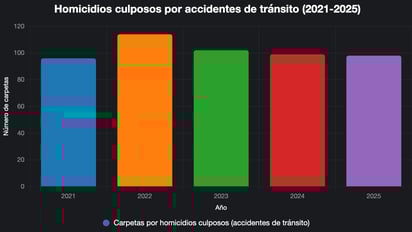
On average, 16 investigation files were opened per month between January and May of this year, with 19 in May, 13 in April and January, 14 in March, and 22 in February.
The state capital accounted for 27 of these fatalities during the first half of the year, the same number it had in 2024. Gómez Palacio reduced its cases from 27 in that period of 2024 to 20 in 2025 (–26%), while Lerdo increased from five to nine (+80%).
Although the statewide trend remains stable, the data is no cause for celebration: each opened case represents a life that did not return home, causing irreparable damage to families and the community.
Specialists and local authorities acknowledge that, despite statistical stability, a structural problem persists: negligent driving, excessive speed, alcohol, cell phone use, and a lack of road safety, along with weak infrastructure and ineffective regulations.
Durango’s new traffic regulations, which prioritize pedestrians and reduce speed limits, still face challenges in their implementation due to insufficient signage and lack of effective supervision. Furthermore, mandatory vehicle insurance (fines of up to 850 pesos for non-compliance) has not yet translated into widespread adoption by the population.
First-half figures
The 2025 figure represents a marginal reduction compared to 2024, but still shows a serious scenario close to the highest level recorded since 2021.
A controversial new speed limit
Durango’s new traffic and road regulations, approved on July 17, 2025, establish a speed limit of 50 km/h on primary roads, seeking to improve road safety and prioritize pedestrians and cyclists. However, it has generated discontent among citizens, who perceive the measure as restrictive and demand equitable enforcement of the law, along with increased surveillance to ensure compliance.
The population of Durango is demanding that, beyond reducing speed limits, authorities strengthen street enforcement and apply sanctions fairly.
It’s urgent to move from numbers to action.
Although recent data show stability or a slight decrease compared to previous years, the number remains unacceptably high. What’s needed:
Effective enforcement of the new regulations: clear signage, constant supervision, and real sanctions.
Comprehensive road safety information and education, targeting young people and frequent drivers.
Mandatory vehicle insurance, accompanied by awareness campaigns and surveillance protocols.
Safe road infrastructure, with traffic lights, speed bumps, and well-designed pedestrian crossings.
Every life lost on our streets is a sign that prevention remains an outstanding challenge.
It’s not enough to stabilize the numbers: it’s time to move toward a preventive road culture that truly saves lives.
Source: elsiglodedurango