
In the context of the World Day Against Trafficking in Persons, commemorated every July 30th, millions of people walk through streets and avenues every day, paying no attention to those who stand at intersections or street corners, begging for financial support.
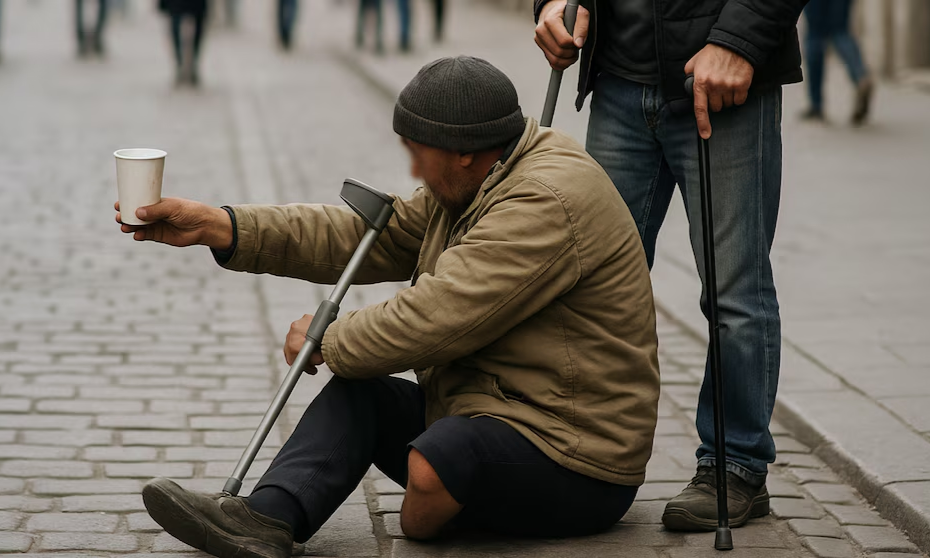
Behind those outstretched hands, especially when they belong to people with disabilities, lies a hidden problem that is part of the urban landscape.
We are talking about trafficking for the purpose of forced begging, which involves individuals who, due to their condition, are more vulnerable to exploitation networks. Mexico is experiencing a complex situation in this area.
Official data from the Legislative Branch and the Ministry of the Interior indicate that, between 2015 and 2023, reports have fluctuated significantly, from 415 in 2015 to 729 in 2023, with variations in between that reinforce the seriousness of the phenomenon and its persistence over the years.
The Hidden Face of Human Trafficking
María Elena Esparza, founder of Ola Violeta AC and gender advisor to the Mexico City Citizen Council, warned about this phenomenon.
“Trafficking of people with disabilities for forced begging represents one of the cruelest forms of human rights violations,” Esparza acknowledged through Yo También, a foundation dedicated to providing information on disability, inclusion, and accessibility.
This forceful statement brings to the forefront of the debate a reality that, although visible on the streets of Mexico City, Guadalajara, or Monterrey, often goes unnoticed by most passersby.
The daily presence of people with disabilities asking for financial support at traffic lights, street corners, or intersections has become so normalized that it has become invisible, diluting the seriousness of a phenomenon that, according to official figures, affects hundreds of victims each year.
Between 2015 and 2023, records of reports of human trafficking for forced begging in Mexico have shown an alarming trend. Data from the Chamber of Deputies documented that in 2015 there were 415 cases, a figure that dropped to 304 in 2017, then rebounded to 729 in 2023 and reached a peak of 805 reports that same year.
This variability reflects both the difficulty of detection and the persistence of the crime. The Ministry of the Interior officially recognized that forced begging is one of the most common purposes of human trafficking, particularly affecting minors and people with disabilities.
Disability as a tool of exploitation for criminals

The criminal logic behind this crime is as perverse as it is effective. María Elena describes how traffickers discovered that disability generates greater compassion in passersby, which translates into greater profits.
“Why, as a society, have we allowed vulnerability to become a tool of exploitation?” Esparza Guevara asked.
The expert asserts that this strategy not only destroys individual lives but also perpetuates stereotypes that hinder the genuine inclusion of people with disabilities in Mexican and Latin American society.
The institutional response has attempted to adapt to the magnitude of the problem. In Mexico, the National System for the Protection of Children and Adolescents (SIPINNA) launched campaigns such as #AQUÍESTOY (#HEREISOY), which aim to highlight forced child begging and raise public awareness about the exploitation of minors and people with disabilities.
At the international level, the United Nations Office on Drugs and Crime (UNODC) warned of an apparent decrease in the number of detected victims. According to the organization, the number of victims detected worldwide decreased by 11% in 2020, mainly due to difficulties in detection during the pandemic.
This reduction, far from being good news, highlights the obstacles that the health emergency imposed on victim identification and protection mechanisms. In this context, invisibility has worsened.
The Economic Commission for Latin America and the Caribbean (ECLAC) has documented the limited progress in collecting information on people with disabilities.
This deficiency makes it difficult to understand the true magnitude of the problem and, consequently, to design effective solutions. “Without accurate data, it is difficult to design effective solutions,” the publication notes, underscoring the urgency of improving registration and monitoring systems.
Detecting victims of trafficking for forced begging presents unique challenges. Many of them do not recognize themselves as such due to relationships of emotional dependence on their exploiters, who are often family members or caregivers.
This complex dynamic requires rethinking the approach to prevention and care, developing specialized protocols that consider the specificities of each type of disability.
The Citizen Council for Security and Justice of Mexico City maintains its 24-hour hotline and National Chat Against Human Trafficking (800-5533-000), where any suspicion is sufficient to activate the investigation protocol, in partnership with authorities from the 32 states of Mexico, the United States, Canada, and more than 30 countries from which they receive reports of this crime.
The normalization of the presence of people with disabilities begging on Mexican streets generates a kind of collective blindness.
“You see them, but you don’t look at them, and therefore, you don’t suspect them; their presence has become normalized to the point of being invisible,” describes María Elena Esparza Guevara. This social invisibility allows crime to flourish in plain sight, without most citizens perceiving the seriousness of what is happening.

Source: infobae