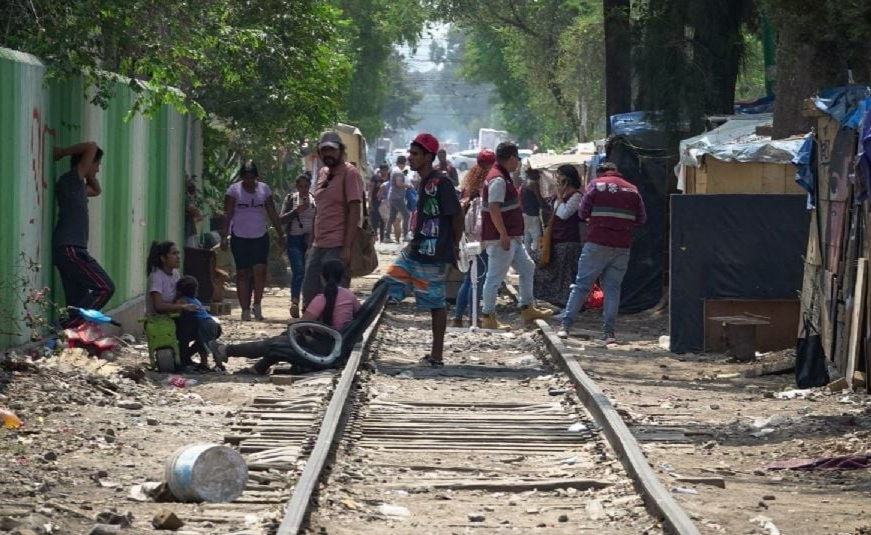

Thousands of migrants are “trapped” in Mexico, where they face an escalation of violence and criminalization since the return of US President Donald Trump to the White House, rendering them “invisible” and affecting their physical and mental health, according to a report by the civil organization Doctors Without Borders (MSF) presented this Tuesday.
At the beginning of Trump’s presidency, on January 20, the suspension of the CBP-One application for asylum applications in the United States “left 300,000 people stranded in Mexico without a legal path forward,” according to the report “Rejected: The devastating human impact of migration policy changes in the United States, Mexico, and Central America.”
Jorge Pedro Martín, coordinator of the MSF project in Mexico City and the State of Mexico, told EFE that, although the region has experienced several migration crises, “there has never been a crisis like this before, where the population is trapped and invisible.”
Martín warned that, although governments in the region, including the United States, “want to pretend that policies are producing results because today migrants are invisible and do not cross into the United States,” this “has human consequences.”
These consequences range from damage to mental, physical, and sexual health, vulnerability to violence from organized crime and abuse by authorities, as well as criminalization and social stigma that increase barriers to people accessing basic services in Panama, Honduras, Guatemala, and Mexico.
“Many stranded migrants and asylum seekers have dispersed, going into hiding out of fear and stigma after being repeatedly persecuted and labeled as criminals. This deters some people in need from seeking help and basic services,” the report states.
From January 2024 to May 2025, MSF conducted nearly 17,000 mental health consultations along the migration route from Panama to Mexico, most of them motivated by violence.
Furthermore, the report indicates that 75% of the care provided was in Mexico, a figure that doubled after Trump’s election victory in November.
Martín also noted an “exponential” increase in medical care for complex cases, such as chronic illnesses and multiple injuries, since previously people were only in transit, but now, being “stranded,” require care and even hospitalization.
In Mexico City and its surrounding areas alone, MSF’s management of complex cases increased from about two or three to nearly 60 per month, Martín indicated.
The Traces of Criminalization
Trump’s rhetoric criminalizing migration has also had significant impacts and “has negatively influenced the rest of the governments in the region, whether through sympathy or pressure,” Henry Rodríguez, general coordinator of MSF Mexico, warned in a press conference.
“They lump them all together, and it seems that just because you’re a migrant you’re a criminal, and this has caused multiple barriers (…) to accessing basic health services,” Rodríguez explained.
MSF treated nearly 90,000 patients in the region between January 2024 and May 2025, of which 4,500 were affected by violence, and “many of them were classified as torture,” Rodríguez warned.
In addition, the NGO treated 3,500 survivors of sexual violence and provided a total of 11,850 sexual and reproductive health consultations, including for pregnant women, “something that hadn’t been seen before,” according to the specialist.
The report highlights that in recent months, “most of the cases of sexual violence treated by MSF teams have been concentrated in Mexico.”
MSF teams have also witnessed how asylum processes have become longer and more complex in several Mexican cities, while the violence perpetrated by organized crime remains “alarming,” including kidnappings, extortion, robbery, sexual violence, and labor exploitation.
Finally, MSF urgently called on governments in the region to replace “practices of deterrence and abandonment” with “humane policies” that guarantee the right to asylum, medical care, and protection along the migration corridor.

Source: latinus.us