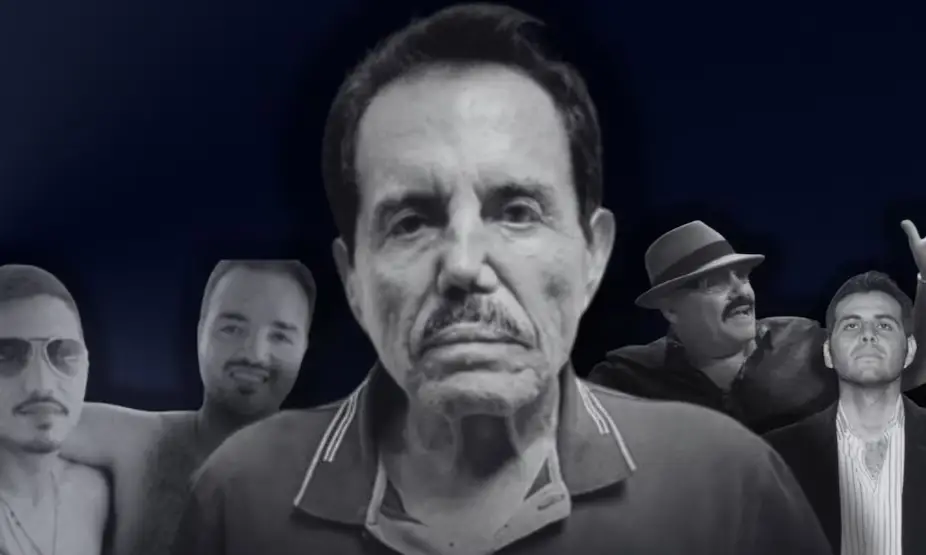

This Monday, August 25, Ismael “Mayo” Zambada will appear before Judge Brian Cogan in federal court in New York to plead guilty. The news marks the end of decades of judicial evasion and transforms the longtime Sinaloa Cartel boss into the most notorious member of a criminal dynasty for whom “singing,” in drug slang, has become a sign of survival.
This agreement will prevent the 77-year-old veteran boss from going to trial, and although he will likely spend the last days of his life in prison, he may enjoy better conditions than those of his friend Joaquín “El Chapo” Guzmán, who was sentenced in 2019 to life in prison in the most extreme prison in the United States, ADX Florence, in Colorado, after the so-called “trial of the century.”
Mayo Zambada’s decision highlights a family tendency: to break the omertà—the code prohibiting members of a criminal organization from speaking to authorities or revealing the group’s secrets, regardless of the consequences—and negotiate with US authorities, following a path paved by his own sons and brother.
The process, which began with the capture of Vicente Zambada Niebla, alias El Vicentillo, 15 years ago, was consolidated in the last decade with the collaboration of several Zambadas with the US justice system.
The Guilty Mayo: The End of a 40-Year Manhunt
Ismael Zambada García, along with “El Chapo” Guzmán, founded one of the most powerful and long-standing cartels in Mexico. For more than four decades, he managed to avoid arrest thanks to a network of protection, corruption, and mobility within Mexico. His arrest on July 25, 2024, marked the end of his life in hiding, after crossing into the United States accompanied by Joaquín Guzmán López, son of El Chapo.
According to a letter written by the drug lord, Zambada claimed to be the victim of an ambush and maintained that he was handed over by the son of his former associate in exchange for benefits for the Guzmán family, especially the brothers Ovidio and Joaquín Guzmán López.
The former criminal leader’s signature
Since then, he faces 24 criminal charges (after his trial in Texas was merged with that in New York), including murder, arms trafficking, and drug distribution, with an emphasis on trafficking fentanyl, whose circulation has caused record numbers of overdoses in the United States in recent years.
The change of plea announced for Monday, the 25th, comes after the US Department of Justice publicly renounced seeking the death penalty, paving the way for a far-reaching judicial agreement. According to experts, Zambada García’s guilty plea would pave the way for him to join the witness protection program.
Experts have also pointed out that El Mayo’s collaboration would have legal repercussions both inside and outside Mexico due to his decades-long ability to corrupt politicians, high-ranking officials, members of the police force, and businessmen, considering him the walking encyclopedia of drug trafficking in Mexico.
El Vicentillo: From Criminal Heir to Key Informant

Jesús Vicente “El Vicentillo” Zambada Niebla, the eldest son of El Mayo, was considered for years the natural heir to his father’s criminal empire in the Sinaloa Cartel.
His arrest in March 2009 in Mexico City and subsequent extradition to the United States marked a turning point in the family’s history and its alliances with the Guzmáns.
After arriving in Chicago, El Vicentillo accepted a plea deal with the US Attorney’s Office and exchanged information about routes, associates, and corrupt officials for a reduced sentence. The agreement, which served as testimony, was key to the arrests and convictions of other leaders, including “El Chapo” Guzmán himself.
During the “trial of the century,” his testimony revealed the cartel’s financial structure and the mechanisms used to bribe politicians and military personnel in Mexico. Since 2021, he has been free in the US under protection, with a new identity granted to him by the federal witness program, and with his wife and children in an unknown location and under unknown circumstances.
In January 2024, he was photographed at a US airport, but nothing has been heard from him since.
Ismael “Mayito Gordo” Zambada Imperial, El Mayo’s youngest son, was captured in Sinaloa in 2014 and extradited to San Diego, California. The Federal District Court for the Southern District of California charged him with conspiracy to import and distribute cocaine, methamphetamine, and marijuana into the United States.
After pleading guilty and cooperating with prosecutors, he was sentenced in 2021 to nine years in prison and fined $5 million in reparations.
After spending the years in pretrial detention, “Mayito Gordo” was released in 2022. As part of the agreement with the US government, he cannot return to Mexico, as his judicial cooperation would be voided, and he could face further prosecution.
Born in San Diego, Serafín Zambada Ortiz is the son of the drug lord and Leticia Ortiz. He was arrested in 2013 on the Sonora-Arizona border while trying to enter the United States. Unlike his brothers, his media profile was higher due to his displays of wealth and luxury on social media.
After pleading guilty to drug trafficking charges, he was sentenced to just over five years in prison in 2014. He was released in 2018 and currently resides in the United States with his mother and sister Teresita Zambada, supposedly staying away from visible criminal operations.
Jesús Reynaldo “El Rey” Zambada García, brother of El Mayo, was one of the Sinaloa Cartel’s most prominent operators. A graduate of UNAM’s accounting program, he migrated to drug trafficking after facing the impossibility of finding employment due to the weight of his surname. His capture in 2008 in the Mexican capital and subsequent extradition to the United States cleared the way for him to become a protected witness.
In an interview with producer Pepe Garza broadcast on YouTube, King Zambada explained that since graduating, he has tried to pursue a legitimate professional life, although family stigma influenced his decision to join the cartel.
After cooperating with the courts, he received a reduced sentence and was removed from the State Department’s blacklist in 2021.
He testified in the trial against Joaquín Guzmán Loera and Genaro García Luna and has since resided in the United States on parole. His new occupation, according to media reports, is composing regional Mexican songs.
The Informer Dynasty?
Betrayals within the Zambada ranks were not the norm during his early days in organized crime. For years, the clan emphasized family ties and absolute loyalty to the pact of silence. However, judicial pressure in the United States and the tangible benefits of cooperation pushed the Zambadas to break that tradition.
The life sentence against El Chapo Guzmán, the mass arrests of mid-level leaders, and Mexico’s extradition policy marked an irreversible change.
Today, the structure of the Sinaloa Cartel is fragmented among different factions, with the sons of Joaquín Guzmán (“Los Chapitos”) facing off against the “Mayista” branch, now led by Ismael Zambada Sicairos (“El Mayito Flaco”). The judicial process of Ismael Zambada García will test the last vestiges of an old criminal code, broken from within by the voices of its own founders.

Source: infobae