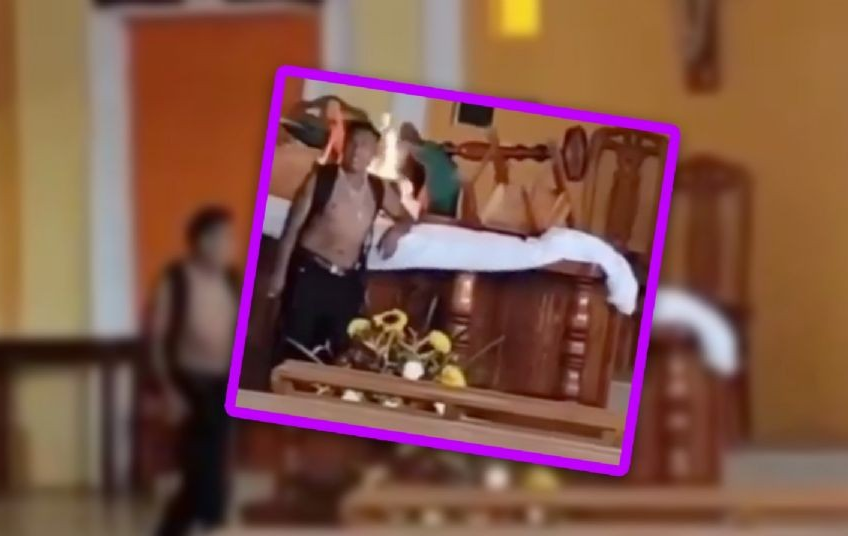

The community of Tilapan, in the municipality of San Andrés Tuxtla, Veracruz, was shaken by an act of sacrilegious violence when a man, identified as Miguel “N,” 55, broke into the Nuestra Señora de Guadalupe parish and set fire to the main altar while shouting that “the devil ordered me to.”
The incident, which occurred on Thursday, August 21, 2025, left two employees injured and three women suffering from nervous breakdowns. After the incident, the Diocese of San Andrés Tuxtla held a Mass of reparation and consecration to restore the sanctity of the site.
What happened at the Nuestra Señora de Guadalupe church in Veracruz?
It was around 5:00 p.m. when Miguel “N” entered the church half-naked and armed with a machete. According to witnesses, he was acting in an agitated manner, possibly under the influence of drugs.
He advanced toward the altar, poured fuel on it, set it on fire, and burned religious images. Two collaborators who tried to stop him were injured by the machete he was holding.
Municipal police responded to the scene after 911 calls and were able to arrest him without resistance. During his arrest, the man repeated incoherent statements about diabolical orders.
The Bishop of the Diocese of San Andrés Tuxtla, Msgr. José Luis Canto Sosa, ordered immediate measures to respond to the desecration. The church was temporarily closed, and all altar ornaments—tablecloths, flowers, and lamps—were removed as a sign of penance.
On Friday, August 22, at 6:00 p.m., a Mass of reparation and consecration was celebrated, presided over by the bishop. The ceremony began in Tilapan’s Main Park, from where the faithful processed toward the church.
Father Teódulo Morales Meza, diocesan spokesperson, explained that this rite seeks to “expiate any desecration or sacrilege committed against a sacred place” through prayers, blessings, and the anointing of the altar with sacred oils. Community participation was massive, reflecting spiritual unity in the face of the violent act.
The desecration of a Catholic church, especially when it involves the Eucharist or the altar, is considered one of the gravest sins in canon law. The Code of Canon Law establishes that violated sacred places cannot be used for worship until a penitential rite is performed. Furthermore, those who commit sacrilegious acts with malicious intent face excommunication.
The shocking incident of desecration at the church in Tilapan, Veracruz, where a man claimed “the devil ordered it,” transcended a mere act of vandalism to become a test of faith for the Catholic community in the region.
Source: mvsnoticias